13 min read
Digital Marketing for Business Growth: A Tactical Playbook
Drive measurable results with digital marketing for business growth. Learn channel prioritisation, 90-day execution plans, KPIs, and AI automation tactics.
By the LitSpark Solutions team · Updated
- AI Automation
- Advertising
- Designing
- Development
- Digital Marketing
- MVP
- Resource Hiring
- Shoot
Being online is no longer a competitive advantage for Indian SMEs. Your competitors already have websites, social profiles, WhatsApp conversations, marketplace listings, and paid campaigns. The popular advice, “just go digital”, has become too shallow to guide a real budget.
Digital marketing for business growth now depends on allocation, not adoption. India had 958 million active internet users in 2025, while official telecom data recorded 1,028.61 million internet subscribers by December 2025 and internet access coverage of 72.24% of the population (NDTV's report on India's internet user base). That scale creates opportunity, but it also creates expensive competition for attention.
The practical question is no longer whether your business should use digital channels. It's which channels produce incremental revenue, which audiences they reach, how long conversion takes, and where the next rupee should go.
Table of Contents
- Why Going Digital Is Not Enough for Real Growth
- Setting Goals and Defining Your Target Audience
- Prioritising Channels Based on ROI and Business Stage
- Building Your 90-Day Execution Plan
- Measuring What Matters with the Right KPIs
- Leveraging Automation and AI for Scale
- Ready-to-Use Templates and Real-World Examples
Why Going Digital Is Not Enough for Real Growth
A website, an Instagram page, and a paid media account can create the appearance of progress without producing profitable growth. I've seen SMEs generate plenty of impressions and enquiries, yet struggle to explain which campaigns created new customers rather than merely capturing demand that would have arrived anyway.
That distinction matters because digital advertising is already central to India's commercial environment. The Pitch Madison Advertising Report 2026 estimated India's advertising market at ₹1,55,105 crore in 2025, with a projection of ₹1,74,605 crore in 2026. It also projected digital advertising to represent about 64% of total ad spend, or roughly ₹1,11,976 crore, in 2026 (Pitch Madison Advertising Report 2026). When nearly every serious competitor buys digital inventory, merely appearing online won't guarantee growth.
Adoption creates activity, not necessarily revenue
The most common failure is treating every channel as interchangeable. Search and commerce advertising capture intent. A buyer searching for a specific product or visiting a commerce platform is closer to a transaction than someone casually watching a social video. Social and display can create demand, strengthen recall, and support retargeting, but their contribution often requires a longer measurement window.
The problem becomes worse when teams judge success too early. One India-focused benchmark notes that 78% of digital marketers claim to measure digital ROI before the sales cycle ends, while only 3% measure ROI over six months or longer (India retargeting effectiveness benchmarks). A short window can make an awareness campaign look weak, or make an early lead source look artificially strong.
Practical rule: Allocate budget according to incremental revenue and customer quality, not the size of the audience a platform can display.
A useful diagnostic is to ask what changed after a campaign launched. Did branded search rise? Did qualified enquiries increase? Did new customers purchase at an acceptable acquisition cost? Did existing customers buy again? If the answer is only “reach improved”, you have a media result, not yet a business result.
Reframe the growth problem
Start with a channel audit that separates:
- Intent capture: Search, SEO, product feeds, marketplaces, and commerce-led advertising.
- Demand generation: Video, influencer activity, organic social, and educational content.
- Conversion support: Landing pages, remarketing, email, WhatsApp, and sales follow-up.
- Retention: Lifecycle email, customer service, loyalty offers, and post-purchase messaging.
For a practical overview of advanced tactics such as conversion optimisation, retargeting, and performance measurement, the CartBoss digital marketing guide is a useful supporting resource. The key lesson is simple: going digital is the starting condition, not the growth strategy.
Setting Goals and Defining Your Target Audience
Before spending a rupee, define the commercial outcome. “Increase visibility” is too vague to control a budget. A useful goal connects a business constraint to a measurable action, a customer group, and a review date.
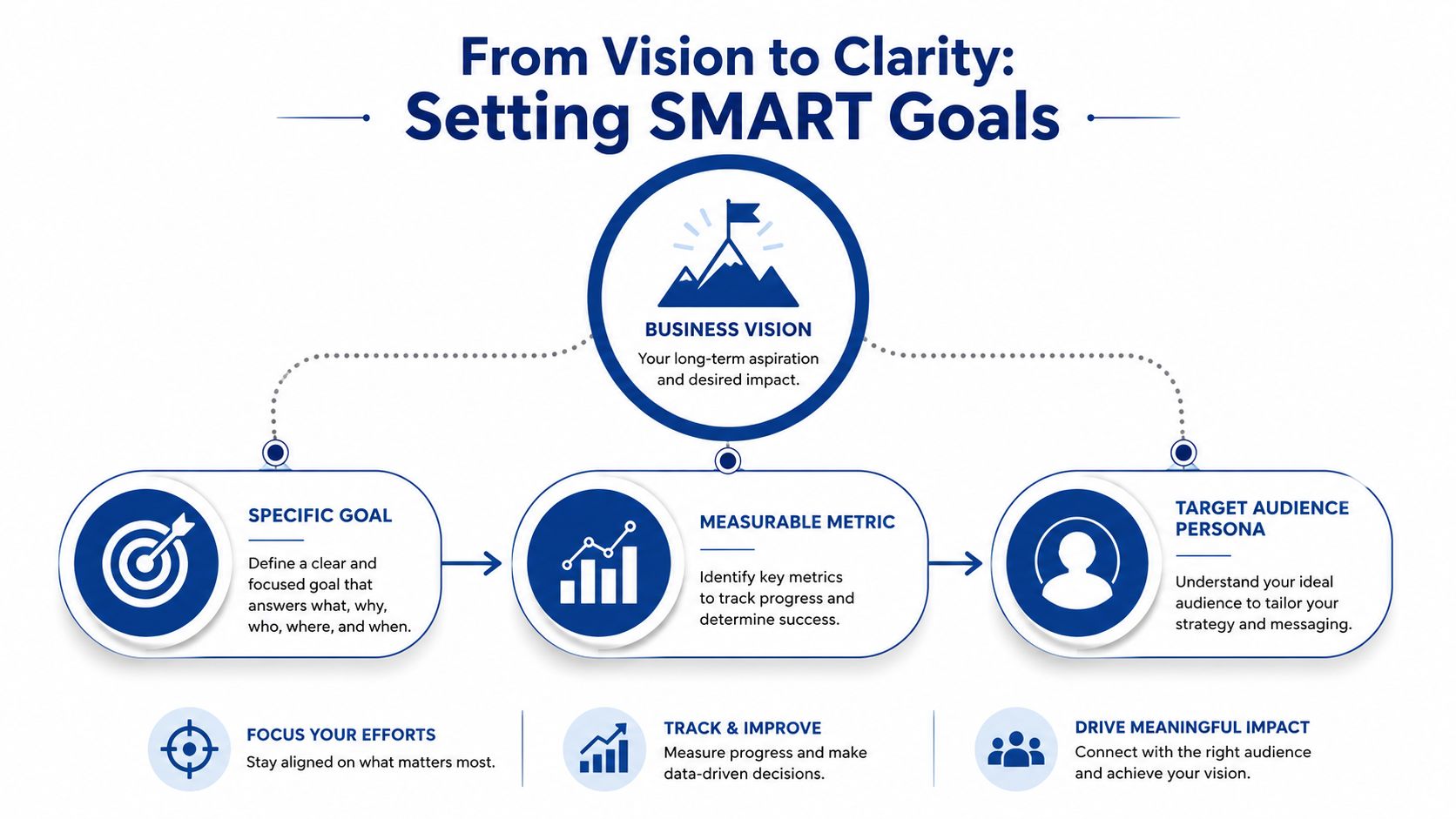
Start with a revenue-linked goal
Write the goal in one sentence:
“We need to acquire more profitable customers for [product or service] from [audience] through [channel], while keeping acquisition economics within [margin-based limit].”
Then add four checks:
- Specific: Name the product, location, audience, and desired action.
- Measurable: Track qualified leads, purchases, contribution margin, repeat orders, or sales-qualified opportunities.
- Achievable: Base the target on your sales capacity, inventory, fulfilment, and creative resources.
- Relevant and time-bound: Set a review period that matches the sales cycle, not the platform's reporting convenience.
Your CAC target should come from unit economics. Map average order value or contract value, gross margin, fulfilment costs, sales commissions, and expected repeat purchases before setting a media ceiling. A customer can be cheap to acquire and still unprofitable if the first order carries little margin or the buyer rarely returns.
Segment by behaviour before demographics
Demographics describe people. Behaviour helps you decide what to say and where to reach them.
Separate audiences into groups such as:
- Problem-aware visitors: They've consumed educational content but haven't requested an offer.
- High-intent prospects: They searched for a solution, visited a pricing page, or engaged with a product catalogue.
- Existing customers: They need replenishment, upgrades, complementary products, or support.
- Dormant customers: They purchased previously but haven't responded to recent communication.
Then add language and market tier. A Bengaluru professional, a small-business owner in Jaipur, and a family buyer in a tier-3 city may need different proof, payment reassurance, delivery information, and creative formats. India's fragmented market makes local-language messaging and market-specific offers important, but don't assume translation alone is localisation. Adapt examples, objections, testimonials, response channels, and sales assistance.
Finally, map the journey from discovery to purchase. Note the question a buyer asks at each stage, the evidence needed to answer it, and the channel most likely to deliver that evidence. This exercise often exposes a gap: a brand is buying traffic before it has a credible offer, a fast landing page, or a follow-up process.
Prioritising Channels Based on ROI and Business Stage
Channel benchmarks can narrow the first test, but they cannot replace unit economics. Audience fit, creative quality, landing-page performance, sales execution, and attribution all affect the result. For Indian SMEs, the practical question is which channel can produce incremental contribution at the current business stage.
A cited industry analysis reports ROI of 6.2x for influencer marketing, 4.8x for Google Ads, 4.2x for YouTube, and 2.9x for Facebook (India digital advertising analysis).
| Channel | Reported ROI | Best for | Typical use case |
|---|---|---|---|
| Influencer marketing | 6.2x | Trust-led consumer products | Demonstrations, reviews, creator-led discovery |
| Google Ads | 4.8x | Existing purchase intent | Search campaigns, category demand, lead capture |
| YouTube | 4.2x | Education and demand generation | Product explanation, use cases, remarketing audiences |
| 2.9x | Broad reach and retargeting support | Offers, community audiences, catalogue promotion |
Match the mix to the business stage
Early-stage businesses should concentrate limited budgets on channels closest to existing demand. Tightly grouped search campaigns, a credible landing page, and basic conversion tracking provide a clearer starting point than launching across every platform. Organic search can build durable demand, but it needs consistent content and technical work. Teams setting up that foundation can review LitSpark's SEO services as one possible execution option.
Scaling SMEs can add demand-generation channels after identifying offers that convert. Influencers suit products that need demonstrations or social proof, while YouTube can explain products with longer consideration cycles. Paid social can build retargeting pools, yet reach alone does not justify higher spend. Increase budgets only when downstream revenue and margin support the decision.
Enterprise teams need budget governance across brand, acquisition, commerce, retention, and regional activity. Consistent definitions make comparisons useful, while different sales cycles require different attribution windows. More channels will not correct weak measurement or unclear ownership.
Commerce-led advertising deserves focused review. It is projected to be India's fastest-growing digital advertising segment at 24.2% in 2026 (Ipsos analysis of digital marketing in India). For D2C and marketplace brands, commerce placements can capture demand closer to purchase than broad social campaigns. The trade-off is dependence on platform rules, marketplace margins, and less control over the customer relationship.
Use a decision matrix covering intent strength, margin, audience reach, creative demands, sales-cycle length, and measurement quality. If a channel produces attention but weak downstream revenue, reduce its budget even when the dashboard reports strong reach. Review the mix after each testing cycle, then fund the channel that improves incremental profit rather than just adding traffic.
Building Your 90-Day Execution Plan
A 90-day plan works because it prevents two costly behaviours: launching before the basics are ready and scaling before the evidence is reliable. The plan below gives a small team enough structure to move without turning marketing into a long planning exercise.
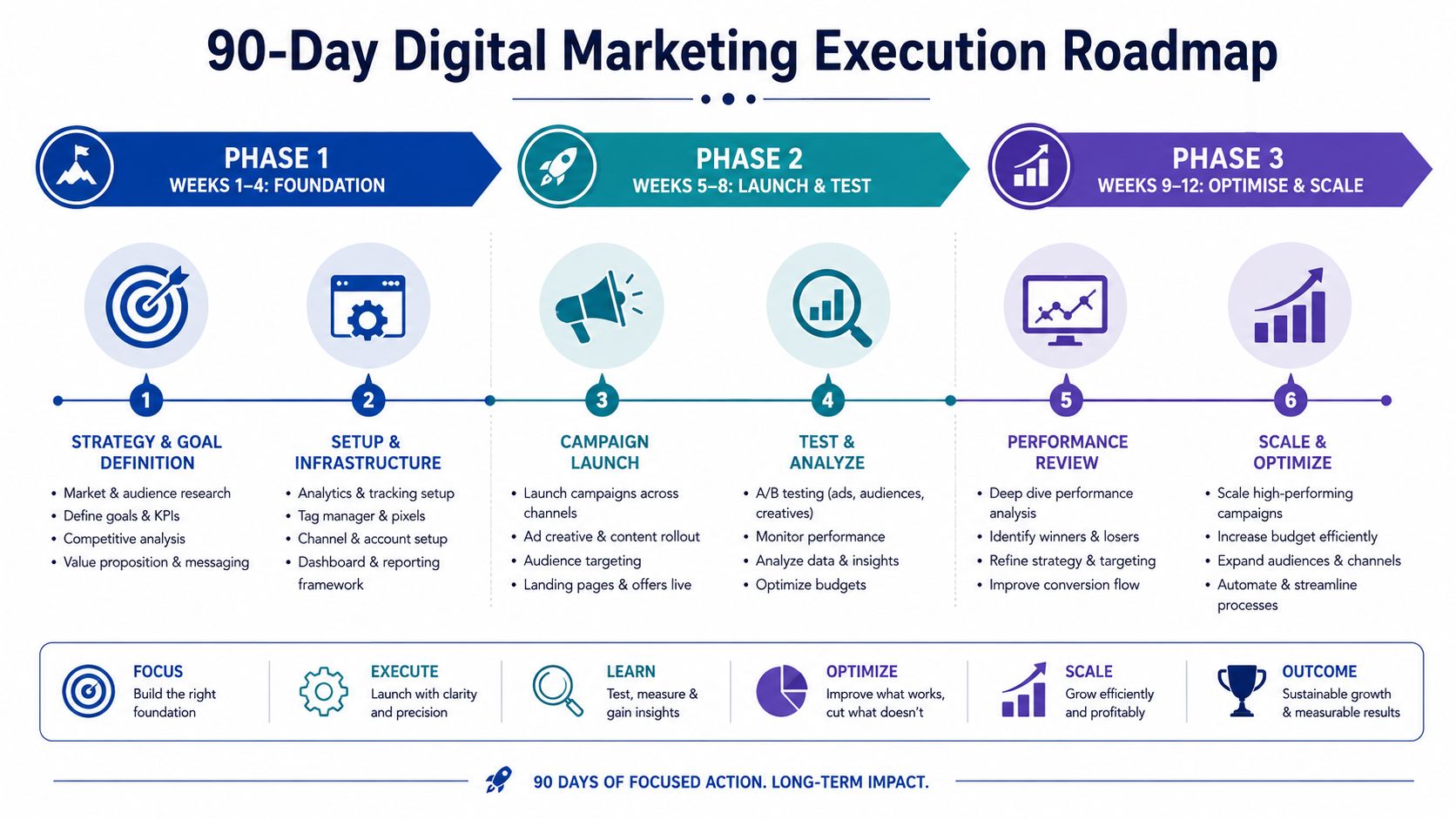
Weeks 1 to 4 build the foundation
Week 1 is commercial clarity. Select one primary growth outcome, define the target audience, document the offer, and establish the margin-based CAC ceiling. List the customer objections that sales, support, and existing reviews reveal.
Week 2 is measurement setup. Connect analytics, ad-platform conversion events, CRM stages, call tracking where relevant, and order or revenue data. Use consistent campaign naming. Decide which events count as a lead, a qualified lead, a sale, and a repeat purchase.
Week 3 is conversion preparation. Create or revise landing pages, product pages, enquiry forms, catalogue flows, and follow-up scripts. Test mobile usability, page speed, trust signals, payment options, delivery information, and the handoff from marketing to sales.
Week 4 is creative production. Prepare search copy, short videos, product demonstrations, testimonials, regional variations, email messages, and retargeting assets. Build a small testing library rather than relying on one advert.
Weeks 5 to 8 launch and learn
Start with a controlled set of campaigns. Separate cold audiences from warm visitors, and separate brand search from non-brand intent. Review search terms, lead quality, product-level revenue, assisted conversions, and sales feedback.
Run weekly experiments around one variable at a time:
- Offer: Trial, bundle, consultation, guarantee, or delivery benefit.
- Audience: Location, language, customer type, or behavioural signal.
- Creative: Demonstration, comparison, problem-led message, or proof.
- Landing experience: Form length, page structure, pricing clarity, or call-to-action.
Use email to nurture people who aren't ready to buy, rather than forcing every visitor into a sales conversion. A practical workflow can combine lead capture, segmentation, welcome messages, follow-up reminders, and reactivation through LitSpark's email marketing services.
Weeks 9 to 12 optimise and scale
Pause weak combinations, refresh fatigued creative, improve the landing pages with the clearest friction points, and shift budget towards qualified revenue. Don't scale every campaign that produces a cheap click. Scale only after checking cancellation, refund, repeat purchase, gross margin, and sales acceptance.
Keep a weekly decision log. Record what changed, why it changed, which evidence supported it, and what happened next. That log becomes more valuable than a collection of screenshots because it gives the team a repeatable learning system.
Measuring What Matters with the Right KPIs
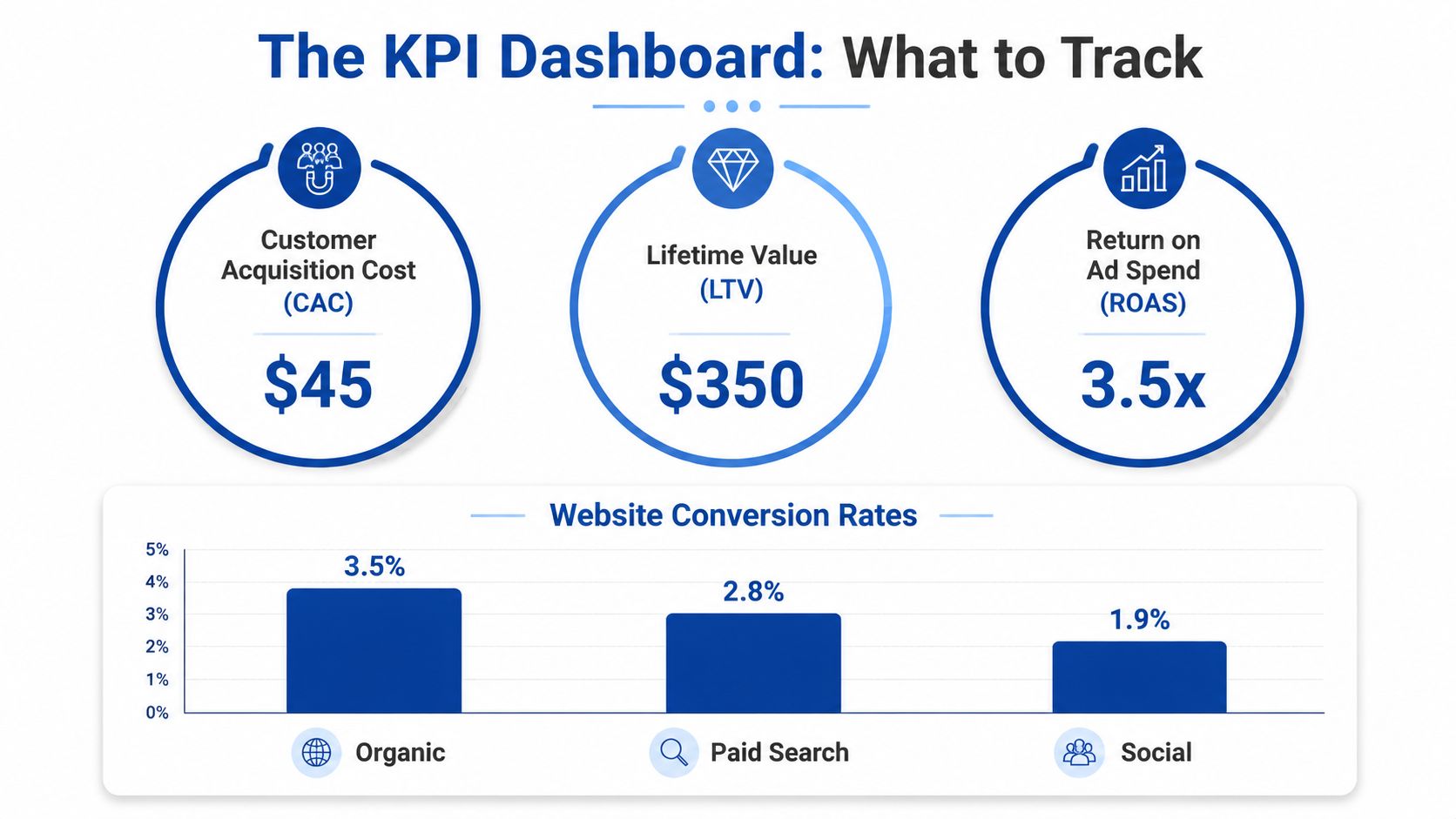
A useful marketing dashboard answers three operating questions: which activity produced revenue, what is likely to produce it next, and where the budget should change. Clicks and impressions help diagnose delivery. They cannot, on their own, prove business growth.
Build a metric hierarchy
Leading indicators show whether the system is functioning. Track qualified traffic, landing-page engagement, completed forms, product views, email clicks, sales response time, and add-to-cart activity.
Commercial indicators show whether marketing is creating viable demand. Use CAC, customer quality, contribution margin, sales-qualified opportunities, conversion rate, average order value, and pipeline progression.
Lagging indicators confirm the commercial result. These include realised revenue, repeat purchase, retention, payback, refunds, and profit after marketing costs.
India benchmark data for email planning reports an average 25.84% open rate and 8.22% click-through rate, with the click-through rate described as the second-highest among the 25 countries in that benchmark set (India email and WhatsApp marketing benchmarks). Treat these figures as directional rather than targets that override customer quality or revenue. These email benchmarks sit within the leading indicators band and help calibrate nurture-flow performance before downstream commercial outcomes are evaluated.
Choose attribution that matches the journey
First-touch attribution credits the initial discovery source, while last-touch attribution credits the final measurable interaction. Both are easy to explain, yet either can distort budget decisions when several channels influence a purchase.
Multi-touch attribution distributes credit across interactions. Use ROMI as (revenue attributed to campaign minus campaign cost) divided by campaign cost, and consider data-driven allocation methods such as Shapley value analysis. For high-consideration services, compare channel reporting with CRM progression and closed revenue. For e-commerce, connect campaigns to product margin, not just order volume.
A practical dashboard should place spend, attributed revenue, CAC, ROAS, conversion rate, sales-cycle position, and customer quality in the same view. Teams can use this guide to design a performance dashboard that drives decisions, keeping reporting tied to budget action.
Measurement discipline: Do not move budget because one channel wins inside a window that ends before customers have had time to decide.
Leveraging Automation and AI for Scale
Automation should remove repetitive work, not remove judgement. The most valuable use cases usually sit between a customer action and a team response: lead routing, scoring, reminders, retargeting audiences, product recommendations, and lifecycle email.
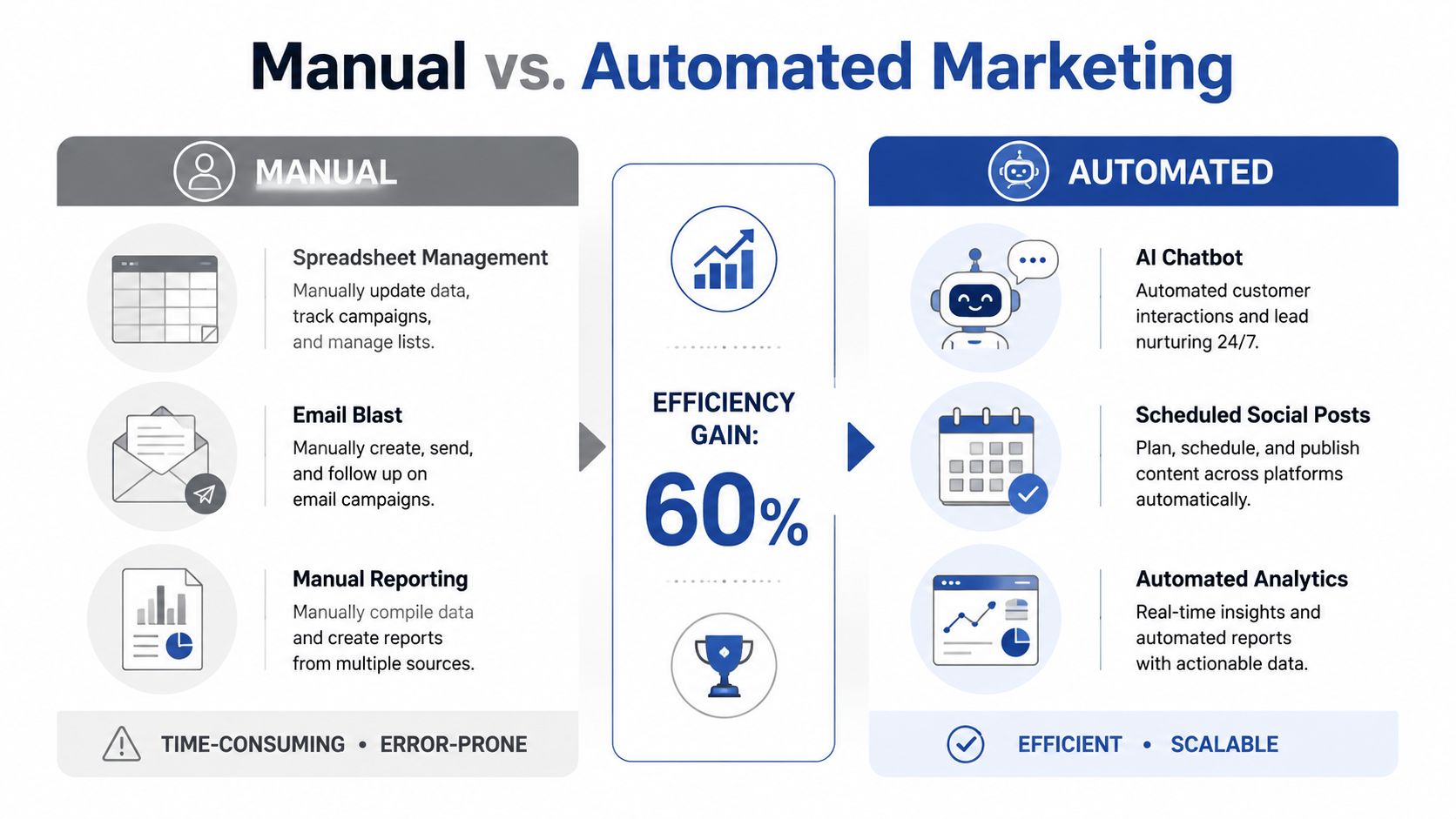
A lean SME can begin with a connected stack rather than a large marketing platform:
| Need | Practical option | Human judgement still required |
|---|---|---|
| Lead capture and routing | CRM workflows, form integrations, WhatsApp alerts | Qualification rules and ownership |
| Email lifecycle | Welcome, abandoned enquiry, post-purchase, and reactivation flows | Offer, tone, timing, and suppression |
| Paid media optimisation | Platform bidding and audience tools | Budget limits, exclusions, creative review |
| Content production | AI-assisted briefs, variants, and transcription | Accuracy, local context, brand voice |
| Reporting | Scheduled dashboards and anomaly alerts | Interpretation and budget decisions |
Build, buy, or outsource
Build internally when the workflow is close to your operations and requires proprietary data or frequent changes. Buy software when the process is common, such as email delivery, customer relationship management, or dashboard reporting. Outsource specialist execution when the team lacks skills in tracking, paid acquisition, SEO, creative production, or automation architecture.
AI can draft multiple message variants, classify incoming leads, summarise customer conversations, and identify unusual changes in campaign performance. It shouldn't invent product claims, answer sensitive complaints without oversight, or publish regional creative without review. Human checks protect both conversion quality and trust.
Teams that need custom workflow design can evaluate LitSpark's AI automation development alongside tools such as HubSpot, Zoho, Brevo, Mailchimp, Make, Zapier, and native advertising-platform automation. The right choice depends on data access, integration complexity, internal capability, and the cost of maintaining the system.
A useful rule is to automate a task only when its inputs are reliable, its output can be checked, and failure has a clear recovery path.
Ready-to-Use Templates and Real-World Examples
Templates turn strategy into a working routine. Create four documents before the next campaign:
- Campaign brief: Audience, commercial goal, offer, proof, channel, budget owner, and conversion event.
- Content calendar: Topic, language, format, funnel stage, distribution channel, and repurposing plan.
- Budget sheet: Planned spend, actual spend, attributed revenue, gross margin, CAC, and next action.
- KPI dashboard: Leading indicators, sales stages, realised revenue, retention, and reporting window.
The case examples in this plan should be treated as adaptation patterns, not promises of identical outcomes. A D2C brand can test commerce-led advertising when product intent is strong, catalogue data is clean, margins are understood, and the brand has a retention path beyond the marketplace. A B2B SaaS company can build an SEO and content engine around high-intent problems, but it must connect content engagement to qualified pipeline rather than counting traffic as success. A service business can use WhatsApp-led relationship marketing for reminders, education, referrals, and repeat conversations, provided consent, response ownership, and message relevance are clear.
For each example, document four things: the initial constraint, the chosen channel, the execution change, and the revenue evidence. This prevents teams from copying a headline tactic while ignoring the operating conditions that made it viable.
The strongest SME playbooks usually share the same discipline. They localise creative by audience and market tier, separate demand creation from intent capture, follow up quickly, and judge campaigns by downstream economics. They also stop activities that attract attention without producing an acceptable commercial outcome.
LitSpark Solutions Private Limited combines SEO, PPC, social media, email marketing, content, lead generation, analytics, and AI automation for startups, SMEs, and e-commerce brands. Visit LitSpark Solutions Private Limited to discuss a channel mix and execution system built around measurable business growth.
- digital marketing for business growth
- growth marketing playbook
- SME digital strategy
- performance marketing India
- marketing automation