Digital Marketing15 min read
Performance Marketing vs Digital Marketing: A Guide
Performance marketing vs digital marketing explained with key differences, KPIs, and budgets for Indian businesses in 2026.
By the LitSpark Solutions team · Updated
- AI Automation
- Advertising
- Designing
- Development
- Digital Marketing
- MVP
- Resource Hiring
- Shoot
Your budget is tight, the board wants growth, and someone on your team is still arguing over whether the next rupee should go into “digital” or “performance.” If you're running an Indian SME, D2C brand, or B2B lead-gen engine, that argument is usually backwards. The key decision is simpler: should you pay for reach and consideration, or pay only when the market gives you a click, lead, install, or sale.
That matters more in India right now because digital spend is no longer a side bet. GroupM projected India's digital advertising spend at ₹59,200 crore in 2025, with a 15.4% CAGR through 2029, and digital expected to account for over 50% of total ad spend by 2025 (GroupM forecast summary). In a market that large, founders can't afford fuzzy definitions. They need a billing model, a measurement model, and a budget model that match the stage of the business.
| Approach | What you pay for | Best use case | Main risk |
|---|---|---|---|
| Performance Marketing | A completed action, such as a click, lead, install, or sale | Direct response, lead gen, app installs, commerce sales | Over-optimising for cheap actions that don't convert well |
| Digital Marketing | Channel activity across SEO, social, email, content, display, video, and paid ads | Brand building, discovery, nurturing, demand creation | Spending without a clean line to revenue |
Table of Contents
- Why This Comparison Matters for Your Business
- Defining Performance Marketing and Digital Marketing
- Side by Side Comparison Across Five Criteria
- Budgeting Models and Sample Spend Scenarios
- KPIs, Attribution, and Measurement in India
- When to Choose, Blend, or Sequence Each Approach
- Implementation Checklist and 90-Day Sample Plan
- Real Scenarios, Recommended Engagement Model, and FAQs
Why This Comparison Matters for Your Business
The founder's real question is never “Which term sounds more modern?” It's, “Do I need attention, or do I need accountable outcomes this quarter?” If you're launching a new offer, hiring a sales team, or trying to prove channel ROI, that decision shapes where the money goes and how fast you can learn.
Performance marketing is a billing and measurement discipline. You pay for an outcome, not for the possibility of one. Digital marketing is the broader discipline that uses online channels to reach, educate, and convert audiences, whether the payment model is tied to outcomes or not (Salesforce on performance marketing).
That distinction matters because the three jobs in marketing are not the same job. First, you need to get found. Then you need to get considered. Only then do you need to get a conversion.
Practical rule: if the next meeting is about pipeline, sales, or paid acquisition efficiency, performance marketing should lead. If the meeting is about brand recall, category education, or long-cycle trust, broader digital marketing deserves more of the budget.
A useful way to sanity-check the split is to look at audience depth, not just channel preference. If you need sharper audience research before scaling, master audience insights is a useful reference point because better targeting starts with better understanding of who buys.
| The Real Question Behind the Comparison | Performance Marketing Fit | Broader Digital Marketing Fit |
|---|---|---|
| Marketing Job | Conversions, leads, installs, sales | Discovery, trust, education |
| Budget Logic | Pay for verified outcomes | Pay for presence and momentum |
| Risk Sharing | More risk shifts to the agency or platform | More risk stays with the brand |
| Best Stage | Early learning, direct response, efficient scaling | Brand building, category creation, retention |
| KPI Style | CPA, CPL, ROAS, conversion rate | Reach, engagement, traffic quality, brand signals |
Use that table as the filter. If you can't name the job, you can't pick the spend model.
Defining Performance Marketing and Digital Marketing
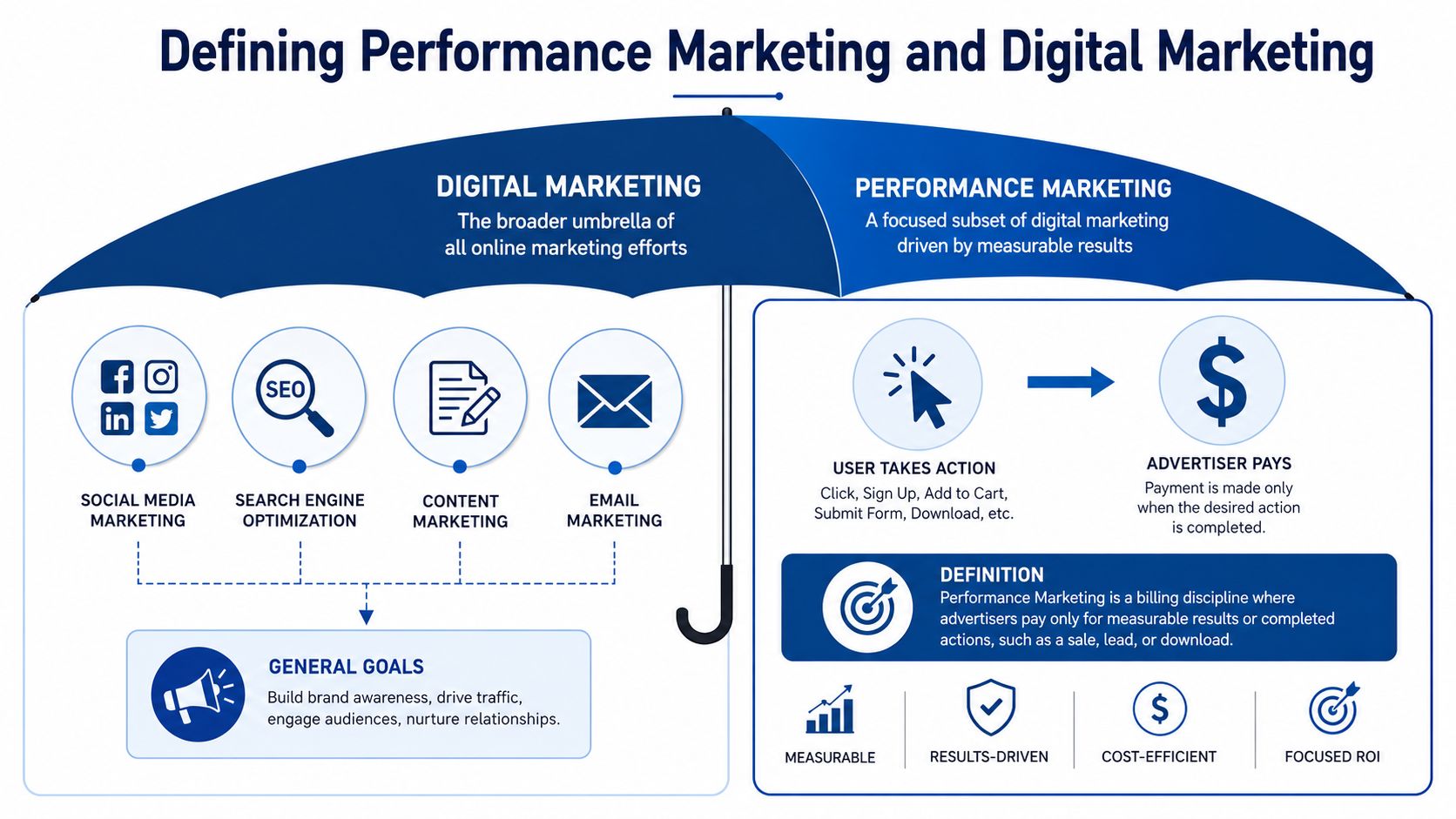
The real split is billing and measurement
A founder can spend money across the same channels and still buy two very different things. Digital marketing covers the full mix, including SEO, social media, email, content, display, video, and paid ads. It is the broader operating model for building visibility, trust, and demand across digital touchpoints. A campaign can be built for awareness, consideration, or conversion, and the payment model depends on the work being done.
Performance marketing is a billing and measurement discipline that can sit inside digital channels. It is used when payment is tied to a completed action, such as a click, lead, app install, or sale. That is why it is usually structured around CPC, CPA, CPL, and sometimes CPS. The point is simple, you pay against a verified outcome, not just exposure.
That distinction changes how a founder should budget. A retainer for content, SEO, and brand distribution is digital marketing spend. A paid search or paid social campaign priced on leads or sales is performance marketing. The same channel can belong to either model depending on how the work is priced, tracked, and judged.
The practical difference for a founder
A campaign can live inside the same platform and still behave differently. Search ads can run as performance marketing. Social ads can do the same. Affiliate, marketplace, and commerce media can all be run with performance rules. The label comes from the pay-for-performance structure and the audit trail behind it, not from the channel itself (Softtrix).
That matters in vendor calls. A partner saying “we'll do digital” might be offering content, SEO, media buying, or all three. A partner saying “we'll do performance” should tell you which action they will optimize for, how they will measure it, and what level of conversion quality they are responsible for. If you want a broader service mix under one roof, a digital marketing partner can cover planning, content, paid media, and analytics. The label is not the decision. The buying model is.
For Indian SMEs and e-commerce brands, the choice should match the stage of the business. If you need demand now and you can measure each lead or order cleanly, performance marketing should carry the heavier budget. If you are still building category trust, educating the market, or supporting a longer sales cycle, broader digital marketing deserves more spend.
Bottom line: performance marketing is how you pay and measure specific outcomes, digital marketing is the wider set of channels and activities you use to grow.
Side by Side Comparison Across Five Criteria
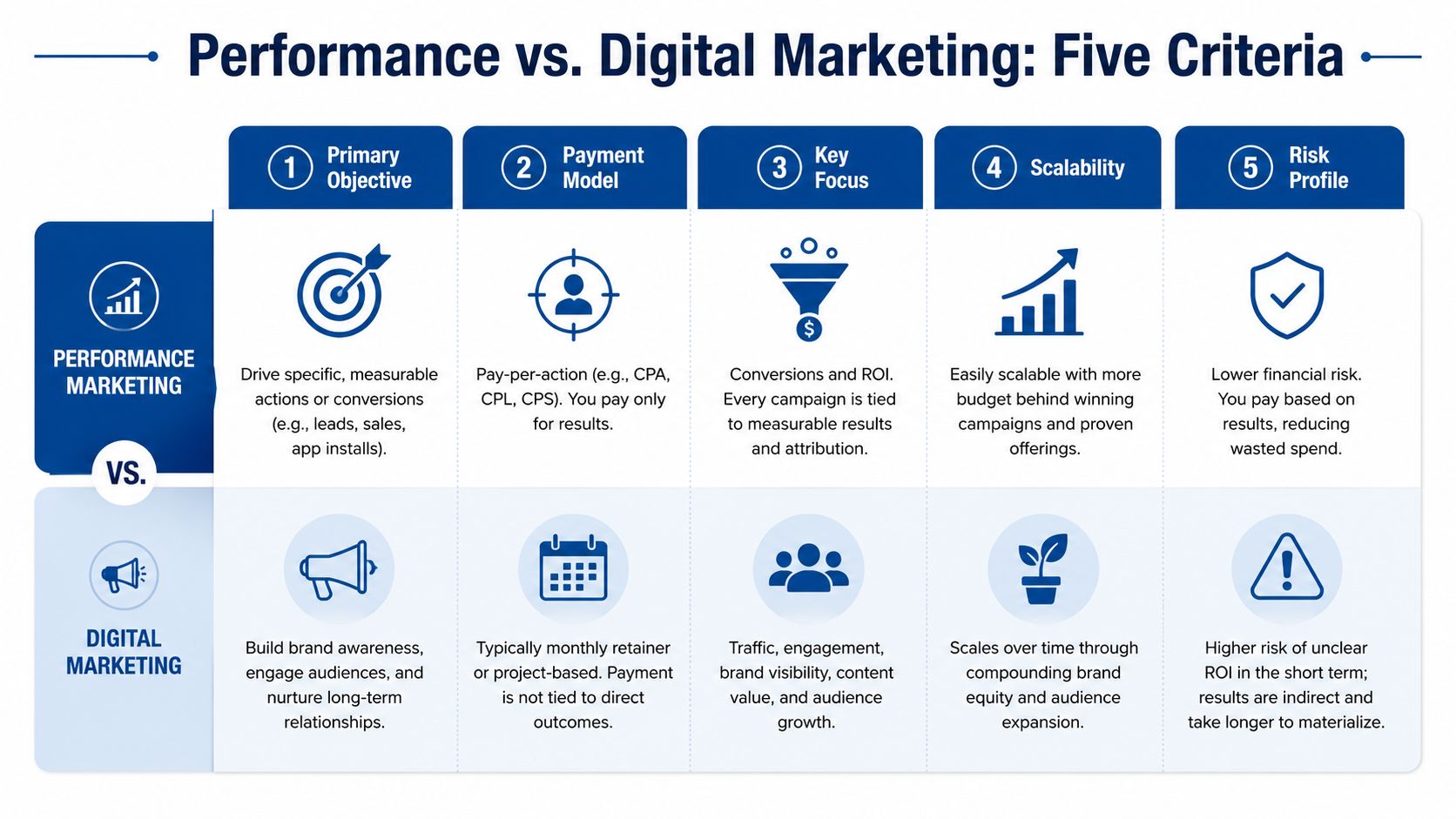
The five criteria that actually change the budget decision
A founder does not need another vague debate about channel names. The decision gets clearer when you compare objective, payment model, measurement, scale, and risk. That is where performance marketing stops looking like a narrow tactic and starts looking like a billing and measurement discipline you can apply across search, social, marketplaces, affiliate, and other digital channels.
| Criterion | Performance Marketing | Digital Marketing (Broad) |
|---|---|---|
| Primary Objective | Convert traffic into a measurable action | Build awareness, trust, and demand |
| Payment Model | CPC, CPA, CPL, sometimes CPS | Retainer, project fee, or media spend without direct outcome billing |
| Key Focus | Funnel efficiency, conversion quality, ROI discipline | Content, visibility, audience growth, brand consistency |
| Scalability | Scales when unit economics hold up | Scales across more touchpoints and longer time horizons |
| Risk Profile | More exposure to variable results, but more accountability | More predictable activity, but weaker direct accountability |
The objective row should decide most budgets. If the job is booked demos, qualified leads, or completed checkouts, performance logic fits cleanly. If the job is to build familiarity before the buyer is ready, broad digital marketing deserves a bigger share.
The payment row is the sharper filter. CPC means you pay per click, CPA means you pay per acquisition, CPL means you pay per lead, and CPS means you pay per sale. That structure shifts more risk onto the vendor or campaign owner and gives you a cleaner line from spend to result.
A good online ads partner should be able to explain which billing model they use, what they optimize for, and which conversion quality they are willing to own.
The hidden difference in team structure
Performance teams plan around cohorts, landing pages, audiences, and conversion paths. Brand and digital teams plan around narratives, content calendars, creative systems, and consistency. Both matter, but they solve different business problems.
The measurement row is where founders get misled. Performance work needs tight attribution and fast feedback, because it lives or dies on provable outcomes. Broader digital work usually builds slower gains through content and visibility, which can be real value even when it is harder to tie to one click or one form fill.
The risk profile row is the bluntest one. Performance marketing can look efficient and still produce poor-fit customers if lead quality is weak. Broader digital marketing can look expensive and still do the groundwork that makes future acquisition cheaper. For an Indian SME or e-commerce brand, the right choice depends on whether the next rupee should buy proof or presence.
Budgeting Models and Sample Spend Scenarios
A performance budget is built backwards. Start with a target acquisition cost, estimate conversion rate, then decide how much traffic or lead volume you can buy without breaking the unit economics. That is more disciplined than just saying “let's spend on ads.”
For a monthly ₹10 lakh e-commerce budget, a practical split is often shaped by the job, not the channel. Search gets the highest intent. Social buys demand and remarketing. Affiliate and programmatic can extend reach if the economics justify it. The exact split depends on what is converting, not on what sounds neat in a slide deck.
Two sample budget structures
An Indian D2C brand could use a performance-heavy allocation like this:
- Search and shopping ads: high-intent demand capture
- Meta Ads: prospecting and remarketing
- Affiliate or partner placements: commission-linked sales support
- Programmatic or video retargeting: assist conversions, not vanity reach
A brand-led digital budget can look different. A ₹5 lakh monthly spend may sit across SEO, content, email, and creative production if the goal is to build repeatable discovery and nurture. That kind of spend doesn't force every rupee to prove itself on the spot, but it does need discipline on content quality and audience fit.
Practical rule: if the budget cannot survive a weak attribution model, it's probably too performance-heavy for the current stage.
The hidden costs people forget
The media line item is only part of the bill. You still need creative, landing pages, analytics setup, and sometimes agency or freelancer fees. A “cheap” performance campaign can get expensive quickly if every new test needs fresh design, copy, and tracking support.
If you want a place to cross-check how online ad execution is usually packaged, online ads services show how paid media work often sits inside a wider execution stack. That is the reality founders run into, not the simplified promise of “pay only when it works.”
For B2B lead generation, the logic shifts again. A campaign might pay on a lead, but the actual cost is the qualified opportunity, not the raw form fill. That's why a performance plan should always be challenged on lead quality, not just cost per lead.
The honest answer is that performance marketing is not cheap. It is usually more accountable, not automatically more economical.
KPIs, Attribution, and Measurement in India
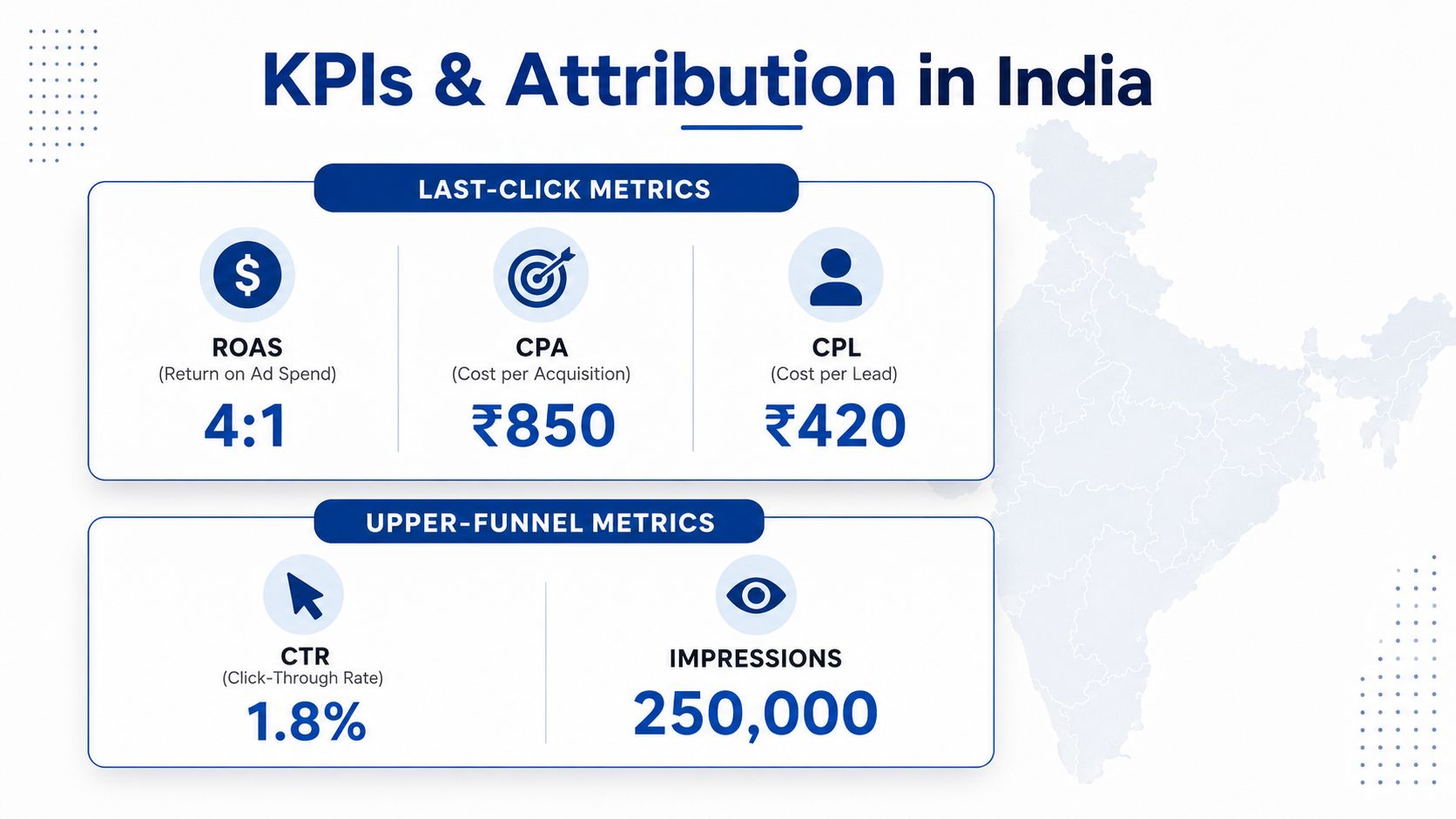
Track the right layer of the funnel
A mature growth team separates last-click metrics from upper-funnel metrics. ROAS, CPA, and CPL tell you whether a campaign is producing efficient outcomes. CTR, CPM, and impressions tell you whether the campaign is getting attention and traffic at a reasonable cost.
That split matters in India because attribution is getting harder, not easier. More traffic moves across apps, video, retail environments, and other walled surfaces, while third-party signals weaken. Connected TV is one of the faster-growing subsegments in the broader digital mix, which makes simple last-click reading less trustworthy for app-first and commerce businesses (YouTube research reference).
Build a KPI stack, not a vanity dashboard
A founder should ask for a layered measurement setup.
- Top of funnel: impressions, reach, CTR
- Mid funnel: landing page engagement, assisted conversions, lead quality
- Bottom of funnel: CPA, CPL, ROAS, revenue, close rate
- Business layer: blended CAC and LTV
That stack is harder to fake than a single ROAS number. It also stops teams from optimising for cheap clicks that never become customers.
If you want a practical reference point for using metrics to improve return on spend, improve ad ROI is a useful read because the game is not just reporting, it's interpreting what the numbers mean.
Why last-click alone is not enough
Last-click is useful for debugging, but it is not the whole truth. A buyer may discover you on social, revisit through search, and convert after email or retargeting. If you only credit the final touch, you understate the channels that built intent.
That is why incrementality, geo-tests, and blended CAC versus LTV matter more as the business matures. The more fragmented the journey, the less sensible it is to pretend that one click explains the whole sale.
For teams running demos and nurture flows, lead generation systems are where measurement discipline really shows up, because lead volume without qualification is just noise.
Takeaway: if your reporting stops at last-click ROAS, you're seeing the easiest part of the funnel, not the whole business.
When to Choose, Blend, or Sequence Each Approach
Use the business stage as the rule
A pre-product-market-fit startup should lean hard on performance marketing. The goal is cheap learning, fast feedback, and clean evidence of demand. A growth-stage D2C brand should blend performance with broader digital marketing, because it needs both sales now and stronger category memory later.
An enterprise usually needs both tracks running at once. Brand campaigns build reach and trust. Performance campaigns convert that demand into measurable outcomes. The mistake is not blending them. The mistake is blending them without separate KPIs.
- Choose performance first when the offer is clear, the landing page is ready, and you need evidence fast.
- Blend both when direct response is working but branded search, repeat visits, or category recall still look weak.
- Sequence more brand digital work when the market needs education, the sales cycle is longer, or a new category must be explained before it converts.
A good external benchmark for team structure is a SaaS demand generation agency because demand gen usually lives between education and conversion, not inside one channel alone. That's the same logic Indian founders should use when they decide whether to split budgets or run a single-minded performance push.
Trigger points that justify a shift
Rising CPAs can mean the market is saturated, the creative has gone stale, or the audience is too narrow. Falling branded search volume can mean your upper-funnel presence is weakening. A new product launch often needs category education before paid conversion can scale cleanly.
If those signs show up, don't just pour more money into the same ad set. Rebalance. The better move is often to layer in content, social proof, and email nurture while performance spend keeps the conversion engine alive.
For the first 90 days, the safe sequencing is simple. Learn with performance, support with digital, then scale what the data proves. Anything else is usually a vanity play disguised as strategy.
Implementation Checklist and 90-Day Sample Plan
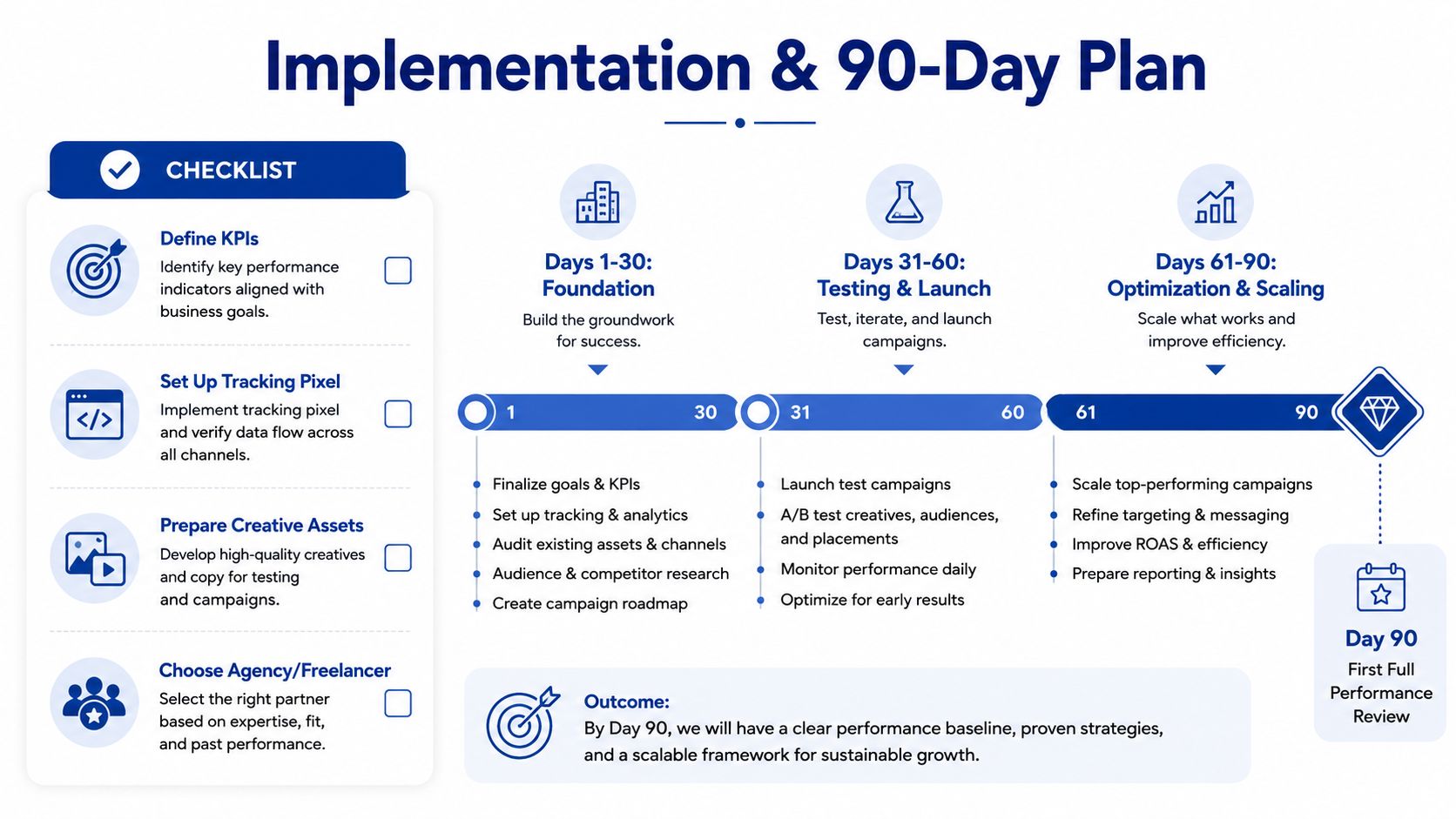
The assets and systems that need to exist first
A campaign fails fast when tracking is weak. Before spend goes live, the team needs pixels, server-side events where possible, GA4 hygiene, clean ad account structure, and landing pages that match the promise in the ad. Creative variants matter too, because one static concept is rarely enough.
A D2C team should verify product feed quality, checkout tracking, and remarketing audiences. A B2B SaaS team should verify form tracking, CRM handoff, and lead qualification rules. Without that, the dashboard becomes a guess.
Most common mistake: launching campaigns before instrumentation is clean, then trying to interpret bad data as if it were strategy.
A simple 90-day operating rhythm
Days 1 to 30, foundation. Audit tracking, confirm events, map funnel stages, and clean up accounts. Decide your default attribution model and lock the reporting cadence.
Days 31 to 60, testing and launch. Run controlled creative and audience tests, then separate winning traffic from noisy traffic. Keep the scope tight so the learning is readable.
Days 61 to 90, optimisation and scaling. Put more budget behind the winners, cut weak variations, and start layering brand digital activity if the funnel is stable.
For an e-commerce brand, that might mean testing shopping ads against Meta prospecting while tightening checkout measurement. For a B2B SaaS team, it might mean demo-form testing, retargeting, and email nurture tied back to opportunity quality.
LitSpark Solutions Private Limited fits naturally when a team needs execution across paid media, SEO, content, creative, and analytics without building every function in-house. That matters more than a generic agency promise, because the work spans tracking, media, and creative all at once.
Real Scenarios, Recommended Engagement Model, and FAQs
A Bangalore-based D2C skincare brand usually needs both systems. Performance spend drives direct sales and gives fast feedback on offer, creative, and landing pages. Broader digital marketing builds category recall, trust, and repeat discovery, which stops the acquisition engine from relying only on discounted conversion traffic. That mix is how a young brand avoids buying every sale at full price.
A B2B SaaS lead-gen team faces a longer cycle. Performance marketing fills the pipeline with qualified demos, while SEO and email keep educating buyers who are not ready to book today. If the team only buys leads, it can end up with low-quality pipeline. If it only publishes content, revenue can arrive too slowly for an impatient founder.
LitSpark's model fits a founder who wants one delivery layer across paid performance, SEO, content, social, creative, and analytics, plus flexible resource hiring when in-house capacity is thin. That setup works well for startups and SMEs that need execution and technical support without staffing every role internally. It also fits teams that want performance marketing discipline inside a wider digital marketing program, not as a silo. For a practical service view, see digital marketing.
FAQ 1. Can performance marketing replace digital marketing?
No. Performance marketing is a subset of digital marketing, and broader digital activity still matters for discovery, trust, and nurture (Salesforce).
FAQ 2. What is a realistic starting budget for an Indian SME?
Start with the amount you can afford to learn from, not the amount you hope to impress with. If the business cannot fund creative, tracking, and testing, the media budget alone will not save it.
FAQ 3. How should I evaluate an agency or partner?
Ask what outcome they are optimising for, how they measure it, and what happens when attribution gets messy. If they only talk about clicks, impressions, or generic reach, they are not running the right conversation.
If you want a practical team that can connect paid media, SEO, content, creative, and analytics into one measurable growth system, speak with LitSpark Solutions Private Limited. They fit founders who need performance marketing discipline without losing the broader digital work that builds durable demand.
- performance marketing vs digital marketing
- performance marketing guide
- digital marketing basics
- performance KPIs
- marketing budget planning