14 min read
Retargeting Facebook Ads That Actually Convert
Set up retargeting Facebook ads that turn warm visitors into buyers. Actionable playbook on audiences, creative, bidding, and measurement for SMEs.
By the LitSpark Solutions team · Updated
- AI Automation
- Advertising
- Designing
- Development
- Digital Marketing
- MVP
- Resource Hiring
- Shoot
A skincare brand can have plenty of warm traffic and still waste most of its retargeting budget. The usual pattern is familiar: one broad website-visitor audience, one discount-led ad, and the same message shown to people who bounced, browsed, abandoned a cart, or purchased recently. The campaign appears active in Ads Manager, but the budget is paying for repetition rather than intent.
That approach is especially expensive in India, where Meta's combined advertising reach was estimated at more than 550 million users, and India's digital advertising market was projected to reach ₹69,856 crore in 2026. Search and social platforms led by Google and Meta were reported to capture 64% of India's digital advertising revenues in 2025, which places Facebook retargeting inside one of the country's largest paid-media channels. India-focused Meta advertising market data shows why a small improvement in warm-audience conversion can matter commercially, but only when the audience structure is sound.
Table of Contents
- Why Most Retargeting Campaigns Leak Money
- Getting the Pixel and Events Right
- Mapping Cold, Warm, and Hot Audiences
- Building Retargeting Custom Audiences That Match Intent
- Creative That Speaks to Where the User Stopped
- Bidding, Budget, and Frequency Controls
- Measuring Performance Without Lying to Yourself
Why Most Retargeting Campaigns Leak Money
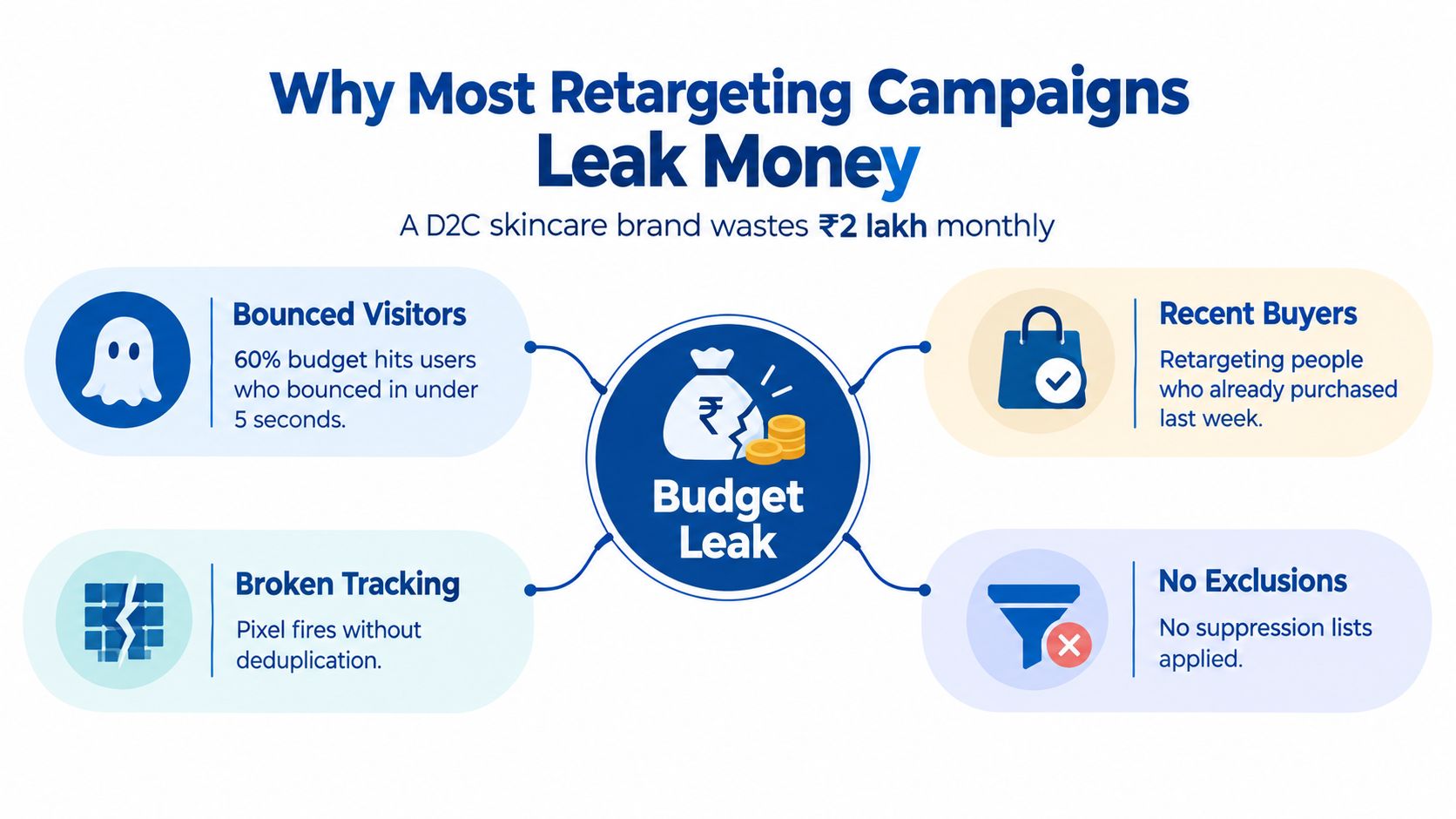
A D2C skincare brand spending ₹2 lakh a month on retargeting often assumes the problem is creative. The team swaps the headline, adds a limited-time offer, and waits for ROAS to recover. Yet a large share of the budget may still reach visitors who left almost immediately or customers who bought last week and have no reason to purchase the same product again.
The leak is structural. A single “website visitors 30 days” audience combines radically different behaviours, while one discount creative treats every user as if they had reached the same point in the buying journey.
The four leaks inside a single audience
- Audience overlap: Product viewers, cart abandoners, Instagram engagers, and purchasers can enter multiple ad sets. Meta then has less clarity about which message should win.
- Wide recency windows: A visitor from several weeks ago usually has weaker intent than someone who abandoned checkout recently. Treating both users identically dilutes the budget.
- Message mismatch: A user who watched a founder video needs education or proof. A cart abandoner needs reassurance about delivery, payment, returns, or the product itself. A coupon doesn't solve every objection.
- Poor exclusion hygiene: Recent purchasers shouldn't keep seeing acquisition ads. Without suppression lists, the brand pays to interrupt customers it should be nurturing or cross-selling.
The answer isn't to add more ad sets blindly. Retargeting needs a tiered audience system, with each tier assigned its own creative, exclusion rules, and measurement logic. Practical guidance on how brands can improve conversions with targeted media is useful here, but the key operational decision remains audience quality, not the number of campaign variations.
Practical rule: If you can't explain why a person is in an ad set and what message they should receive, that ad set isn't ready to spend.
Getting the Pixel and Events Right
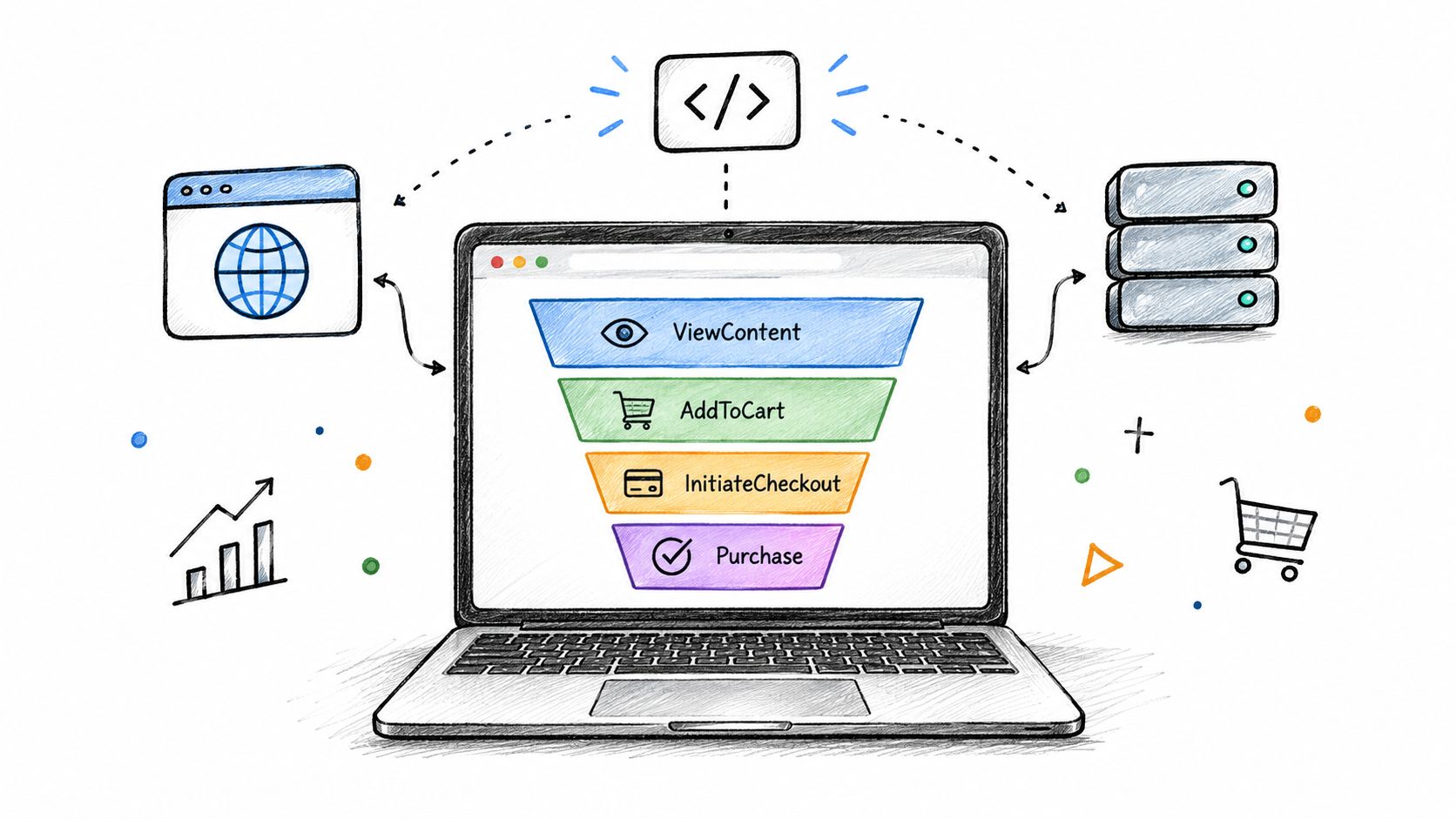
Retargeting starts with clean event collection, not with a discount code. Install the Meta Pixel across the full website, including product pages, cart, checkout, and confirmation pages. Where possible, pair browser tracking with Meta's Conversions API so server-side events reinforce the signals that browsers may not pass consistently.
Give every event a job
Your event map should reflect user intent:
- ViewContent: A person viewed a product or meaningful content page.
- AddToCart: The user showed stronger buying intent by adding a product.
- InitiateCheckout: The user moved closer to payment and deserves a higher-priority audience.
- Purchase: The transaction happened and should trigger suppression, loyalty, or cross-sell logic.
Sending every interaction as a generic event destroys the distinctions Meta needs for optimisation. A product viewer shouldn't be treated like a checkout user, and a purchaser shouldn't remain in the same acquisition pool.
Shopify merchants can often begin with Shopify's native Meta channel, while teams with unusual checkout flows or multiple systems may need a manual Conversions API implementation. In either setup, send a shared event_id for matching browser and server events. Without deduplication, the same purchase can be counted twice, making both platform reporting and optimisation less trustworthy. For implementation checks, these Facebook Ads tracking tips provide a practical reference.
Choose windows that reflect intent
A workable starting structure is:
- Cart abandoners: 7 days
- Product viewers: 14 days
- Engaged video viewers: 30 days
- Broader site visitors: 60 days
Meta audiences can also use website recency windows such as 7, 14, 30, 60, 90, or 180 days, as described in this India-focused guide to Meta website custom audiences. Use the shorter windows for direct conversion messages and longer windows for education, content, or replenishment.
Don't exclude every purchaser from every campaign. Suppress recent purchasers from bottom-of-funnel acquisition ads, but retain eligible customers for loyalty, replenishment, and cross-sell campaigns.
Mapping Cold, Warm, and Hot Audiences
A retargeting campaign becomes easier to manage when cold prospecting, warm engagement, and hot intent live in separate structures. Each tier has a different job, so combining them forces Meta to trade away clarity for volume.
India-specific benchmark data places BOFU website-visitor CPMs around ₹600 to ₹1,200, while cart-abandoner campaigns can reach ₹700 to ₹1,500. Link CTRs may sit around 2.5% to 7.0%, depending on audience quality and creative relevance, according to the India Meta Ads funnel planner. These higher CPMs don't automatically mean poor performance. Hot audiences cost more because advertisers are competing for higher-intent impressions.
| Funnel Tier | CPM (₹) | CTR | First-Click ROAS | Typical Audience Size |
|---|---|---|---|---|
| Cold | Qualitatively lower than BOFU retargeting | Qualitatively lower than hot audiences | Usually weakest at first click | Largest |
| Warm | Variable, generally below high-intent BOFU CPMs | Moderate | Usually stronger than cold prospecting | Medium |
| Hot | ₹600–₹1,500 depending on audience type | 2.5%–7.0% | Often strongest when intent and exclusions are clean | Smallest |
The table uses the India-specific CPM and CTR ranges available for BOFU audiences. The other rows should be treated as directional operating categories rather than unsupported numeric benchmarks.
Why one campaign creates waste
Suppose a product viewer and a cart abandoner enter the same ad set. The cart abandoner may click quickly, while the product viewer needs proof, comparison, or a reminder of the product benefit. If both compete under one budget, the platform can favour the easier conversion path without giving the earlier-stage user the education needed to progress.
Separate each tier by creative, exclusions, and reporting. Cold campaigns should exclude meaningful warm and hot pools where the setup permits. Warm campaigns should exclude cart abandoners and recent purchasers. Hot campaigns should contain the strongest intent signals and the narrowest message.
SaaS teams face a similar distinction between visitors, content engagers, pricing-page users, and demo prospects. A focused guide to retargeting ads for SaaS brands is helpful when the conversion event is a demo or sales conversation rather than a purchase. For Indian businesses that need execution across paid social, creative, and analytics, social media marketing services can also sit alongside the media plan rather than being treated as a separate activity.
Building Retargeting Custom Audiences That Match Intent
Build the audience architecture before opening Ads Manager. Start with Meta Pixel events and, where available, Conversions API events, then name each audience according to its source, recency, exclusions, and intended message.
The core buckets should separate direct buying intent from weaker browsing signals:
- Cart abandoners from the last 1 to 7 days: Include AddToCart users with no Purchase event. They deserve the most direct reassurance because they already selected a product.
- Product viewers from days 8 to 30: Segment by category where the catalogue supports it. A visitor who viewed sunscreen shouldn't receive the same ad as someone who viewed a hair-care bundle.
- Past purchasers from days 30 to 180: Split repeat customers from one-time buyers. Their next message could involve replenishment, complementary products, or a loyalty benefit rather than first-purchase education.
Add engagement without losing discipline
Create a 25% engaged-video audience from qualified video viewers, including 3-second views and top-25% viewers, using a last-30-day window. This pool belongs in the warm layer because video engagement signals interest, but not necessarily product-level intent.
For expansion, use a 1% Lookalike of the 30-day purchaser file when the source quality is strong. Keep this audience in prospecting, not in the same ad set as site visitors. A lookalike is an acquisition tool, even when its seed comes from high-intent customers.
Write exclusions into the audience brief
Exclusions should be explicit:
- Purchasers from the last 14 days should be excluded from non-loyalty campaigns.
- The 7-day cart bucket should be excluded from the broader 30-day product-viewer bucket.
- The current email or CRM list should be excluded when retargeting site visitors, so the brand doesn't bid against its own customer-list campaign.
- Loyalty audiences should remain separate from acquisition suppression logic.
Keep a simple audience register with the audience name, event source, window, exclusions, and intended offer. Three weeks later, that document tells the buyer what each audience is meant to do, which prevents accidental overlap and unexplained performance changes.
Creative That Speaks to Where the User Stopped
The strongest retargeting creative answers the question, “What stopped this person from moving forward?” A cart abandoner may need delivery confidence or product reassurance. A product viewer may still be comparing alternatives. A past purchaser may need a refill or a complementary product.
For a skincare account, I'd build separate creative sets rather than place every format into one general retargeting pool:
- Cart abandoners: Use a carousel showing the exact products left behind, supported by a short UGC unboxing clip for that SKU. The message can address the remaining friction, such as shipping, returns, or availability.
- Product viewers: Use a review compilation in 9:16, a founder-style 15-second explanation, and a before-and-after image pair drawn from genuine customer reviews.
- Past purchasers: Use refill reminders, complementary-product education, or a routine-building angle. Don't show the same first-purchase acquisition ad to someone who already bought.
A discount can work, but it shouldn't be the default creative strategy. If every segment receives the same offer, the brand trains users to wait for promotions and learns nothing about which objection blocked conversion.
| Funnel Stage | Best Format | Hook Angle | Fatigue Signal |
|---|---|---|---|
| Cart abandoner | Product carousel and SKU-specific UGC | Reassurance and completion | Declining click intent after repeated exposure |
| Product viewer | Review compilation or founder explainer | Proof, education, and comparison | Lower engagement with the same proof point |
| Past purchaser | Refill, cross-sell, or routine creative | Retention and product relevance | Existing customers ignoring acquisition-style ads |
Use CBO for controlled tests, but change one variable at a time. Hold the format constant while testing the hook, then hold the hook constant while testing the format. Record winning hooks in a swipe file tagged by funnel stage.
Refresh the ads receiving the highest share of spend every 10 to 14 days, and investigate any ad whose 3-second hold rate falls more than 25% from its week-one baseline. Those are operating rules from the campaign plan, not universal laws, so compare each signal with the account's own baseline before making a decision.
Bidding, Budget, and Frequency Controls
Retargeting shouldn't run as a broad-reach campaign. The audience is finite, and the buyer's job is to capture existing intent without turning repeated exposure into paid irritation.
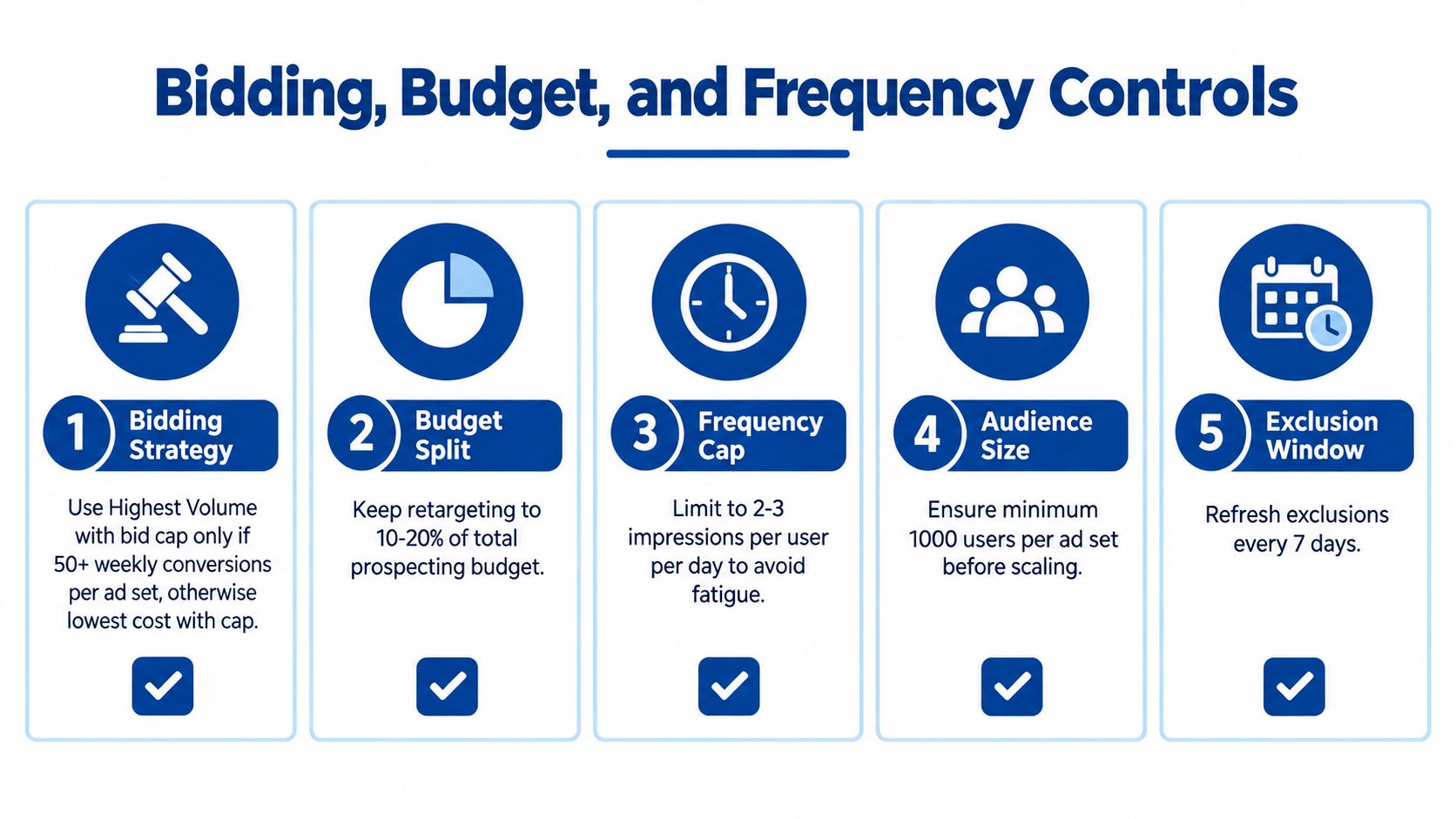
Use Highest Volume when the ad set has enough conversion history for Meta to make useful delivery decisions. A bid cap can make sense when an ad set has at least 50 weekly conversions, but smaller accounts often need more flexible delivery. Where conversion volume is limited, a Cost Cap set roughly 15% to 20% above the 30-day target CPA can give the system room while maintaining a commercial boundary.
Keep the retargeting campaign separate from prospecting. A dedicated budget prevents cold-audience delivery from absorbing money intended for warm users and makes tier-level reporting easier.
Set ceilings before fatigue appears
Useful starting controls include:
- Budget pacing: Keep daily ad-set budgets around 2 to 3 times the target CPA when the account can support that level of spend.
- BOFU frequency: Cap cart audiences at 3 impressions per user over 7 days.
- Mid-funnel frequency: Cap viewer and engagement audiences at 5 impressions per user over 7 days.
- Spend protection: Pause an ad set when CPA rises 30% above its 14-day average, then investigate frequency, CPM, exclusions, and creative before relaunching.
- Weekly review: Check frequency, CTR, CPM, CPA, and audience size before increasing budget.
The practical audience-size minimum in the operating framework is 1,000 users per ad set, while frequency can climb quickly once audiences exceed 50,000 users. These thresholds are management guardrails, not guarantees of performance.
For teams seeking help with campaign setup, tracking, and optimisation, advertising services from LitSpark can complement an internal media buyer without merging prospecting and retargeting budgets.
Measuring Performance Without Lying to Yourself
Retargeting ROAS is easy to overstate. A person may have returned to the site through an organic result, an email, direct navigation, or a saved product link, then seen a Meta ad before purchasing. Meta may claim credit even though the ad didn't create the demand.
For India D2C retargeting, a practical default is 28-day click and 7-day view attribution, based on India-specific benchmark guidance for evaluating warm campaigns. That window captures short-to-medium consideration without reducing every purchase to the final click. A 1-day click view can make retargeting appear exceptionally efficient while hiding whether prospecting created enough demand upstream.
The Monday diagnostic
A media buyer should review the account in the same order each week:
- Pull CPM by audience tier. Rising hot-audience CPM can reflect auction pressure or an audience that is too narrow.
- Review frequency against each audience's cap. Frequency creep usually appears before ROAS collapses.
- Compare CTR and creative-level hook rate. A weak hook can make a healthy audience look broken.
- Check CPA against the account's recent baseline, not only against Meta's reported ROAS.
- Review repeat-purchaser cost separately from first-purchase cost.
- Compare the retargeting audience with a PSA holdout where the account can run one. The question is whether the ad caused additional action, not merely whether Meta recorded a conversion.
| Metric | What to Watch | Threshold to Act |
|---|---|---|
| CPM | Increase by audience tier | Investigate when it rises without stronger intent or conversion quality |
| Frequency | Repeated exposure within a window | Apply the assigned cap before creative fatigue compounds |
| CTR | Decline by creative and audience | Replace the hook or message when relevance weakens |
| CPA | Change versus the recent account baseline | Investigate when it rises 30% above the 14-day average |
| Holdout delta | Retargeted outcome versus PSA control | Pause or repurpose when results remain too close |
| Repeat-purchaser cost | Efficiency of retention activity | Separate from new-customer acquisition reporting |
Shopify and Meta won't always report the same conversion count because they use different tracking, attribution, identity, and order-reporting rules. The gap should be investigated through event quality, deduplication, time zones, refunds, and checkout implementation rather than explained away. Server-side events can reduce missing signal, but they don't make platform attribution identical to store revenue.
Measurement principle: A conversion is not proof of incrementality. It becomes stronger evidence when the retargeted audience outperforms a comparable holdout.
If a retargeting audience performs similarly to a PSA holdout for more than 14 days, treat it as recycled demand. Pause it, narrow the audience, or repurpose the campaign for upsell and retention. A campaign that merely claims conversions from people who were already going to buy is not creating the efficiency its dashboard suggests.
A practical 28-day rollout
Days 1 to 5: Audit Pixel events, validate ViewContent, AddToCart, InitiateCheckout, and Purchase, then deduplicate browser and server events with event_id. Define five non-overlapping custom audiences and document each recency window and exclusion.
Days 6 to 12: Launch BOFU retargeting with two creatives per tier, Lowest Cost bidding, a frequency cap of 6 per 7 days, and a daily budget of 1.2 times projected CPA. Treat this as a controlled validation phase, not a reason to expand immediately.
Days 13 to 20: Add mid-funnel warm audiences, exclude recent purchasers, and introduce one UGC creative plus one offer creative per set. Compare message response by intent tier.
Days 21 to 28: Evaluate holdout delta, stop any audience within 1.3 times holdout ROAS, rotate creatives with hook rate below 25%, and document the next test backlog.
Keep a one-page recap for every cycle:
- Audience: Source, intent, recency, and exclusions
- Creative: Format, hook, offer, and landing page
- Delivery: Spend, CPM, frequency, CTR, and CPA
- Attribution: Click window, view window, platform revenue, and store revenue
- Incrementality: Holdout result and decision
- Next test: One audience, message, placement, or event-quality change
That operating system changes retargeting from a coupon layer into an audience-building system. First-party customer lists, CRM segments, WhatsApp engagement, on-platform video audiences, and clean server events become increasingly important as Meta's targeting environment simplifies. India-focused coverage reports that Meta removed about 10,000 sensitive interests, eliminated Detailed Targeting Exclusions in March 2025, and made older interest stacks less dependable, so brands need owned and engagement-based audience inputs rather than relying only on browser activity. India D2C Meta targeting changes offers useful context for that shift.
Retargeting also has to respect both platform and local requirements. Meta's Advertising Standards govern ad content and business assets, while its India content-restrictions guidance indicates that country-specific legal rules can also apply to campaigns shown to Indian users. Review claims, personal-attribute language, product categories, landing pages, consent practices, and customer-list usage before scaling.
For brands that need support connecting paid media with CRM, landing pages, analytics, and lead-generation services, the important deliverable isn't another isolated campaign. It's a legible system where every audience has a reason to exist, every creative matches intent, and every reported conversion faces an incrementality check.
LitSpark Solutions Private Limited helps D2C, SaaS, and SME teams plan and manage Facebook Ads retargeting alongside tracking, creative, landing pages, and performance marketing. Visit LitSpark Solutions Private Limited to discuss a structured retargeting system built around cleaner audiences and measurable commercial outcomes.
- retargeting facebook ads
- facebook retargeting
- meta ads
- D2C marketing
- smarter campaigns