Resource Hiring14 min read
Contract for Hire in India: Scale Fast and Stay Compliant
Unlock agile growth with a contract for hire model. Our 2026 guide covers Indian labour laws, essential clauses, and how to avoid costly misclassification.
By the LitSpark Solutions team · Updated
- AI Automation
- Advertising
- Designing
- Development
- Digital Marketing
- MVP
- Resource Hiring
- Shoot

In India, contract workers now account for 42% of total employees in the organised manufacturing sector, the highest level recorded since 1997–98, according to ASI reporting covered by Business Standard. That figure changes how founders should think about hiring. Contract for hire is no longer a side tactic for overflow work. It's a mainstream operating model for companies that need speed, flexibility, and specialist talent without locking every hire into a permanent headcount decision.
For Indian tech startups, especially in Bangalore, the opportunity is real. So is the legal risk. A contractor agreement that looks clean on paper can still fail if the working relationship functions like employment in practice. That's where many teams get exposed. They move quickly on product delivery, then discover later that IP ownership, worker classification, termination rights, and benefit obligations were never set up properly.
Table of Contents
- The Strategic Rise of Contract Hiring in India
- Choosing Your Hiring Model A Four-Way Comparison
- Essential Clauses for Your Contract For Hire Agreement
- Navigating Indian Labour Law and Compliance
- The Hidden Risk of Contractor Misclassification
- Best Practices for Engaging Technical Talent
- Your Contract Hiring Action Plan
The Strategic Rise of Contract Hiring in India
Contract hiring is no longer a side channel for Indian employers. It has become a core staffing model across sectors, and tech companies have adopted it for a simple reason. Product demand changes faster than permanent hiring plans.
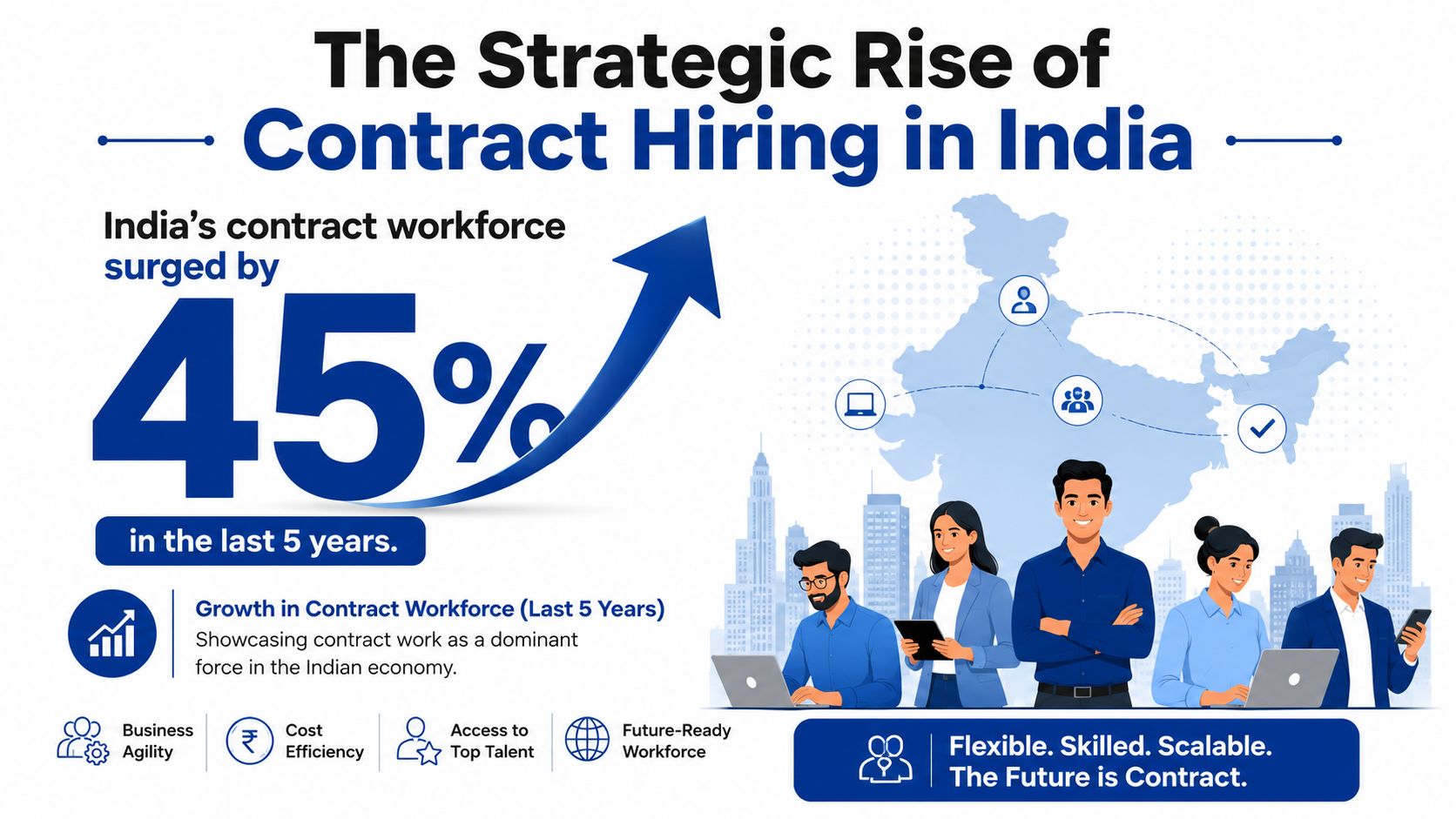
In Bangalore especially, I see founders use contract for hire to close urgent capability gaps without locking themselves into full-time headcount too early. A startup may need a backend engineer for a payment integration, a DevOps specialist for cloud hardening, or a QA lead for a release window. If the scope is clear and the timeline is finite, contract hiring can cut staffing delay and protect cash flow.
The strategic value is speed. The legal risk is misclassification.
That trade-off gets missed in many generic guides. In India's tech sector, companies often engage contractors for work that looks and feels like employment. The contractor uses company systems, follows fixed hours, reports into daily standups, and works under direct supervision for months. Once that pattern sets in, the paperwork matters less than the actual nature of the relationship.
Startups often find themselves exposed. The business gets flexibility on paper, but the operating model creates compliance risk under Indian labour and tax rules. Bangalore companies face this often because engineering teams move fast, managers copy employee workflows, and no one stops to redesign onboarding for non-employees.
Used properly, contract for hire helps teams scale around delivery milestones, funding uncertainty, and uneven client demand. Used carelessly, it creates disputes over PF, gratuity, leave, tax deduction, IP ownership, and termination. The cost of fixing that later is usually far higher than the cost of structuring it correctly at the start.
For teams that need a sharper baseline on classification, this contractor vs employee guide is a useful reference. For more practical hiring and compliance commentary, the LitSpark industry insights blog tracks how digital teams in India are handling these staffing decisions in practice.
Choosing Your Hiring Model A Four-Way Comparison
Not every talent gap needs the same hiring model. Teams often make mistakes because they start with availability, not fit. The better approach is to choose the structure that matches the duration of the work, the level of integration required, and your tolerance for legal complexity.
India's contract staffing market reached $8.2 billion in 2024, and contract workers typically cost 20–40% more per hour than equivalent permanent employees. Even so, firms keep choosing them for agility, and 50% of Indian firms prioritised contract hiring amid layoffs in 2023, according to this analysis on contractual hiring in India. That trade-off is important. Contractors may cost more on an hourly basis, but they can reduce commitment risk and speed up staffing.
When contract for hire works best
Contract for hire makes sense when you need strong capability now and can define the output clearly. Think migration work, sprint-heavy product builds, feature releases, mobile app support, DevOps setup, or interim tech leadership. It's less suitable when the role depends on deep managerial integration, ongoing people supervision, or open-ended ownership that mirrors a permanent function.
If you're still deciding where the legal line sits between contingent and employed talent, this contractor vs employee guide is a useful external reference because it helps frame the commercial and control differences before you draft the engagement model.
Hiring model comparison
| Criteria | Contract for Hire | Contract-to-Hire | Full-Time Employee | Freelancer |
|---|---|---|---|---|
| Best use case | Defined projects, specialist delivery, short to medium business need | Trial period before long-term commitment | Core roles with ongoing ownership | Narrow tasks, one-off assignments |
| Speed to start | Usually fast once scope and contract are ready | Moderate, because conversion terms need planning | Slower, due to full recruitment and onboarding | Often fastest for small deliverables |
| Cost structure | Higher hourly cost, but no permanent commitment | Similar to contract at the start, then potential employment cost later | Lower hourly equivalent, but long-term payroll obligation | Variable, often output-based rather than team-based |
| Team integration | Medium. Enough for delivery, not for full organisational embedding | Medium to high over time | High | Low |
| Legal risk if mismanaged | High if control resembles employment | High during transition if status is blurred | Lower on classification, higher on employment obligations | High if treated like internal staff |
| IP and confidentiality control | Strong only if written properly | Strong only if written properly | Usually stronger through employment terms | Depends heavily on contract wording |
| Scalability | Strong for product bursts and specialist gaps | Good when future headcount is likely | Best for stable growth plans | Best for isolated tasks |
A simple decision rule helps:
- Choose contract for hire when the work has a start point, a finish point, and measurable outputs.
- Choose contract-to-hire when you believe the role may become permanent, but you need a working test first.
- Choose full-time when the role carries continuous ownership, internal management responsibility, or sensitive operational dependence.
- Choose freelance when the task is self-contained and doesn't require ongoing integration.
For technical teams evaluating developers, product specialists, or delivery support, the most practical route is often to align the model with the build stage, then source from a pre-vetted development hiring pipeline instead of trying to retrofit legal terms after someone has already started.
Essential Clauses for Your Contract For Hire Agreement
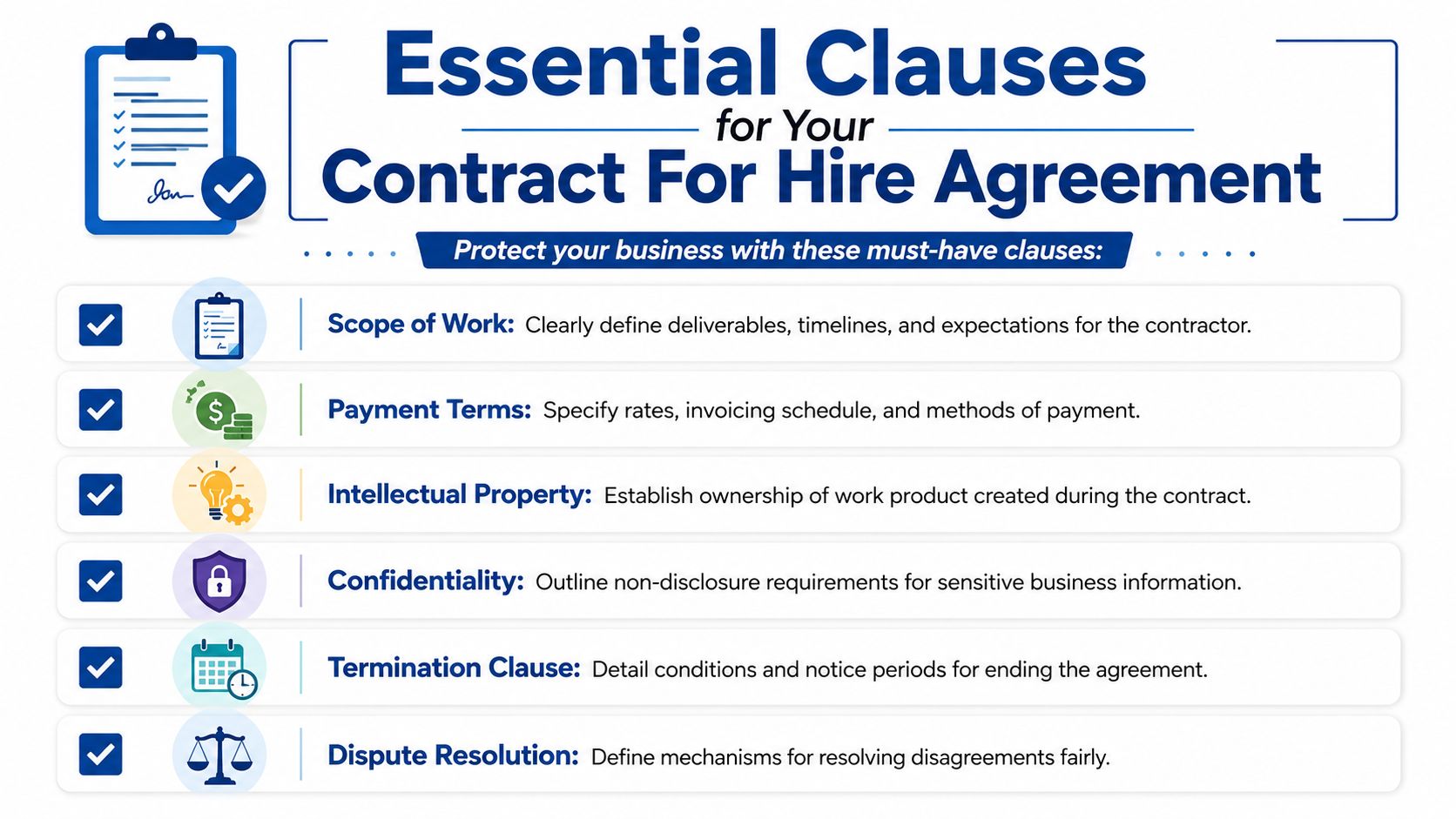
A contract for hire agreement should do more than confirm rates and dates. It should define ownership, limit ambiguity, and preserve the independence of the relationship. If the agreement is vague, the commercial convenience disappears the moment there's a dispute over code, deadlines, access, or termination.
The IP clause that founders get wrong
Under India's Copyright Act, Section 17(b) requires a written agreement that explicitly designates commissioned work by an independent contractor as “work for hire”, otherwise the freelancer retains initial copyright. That point is explained in this analysis of the work for hire doctrine under Indian copyright law. For software and digital product teams, that's not a drafting detail. It's the difference between owning your product assets and merely paying for their creation.
If an external developer writes code for your app, or a designer creates the UI system for your product, payment alone doesn't solve ownership. The contract must explicitly state that the commissioning party owns the work product and all related rights, and it should cover source code, designs, documentation, derivative works, and deliverables created during the assignment.
Practical rule: If the agreement doesn't clearly allocate IP, assume you have a problem.
To review draft agreements before they go live, teams often use legal workflow tools alongside counsel. A document-review utility such as analyze legal employment documents can help flag missing clauses and inconsistent language before the contract reaches signature.
A useful explainer on the broader legal framing appears below.
The clauses that make the agreement usable
A strong agreement usually includes these operational terms.
Scope of work
Spell out deliverables, acceptance criteria, reporting expectations, dependencies, and timelines. Don't write “support development work as needed”. Write what the contractor is expected to produce.Payment terms
State the billing basis, invoice cycle, approval mechanism, and consequences of delayed submission or disputed work. Ambiguity here creates friction fast.Confidentiality
Cover source code, internal documentation, customer data, credentials, pricing, and product strategy. The clause should survive termination.Termination conditions
Define when either party can exit, what notice applies, what happens to work in progress, and when access must be revoked.Dispute resolution
Name the governing law, forum, and escalation path. It saves time when disagreements arise.Relationship wording
State clearly that the contractor controls the manner of work, remains responsible for their own business operations, and isn't entitled to employee benefits unless separately agreed.
Standard durations in India are commonly 3 months, 6 months, or 12 months, and contractor agreements should include IP ownership, confidentiality, and termination terms to reduce confusion and classification risk, as noted in this contract hire overview.
Navigating Indian Labour Law and Compliance
A fast hire can still become an expensive mistake if the paperwork doesn't match the legal framework. Indian labour compliance for contract for hire is moving towards more formal written documentation, clearer worker rights, and closer scrutiny of how businesses structure contingent labour.
What changes under the new framework
Effective November 21, 2025, India's four new Labour Codes govern contract for hire arrangements, and a key compliance feature is a Termination for Convenience clause with a 15–30 day notice period, allowing termination without proving fault, according to this India Briefing labour law guide. That matters because termination rules for permanent employees are stricter. If you want contractual flexibility, your agreement has to preserve it expressly.
The same framework also increases the importance of written agreements. If the contract is informal, inconsistent, or silent on termination mechanics, control, and obligations, enforcement gets weaker when the relationship breaks down.
A workable compliance checklist
The safest approach is operational, not theoretical.
Put everything in writing
Oral understandings are not enough. Contract duration, deliverables, payment, confidentiality, termination rights, and ownership terms should all sit in one signed agreement.Separate employee terms from contractor terms
Don't copy-paste an employment template into a contractor document. The structure, benefits language, and control language are different.Review fixed-term roles carefully
Under India's new Code on Wages framework, fixed-term contract hires are entitled to the same benefits as permanent employees on a pro-rata basis, including gratuity, and a contract denying those benefits is non-compliant, as explained in this employment agreement drafting note.Use termination language deliberately
A contractor agreement should explain clean exit mechanics without importing the disciplinary style used for employees.
When compliance is weak, the business usually notices only at the worst moment. During termination, an IP dispute, or a worker claim.
For startup teams, the goal isn't to memorise every statute. It's to build a repeatable contract review process so every engagement is checked before work starts.
The Hidden Risk of Contractor Misclassification
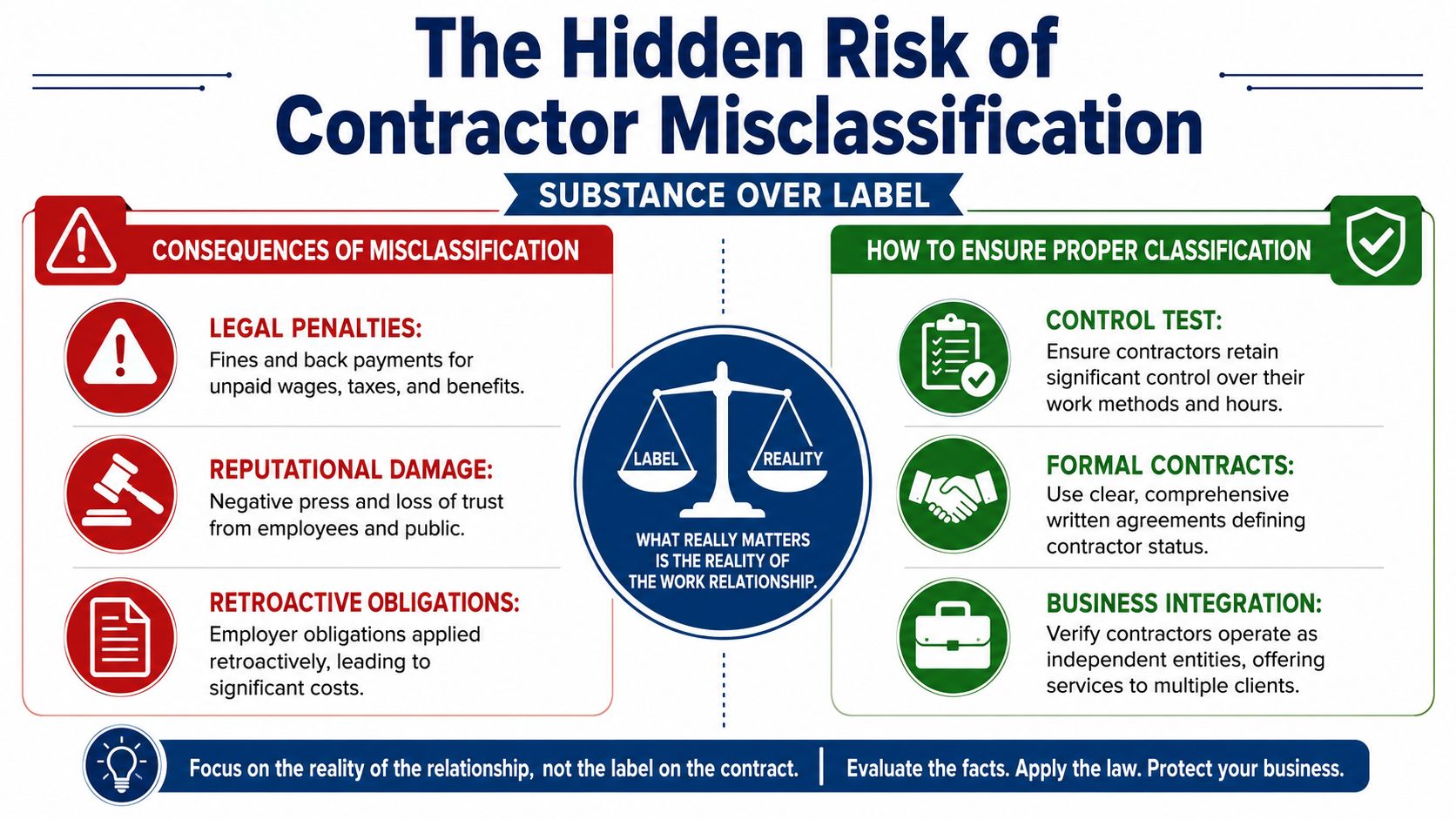
The biggest mistake Indian tech companies make with contract for hire is believing the label controls the outcome. It doesn't. Indian courts look at how the relationship works.
According to this discussion of contractor misclassification in India, courts evaluate the substance of the relationship, not the agreement's title. Treating contractors with fixed hours, daily standups, and company laptops can create single-client dependency and lead to reclassification as employees, triggering statutory liabilities under the Industrial Disputes Act, 1947.
What triggers reclassification
Founders usually don't misclassify on purpose. They do it operationally.
Common red flags include:
Fixed daily supervision
If the contractor has to work your internal schedule exactly like staff, the relationship starts to resemble employment.Embedded management routines
Mandatory standups, manager approvals for daily activity, and close behavioural oversight can undermine independent status.Exclusive dependence
If the person functions as if your company is their sole economic reality, the contractor argument gets weaker.Employee-style tools and identity
Company laptops, employee directories, and internal titles don't decide status on their own, but they add to the picture.
How Bangalore tech teams reduce the risk
In Bangalore, this issue comes up constantly because product teams move fast and want smooth collaboration. Smooth is fine. Indistinguishable from employment is not.
A defensible setup usually looks like this:
- Define deliverables, milestones, and review points instead of prescribing every hour.
- Keep communication focused on output, blockers, and quality.
- Limit internal integration to what the project needs.
- Avoid treating contractors as if they sit inside your standard HR hierarchy.
- Review renewals carefully. Repeated extensions without a fresh legal review can drift into deemed employment territory.
A contractor can join your sprint reviews and still remain a contractor. The problem starts when the company controls the person the way it controls an employee.
This is the hidden compliance gap many generic hiring guides miss. The risk isn't the contract title. The risk is the operating model behind it.
Best Practices for Engaging Technical Talent
Legal compliance matters, but it won't rescue a poorly run engagement. If you want good outcomes from contract for hire, the work has to be defined well, the screening has to be sharp, and the onboarding has to support delivery without collapsing into employee-style control.
Write for outcomes, not supervision
Strong technical contractors respond to precise briefs. Weak briefs create delays, revision loops, and management creep. A useful brief usually includes the product context, tech stack, dependencies, expected deliverables, review cadence, access requirements, and who signs off on completion.
For startup teams, the screening process should test actual fit for the assignment. That means code review where relevant, architecture discussion for senior roles, portfolio validation for UI and UX work, and practical scenario questions for QA, DevOps, or mobile delivery. Generic interview rounds often miss whether the person can handle your specific build constraints.
Onboard contractors without treating them like employees
The line is subtle. Contractors still need access, contacts, and project clarity. They don't need to be absorbed into every internal ritual.
A balanced approach looks like this:
Give project-specific access
Provide the tools and systems required for delivery, not blanket internal visibility.Set communication boundaries
Use a named point of contact and a defined review rhythm instead of constant managerial oversight.Document terms from day one
In Karnataka, a written employment contract is legally mandatory to establish an employer-employee relationship, and the state's Shops and Establishments Act requires written terms for all employees from Day 1, as outlined in this guide to India employment laws. For Bangalore teams, that local legal culture reinforces a broader habit that's smart for all contingent engagements. Write the terms clearly before work begins.Plan the sourcing pipeline
If you need Android, iOS, or full stack capability quickly, it's more effective to work from a structured resource hiring workflow than to search ad hoc after the project is already delayed.
The best contractor relationships feel professional, not informal. Expectations are clear. Deliverables are measurable. Escalations are rare because the scope, documentation, and ownership are settled upfront.
Your Contract Hiring Action Plan
Contract hiring succeeds when the operating model is clear before the first statement of work goes out. In Bangalore tech teams, the biggest mistake is usually not sourcing speed. It is treating contractor engagement as an informal shortcut and cleaning up the classification risk later, after the person already looks and works like an employee.
A workable action plan has four parts.
1. Define the business need before you define the contract
Start with the role, not the paperwork. Decide whether you need a specialist for a fixed deliverable, short-term surge capacity, a time-bound replacement, or a role that is likely to become part of the company's standing org chart. If the role is primarily for an ongoing business function, do not force it into a contractor structure just to move faster. That decision often creates more legal exposure than it saves in hiring time.
2. Build the engagement around independent delivery
The agreement should match how the work will be performed. Set out deliverables, milestones, acceptance criteria, fees, IP assignment, confidentiality, data security duties, termination rights, and dispute handling. For Indian tech startups handling customer code, production access, or sensitive product roadmaps, vague scope is expensive. It creates payment disputes, ownership disputes, and evidence problems if the arrangement is ever reviewed.
3. Test misclassification risk before onboarding
This is the step many startup teams skip. Review the working model as if you had to defend it later to counsel, an auditor, or a labour authority. Daily supervision, fixed schedules, indefinite extensions, company email as default identity, and deep integration into reporting lines all increase the chance that the relationship starts resembling employment. In Bangalore, where startup teams often move fast and managers copy employee processes across the whole engineering org, that risk appears earlier than founders expect.
4. Keep a clean document trail from day one
Store the contract, SOWs, renewal approvals, invoices, access approvals, security acknowledgments, and exit records in one controlled system. Even though it serves a different industry context, this overview of tools for managing construction documents makes the operational point well. Contractor disputes get harder to resolve when the evidence sits across inboxes, Slack threads, and personal drives.
Speed matters. Defensibility matters too.
The best action plans do both. They let startup teams bring in technical talent quickly, while preserving a clear record of why the person was engaged, what they were hired to deliver, and how the company avoided turning a contractor relationship into undeclared employment by habit instead of design.
If you need a practical partner to source, vet, and deploy technical talent without losing control of delivery quality, LitSpark Solutions Private Limited helps businesses hire developers and digital specialists on a flexible basis with fast onboarding and structured support. For startups and growth-stage teams that want to scale without creating compliance chaos, LitSpark offers a direct route to contract and full-time technical hiring.
- contract for hire
- contract staffing India
- labour law compliance
- hiring developers
- resource augmentation