14 min read
Internship in Digital Marketing in Bangalore: Guide 2026
Learn to find, apply, and succeed in an internship in digital marketing in Bangalore with job-search tactics, portfolio templates, and stipend guidance.
By the LitSpark Solutions team · Updated
- AI Automation
- Advertising
- Designing
- Development
- Digital Marketing
- MVP
- Resource Hiring
- Shoot
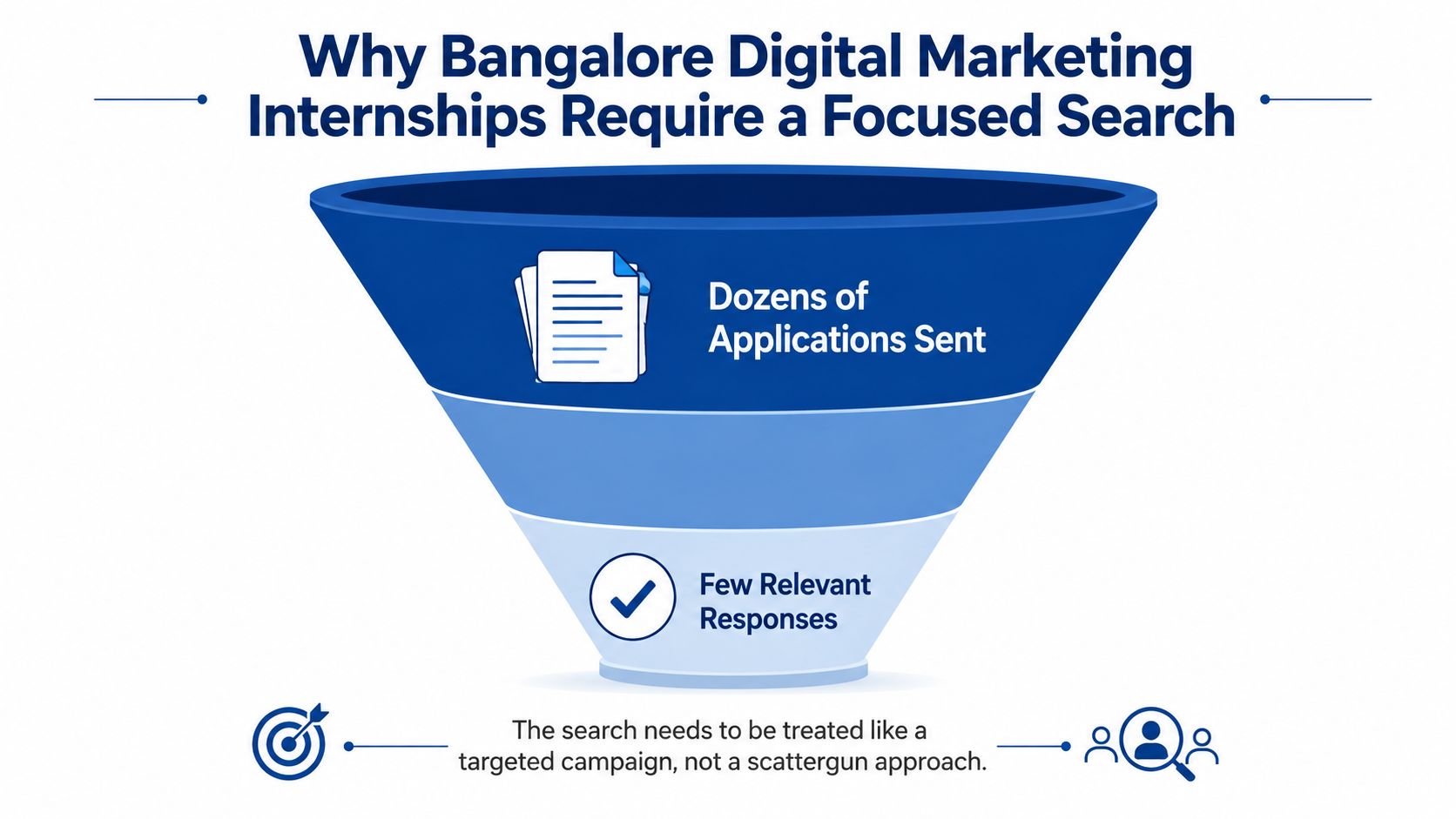
You find dozens of listings for an internship in digital marketing in Bangalore, tailor one application, then hear nothing. After a week, you apply to even more roles, often using the same resume and portfolio link, but the response rate barely changes. The problem usually isn't a lack of opportunity. It's a search process that treats every listing as equally valuable.
Bangalore offers a broad mix of startup growth, SaaS, agency, content, paid media, SEO, social media, email, and analytics work. Employers still screen for evidence, availability, communication, and the ability to learn quickly. A focused search helps you show those qualities before the interview.
Table of Contents
- Why Bangalore Digital Marketing Internships Require a Focused Search
- Choose the Right Internship Format and Hiring Channel
- Build the Skills and Mini Projects Employers Can Evaluate
- Create a Tailored Resume Portfolio and Cover Letter
- Reach Hiring Teams With Personalised Outreach Messages
- Prepare for Interviews and Evaluate the Internship Offer
- Succeed During the Internship and Fix a Slow Search
Why Bangalore Digital Marketing Internships Require a Focused Search
Bangalore has a large internship market, but volume doesn't guarantee access. A major internship platform listed 927 digital marketing internships in Bangalore as of April 7, 2026, while other snapshots showed 105 digital marketing internship jobs in Bangalore in August 2026 and 99 in Bengaluru in July 2025. These figures come from different snapshots and should not be treated as a single live total, but they do show a market with repeated hiring activity rather than one isolated batch. Explore the Bangalore internship market with the understanding that listings change quickly.
A startup may want an intern who can write landing-page copy and report on sign-ups. An agency may prioritise content calendars, client coordination, and platform execution. A SaaS company may value SEO research, LinkedIn distribution, email workflows, or analytics. Applying to all of them with one generic profile makes your strongest evidence harder to see.
Score roles before you apply
Use a simple scorecard for every opening. You don't need complicated software. A spreadsheet is enough if you assess the same criteria consistently:
- Role relevance: Does the work match SEO, content, paid media, social, email, or analytics that you want to practise?
- Skill match: Can you already demonstrate some of the requested work through coursework, personal projects, or previous experience?
- Work mode: Can you reliably attend an in-office or hybrid role if required?
- Mentorship: Is there a named manager, review process, or clear team structure?
- Duration and stipend: Are the expected commitment and payment stated clearly?
- Portfolio value: Will you produce work you can describe without exposing confidential information?
Score each factor in a way that helps you compare roles, then shortlist the ten openings with the strongest overall fit. The aim isn't to reject every imperfect role. It's to spend customisation time where the role can produce a credible interview and useful evidence.
Practical rule: A relevant application with one strong proof point is more useful than a high-volume batch of identical resumes.
Track the search like a campaign
Create columns for company, role, source, contact date, resume or portfolio asset, follow-up date, status, and reason for rejection. Add a notes field for the employer's language, such as “SEO audit”, “weekly reporting”, “Meta Ads”, or “B2B content”.
Review the sheet every few days. If a role repeatedly asks for analytics but your portfolio only shows design, that's a skill gap to fix. If applications from one source produce no conversations, test a different channel instead of automatically increasing volume.
Choose the Right Internship Format and Hiring Channel
The right format depends on what you need to prove next. A startup growth internship often gives you broader ownership, but priorities can change quickly and formal training may be limited. An agency role can expose you to different industries and campaign types, though your work may be divided across clients and reviewed under tight deadlines.
An in-house brand role usually provides deeper context about one audience, product, and funnel. Hybrid work can preserve team access while reducing travel, whereas remote work requires unusually clear communication and self-management. Ask which format will let you create portfolio evidence, receive feedback, and understand why a marketing decision was made.
Bangalore's importance is clear in the wider market. A 2024 survey reported that Bangalore accounted for 10% of internship openings nationally, while separate 2026 data found that Bengaluru and Mumbai together held 43% of active marketing internship listings, with 34% remote or hybrid and 68% from startups under Series B. The India Today survey coverage supports a practical conclusion: funded startups and hybrid roles deserve deliberate attention, not casual browsing.
Compare channels by evidence, not popularity
| Channel | Best For | Measure |
|---|---|---|
| Internship platforms | Finding structured roles with stated duration and stipend | Suitable listings and interview responses |
| Discovering hiring managers, founders, and team activity | Relevant contacts and replies | |
| Company career pages | Applying to roles close to the employer's process | Role fit and application status |
| Startup communities | Finding smaller teams and early hiring signals | Quality of conversations |
| Campus placement cells | Accessing roles filtered for student availability | Interview invitations |
| Referrals | Building trust through a real professional connection | Referred applications and outcomes |
| Direct outreach | Reaching a team when no public listing exists | Personalised messages and responses |
For LinkedIn research, study how a company communicates before messaging it. A practical resource on LinkedIn social media management can help you assess posting consistency, audience engagement, and content structure without pretending that activity alone proves marketing quality.
Use a two-week channel test. Record suitable roles found, applications sent, personalised messages, replies, interviews, and rejections for each source. Keep the two channels that produce the strongest combination of role fit and response quality. You can also review resource hiring options when a company needs flexible talent, but evaluate the actual internship scope rather than assuming every hiring service offers the same mentorship.
Reject unclear offers early
Be cautious when responsibilities are vague, the company asks for unpaid production work before a proper interview, interview stages aren't explained, or the stipend and duration remain undisclosed. These signals don't prove that an employer is unsuitable, but they do justify specific questions before you invest substantial time.
Build the Skills and Mini Projects Employers Can Evaluate
A certificate shows what you studied. A compact project shows how you make decisions. For an internship in digital marketing in Bangalore, build evidence that connects a business problem with an audience, channel, action, and measurement plan. Hiring teams can then judge your working method instead of relying on course titles.
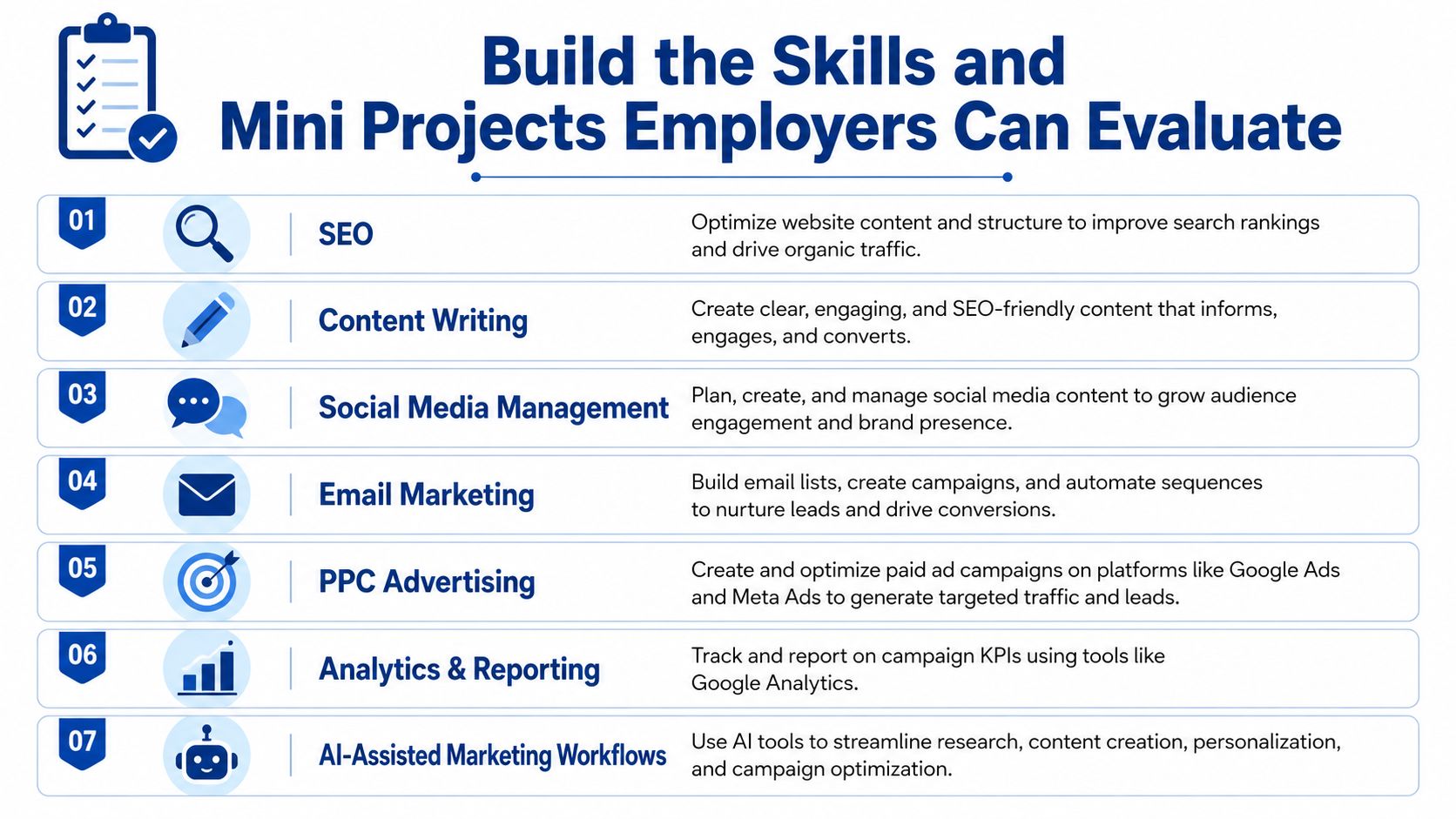
Start with a skills audit. Mark each capability as can explain, can demonstrate, or need practice:
- SEO: Audit titles, headings, internal links, search intent, and technical issues on a sample Bangalore D2C or SaaS website.
- Content writing: Produce a short content brief, one article outline, and a distribution plan for a defined audience.
- Social media management: Build a four-post campaign with platform-specific copy, creative direction, publishing logic, and reporting fields.
- Email marketing: Draft a short sequence with subject-line variants and a clear conversion proxy, such as a click or form completion.
- PPC advertising: Create a campaign simulation with audience assumptions, keyword groups, ad variants, budget logic, and a test hypothesis. Label it as simulated work.
- Analytics and reporting: Build a dashboard that connects channel activity to meaningful actions instead of reporting reach alone.
- AI-assisted marketing workflows: Show where AI supports research, clustering, or first drafts, then document your fact-checking and editorial decisions.
You can practise campaign planning with this social media marketing service resource. Keep the portfolio focused on what you personally produced, tested, and measured.
Write the case study before polishing the design
Each project should state the brief, audience, objective, channel choice, execution, result or current status, limitation, and next action. If no real audience saw the work, do not invent reach, leads, revenue, or engagement. Show the measurement design and label the project as a simulation, personal project, or coursework.
For example: “I selected a B2B software audience, mapped content to awareness and evaluation stages, created four LinkedIn concepts, and defined engagement and click-through tracking.” This demonstrates planning without claiming business results the campaign did not generate.
Startup and agency internships can offer different learning conditions. A startup may give you wider ownership and faster feedback, while an agency may expose you to several clients and channels. Use your projects to show that you can work within either environment, then ask about supervision, review cycles, and access to performance data before accepting an offer.
Use a one-week build order
On day one, choose a business and audience. Complete the SEO or content research next. Create the asset, document each decision, add a measurement plan, and record the limitation. Finish by converting the work into a clean PDF or portfolio page.
Two well-explained projects usually give a hiring manager more to assess than a large folder of unfinished certificates. Track your weekly output as a small hiring KPI set: projects completed, applications matched to those projects, replies, interviews, and feedback received. That record helps you improve both the portfolio and the search.
The following video can support your tool and workflow preparation:
Create a Tailored Resume Portfolio and Cover Letter
Your application package should answer three questions quickly: what can you do, what have you produced, and why does it match this role? A fresher can use coursework or personal work, provided it's labelled accurately and the description explains the candidate's contribution.

Keep the resume simple and readable by both people and applicant tracking systems. Use standard headings such as Skills, Projects, Education, Experience, and Tools. Match genuine terms from the listing, but don't fill the page with keywords you can't discuss.
A useful project entry has this shape:
- Project: Technical SEO audit for a sample D2C website.
- Action: Reviewed search intent, metadata, headings, internal linking, and page structure.
- Evidence: Delivered a prioritised issue list, recommendations, and a measurement plan.
- Status: Personal project, not client work.
Name files clearly, such as Name_Digital_Marketing_Intern_Resume.pdf, and use a portfolio link that opens without a login. Your homepage needs a short positioning statement, two or three case studies, and an optional project index. Each case study should show the decision process, not only attractive screenshots.
Make each application visibly specific
For a content internship, a weak bullet says, “Wrote social media posts.” A stronger truthful version says, “Created a four-post content campaign for a defined audience, including keyword rationale, platform-specific copy, distribution choices, and KPI tracking.”
For a performance marketing internship, replace “Learned Google Ads” with “Built a paid search campaign simulation with audience assumptions, keyword groups, ad variants, test hypothesis, and conversion-proxy measurement.” Never describe simulated work as client experience.
Your cover letter should connect one employer requirement to one project. Explain what you made, how you approached it, and what you would like to discuss next. A tool such as the AIApply cover letter generator can help organise a first draft, but you must fact-check it, remove generic claims, and rewrite the message in your own voice.
A 2025 hiring report stated that 91.5% of entry-level digital marketing roles were in-office or hybrid, reinforcing the value of showing collaboration and rapid learning through project documentation. The hiring report also makes location and availability details worth stating clearly.
Use seven days to draft, edit, test the portfolio link, tailor the resume, write the letter, ask someone to review it, and export the final PDF. Don't claim tools, results, or responsibilities that you can't explain in an interview.
Reach Hiring Teams With Personalised Outreach Messages
A candidate notices that a Bangalore SaaS company is publishing regularly but has no visible internship listing. They review the company's recent posts, identify the likely growth or content lead through the company website or LinkedIn, and prepare one useful observation. The message doesn't ask for a job without context. It connects the company's work to a relevant project.
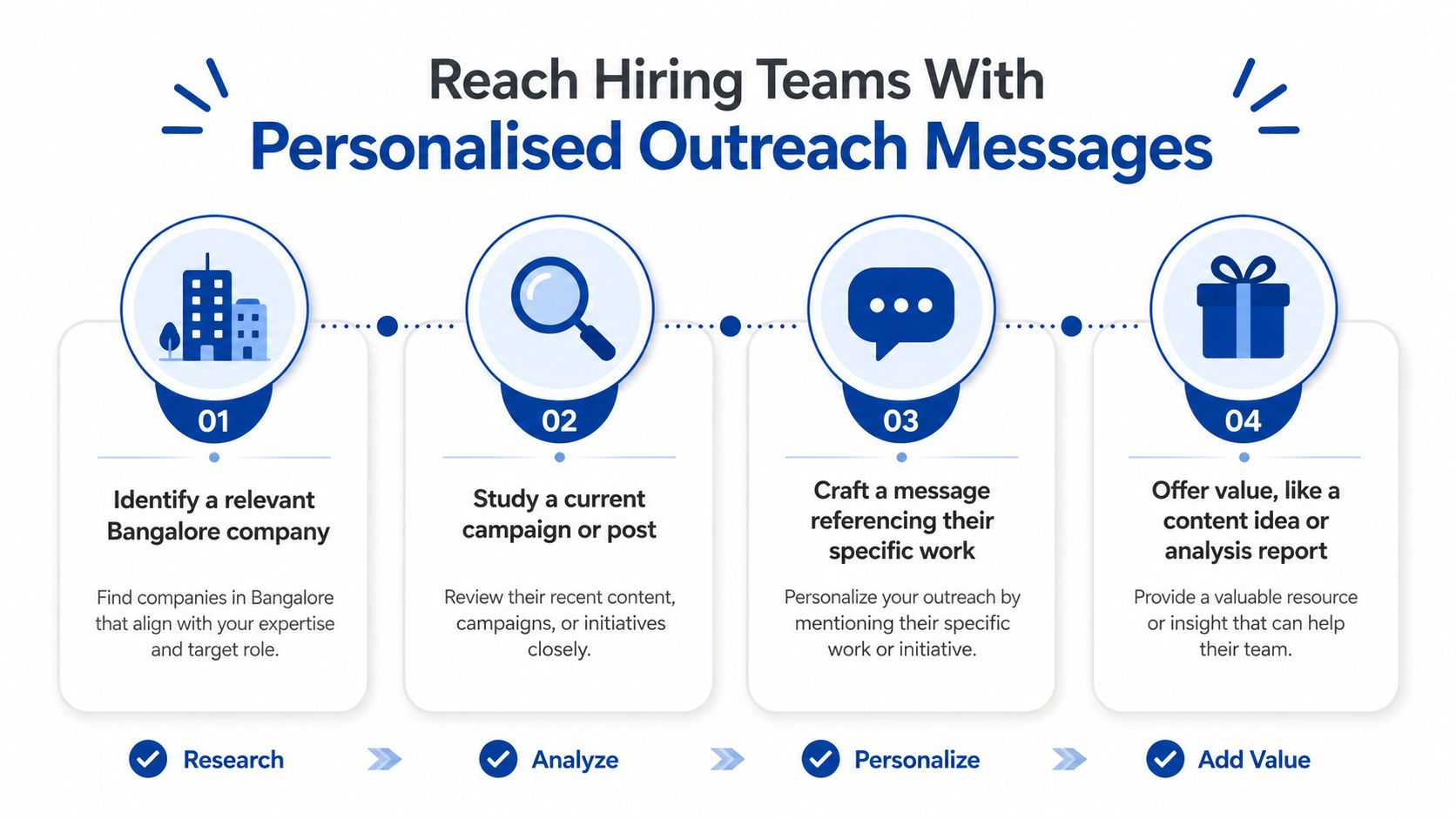
A first connection can be short:
“Hello [Name], I'm applying for digital marketing internships in Bangalore and have been studying [Company]'s recent [channel] work. I recently built [project], where I documented [specific evidence]. Would you be open to connecting?”
If the person accepts, don't immediately send a long biography. Use a referral request only when there is a genuine role or clear team fit:
“Thank you for connecting. I noticed the [role] opening and saw that it involves [requirement]. My [project] demonstrates [evidence]. If you feel my profile is relevant, would you be comfortable pointing me to the right application route?”
Follow up without creating pressure
Internship listings in Bengaluru included roles asking for 3–6-month commitments, so acknowledge availability early when you contact a team. The listed role examples show why a manager needs to know whether you can meet the expected duration.
After seven days, send one follow-up:
“Hello [Name], I'm following up on my note about the [role]. I'm available for the stated [duration] and can share my [project or audit]. If the team isn't hiring interns currently, no reply is needed. Thank you for considering it.”
A final courtesy note should close the loop rather than demand attention:
“Thanks for reading, [Name]. I'll keep following the company's work and will apply through the formal route if a suitable role appears.”
Log the company, contact, date, message type, role, response, and next action. Calculate response rate as replies divided by personalised messages sent. Compare that result with generic applications, but don't treat a small sample as a definitive verdict.
Avoid mass copy, excessive emojis, false familiarity, and requests for confidential campaign data. You can offer a public-facing content observation or a short analysis, but don't produce unpaid production work before the employer has explained the process. If you want to monitor relevant openings, the LitSpark Solutions careers page is one example of a company careers route to check alongside job boards and direct outreach.
Prepare for Interviews and Evaluate the Internship Offer
Interviewers don't expect a fresher to know everything. They do expect a clear thought process. Use one completed project to answer technical questions with context, action, evidence, limitation, and learning.
For “How would you build an SEO plan?”, explain how you'd define the audience, research intent, review the site, prioritise issues, and measure progress. For “How would you test a campaign?”, identify the hypothesis, audience, variable, conversion proxy, and decision rule. For “What would you do after missing a target?”, explain what you checked, what changed, what feedback you requested, and what you would test next.
Prepare concise answers for:
- Content calendars: Explain how audience stage, channel, publishing capacity, and review time shape the plan.
- Analytics: Distinguish activity metrics from conversion proxies and state what you would verify before drawing a conclusion.
- AI tools: Describe where AI supports research or drafting, then explain your fact-checking and human review.
- Criticism: Give a real example of changing a project after feedback, without blaming the reviewer.
- Learning speed: Show the sequence from unfamiliar task to documented output.
For a mock assignment, write down the audience, business objective, channel, proposed asset, measurement method, assumptions, and next step. This structure prevents attractive but commercially empty answers.
Assess the offer as carefully as the interview
Reported compensation varies widely across Bangalore sources. Glassdoor listed average base pay of ₹15,000 per month, Indeed listed Bengaluru at ₹37,836 per month, and a salary snapshot reported about ₹38,318 per month. These figures come from different datasets, role definitions, and dates, so treat them as indicative rather than guaranteed offers. Review the Glassdoor salary snapshot alongside the actual written offer.
| Factor | Question to Ask |
|---|---|
| Duration | What are the start and end dates, and is the commitment fixed? |
| Stipend | What is the monthly amount, payment date, and evaluation condition? |
| Work mode | Is the role in-office, hybrid, or remote, and where is the workplace? |
| Mentoring | Who reviews my work, and how often will feedback happen? |
| Responsibilities | Which channels and deliverables will I own? |
| Conversion | Is a pre-placement opportunity possible, and what criteria apply? |
| Certificate | What does completion require, and what will the certificate state? |
| College schedule | Can attendance and examination commitments be accommodated? |
The highest stipend isn't automatically the strongest option. A lower-paid role with clear ownership, regular feedback, and publishable evidence may advance your career more than a loosely defined position with little supervision.
Succeed During the Internship and Fix a Slow Search
Treat the first month as an operating system, not a waiting period. In the first week, clarify the audience, offer, channels, goals, tools, approval process, communication norms, and reporting format. Then create a weekly scorecard with deliverables completed, experiments run, feedback received, blockers, and next priorities.
A suggested content cadence can be useful when the role supports it. One Bangalore role-design snapshot recommends a performance-oriented approach built around sustained output, and reports that internships commonly last 3–6 months while combining monthly stipends with performance-based evaluation. Review the role and compensation snapshot before treating any benchmark as a promise.
Use a 30-day search and work plan
- Days 1–7: Complete the skills audit, choose a specialisation, and build the first project.
- Days 8–14: Finish a second project, publish the case studies, and tailor the resume.
- Days 15–21: Send 15 tailored applications, record every outcome, and send a limited set of personalised messages.
- Days 22–30: Schedule two mock interviews, review responses, refine weak evidence, and follow up on active applications.
If you receive fewer than three replies after 20 targeted applications, don't double the volume. Check role fit, resume clarity, portfolio relevance, subject lines, work-mode availability, and whether your evidence matches the requested channel. Change one variable at a time so you can identify what improves the search.
At the end of each week, write three lines: what shipped, what changed after feedback, and what you'll do next. That record can become a truthful portfolio case study and gives your manager a practical basis for coaching.
LitSpark Solutions Private Limited offers digital marketing services across SEO, content, social media, PPC, email, and analytics, alongside technology and resource-hiring support for growing teams. Visit LitSpark Solutions Private Limited to explore its services and careers options, then use the evidence-led approach in this guide to prepare an application that a Bangalore hiring team can evaluate.
- digital marketing internship
- internship in digital marketing in bangalore
- Bangalore internships
- marketing portfolio
- digital marketing careers