17 min read
Outsourced Product Development Services: 2026 Partner Guide
Unlock growth with outsourced product development services. Our 2026 guide covers models, pricing, and choosing a partner for results.
By the LitSpark Solutions team · Updated
- AI Automation
- Advertising
- Designing
- Development
- Digital Marketing
- MVP
- Resource Hiring
- Shoot
Most advice about outsourcing gets the first decision wrong. It treats outsourced product development services as a hiring shortcut, when the actual choice is between buying execution and buying judgment.
Execution gives you people who build what you specify. Judgment gives you a partner who challenges weak assumptions, cuts features that don't earn their keep, flags architecture risks early, and shares responsibility for product outcomes. That distinction matters more than rate cards, team size, or geography.
India remains central to this conversation because scale changes what's possible. India's outsourced product development sector is backed by 5.4 million IT professionals, and nearly 60% of the world's leading companies outsource their IT projects to India, particularly software and web development, according to NASSCOM's 2023 review cited by FDM Group's analysis of outsourcing IT in India. For a wider strategic view of how outsourcing relationships are evolving, Rite NRG's perspective on IT and outsourcing is worth reading alongside that market context.
That scale creates opportunity, but it also creates noise. Plenty of firms can ship tickets. Fewer can own discovery, shape trade-offs, and help a founder or product lead avoid building the wrong thing efficiently. If you're evaluating providers in India, that's the filter that matters.
Table of Contents
- The Strategic Shift in Product Development Outsourcing
- Beyond Coding What Outsourced Product Development Really Means
- Choosing Your Partnership The Four Engagement Models
- Decoding the Investment Pricing Models and Realistic Timelines
- Your Vendor Selection Checklist Finding the Right Partner
- From Kickoff to ROI Onboarding Governance and KPIs
- Common Outsourcing Pitfalls and How to Mitigate Them
The Strategic Shift in Product Development Outsourcing
The old outsourcing model was simple. A client wrote requirements, a vendor estimated effort, and a delivery team built to spec. That still exists, and sometimes it's appropriate. It's useful for migrations, maintenance, or tightly defined engineering work where the decision-making has already happened.
Product development rarely behaves that neatly.
Execution is cheap. Wrong decisions are expensive
A pure execution vendor optimises for output. They close tickets, report velocity, and stay inside the brief. If the brief is weak, they still build it. If the roadmap is overloaded, they'll often keep going. If your onboarding flow is broken at the product level, more coding won't fix it.
A judgment-based partner behaves differently. They ask why a feature matters, what behaviour it should change, what can be deferred, and where technical shortcuts will hurt later. They don't just estimate backlog. They inspect product risk.
Practical rule: If a vendor never disagrees with your scope, you're probably buying labour, not product thinking.
Why this shift matters in India
India's role in outsourced product development has moved far beyond low-cost execution. The stronger firms now compete on product ownership, system design, cloud delivery, DevOps discipline, and specialised technical capability. That matters for Indian startups and SMEs because the local market no longer needs to choose between affordability and product maturity in such rigid terms.
The strategic shift is less about outsourcing code and more about extending your product organisation. The right partner can fill gaps in discovery, UI/UX, architecture, QA automation, release discipline, and post-launch iteration. The wrong one adds engineering capacity without reducing business uncertainty.
What to look for instead
When evaluating outsourced product development services, start with these questions:
- Decision quality: Do they challenge assumptions or just accept tickets?
- Product ownership: Can they cover discovery, design, engineering, and launch without losing context?
- Commercial honesty: Do they explain trade-offs clearly, especially when scope, time, and maintainability are in tension?
- Operational maturity: Can they work inside real product rhythms, not just project milestones?
The firms worth shortlisting aren't the ones that promise the most output. They're the ones that improve the quality of your product decisions.
Beyond Coding What Outsourced Product Development Really Means
The easiest way to explain modern outsourced product development services is with a simple analogy. Hiring coders is like hiring a chef to cook a recipe you already finalised. True outsourced product development is closer to hiring a catering partner who helps design the menu, source ingredients, organise service, and adapt when the event changes.
That's the operational difference between staff supply and product responsibility.
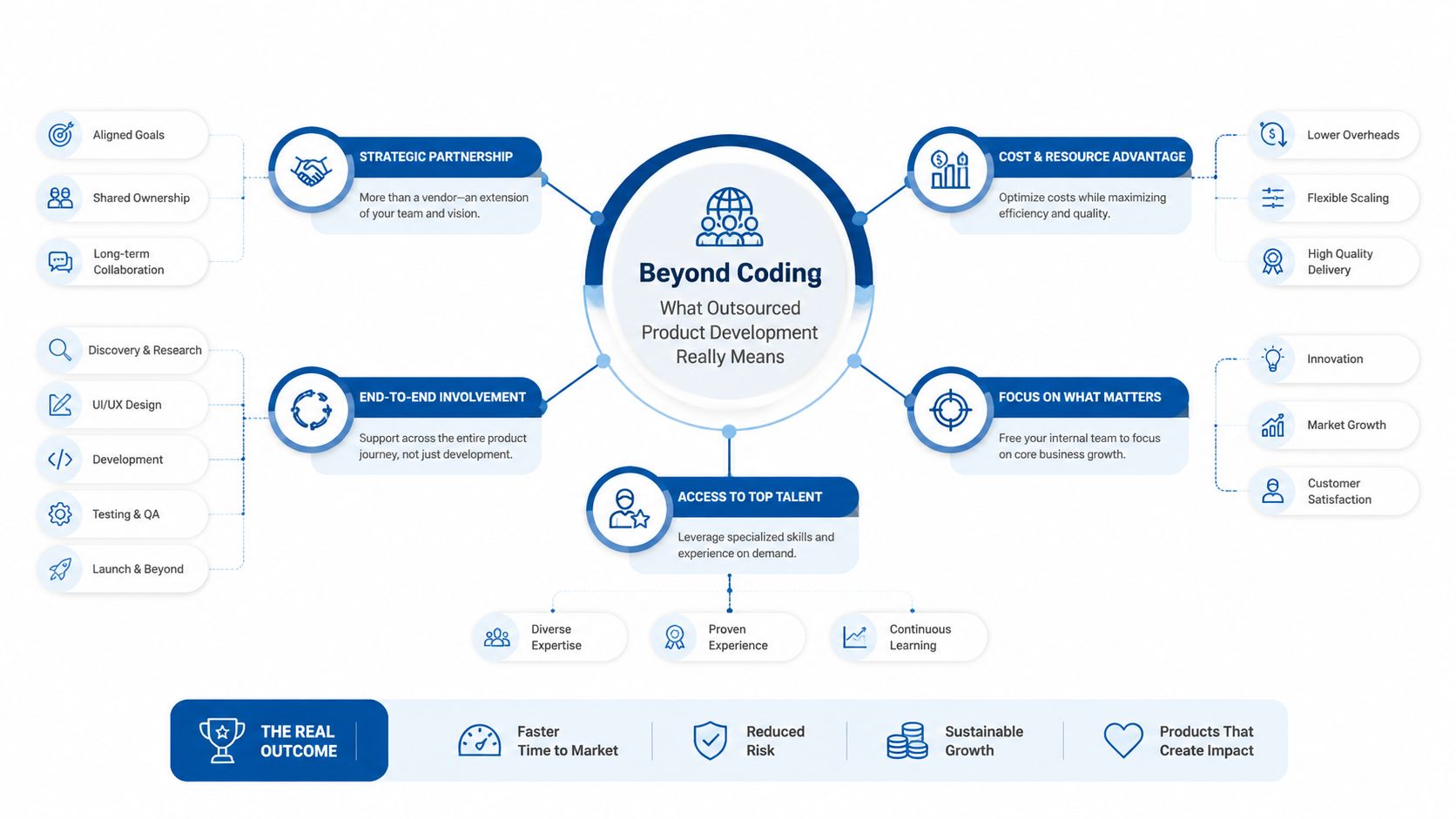
In India, this shift is already visible. Outsourced product development has moved from task-based execution to expertise-based partnerships, where providers contribute strategic business value and technical knowledge across discovery, design, engineering, and deployment, as described in Induji Technologies' review of IT outsourcing in India.
What a real product partnership covers
A proper OPD engagement doesn't begin with coding. It begins with clarity.
That usually means a team works through product intent first. Who is the user, what problem is urgent enough to solve, what's the smallest release that can test demand, and what should wait. If this step is skipped, teams often move quickly in the wrong direction.
From there, the partnership usually spans several layers:
- Discovery and scoping: framing assumptions, user journeys, release priorities, and technical constraints
- Design: turning raw requirements into usable flows, wireframes, and interface decisions
- Engineering: building front-end, back-end, APIs, integrations, and infrastructure
- Quality assurance: combining manual testing, automated checks, regression discipline, and release confidence
- Deployment and support: shipping, monitoring, fixing, and preparing the product for iteration
A founder who needs to validate an idea quickly might start with an MVP sprint such as LitSpark's Get Your MVP service, but the useful question isn't just how fast a team can launch. It's whether they can decide what deserves to be launched first.
The signs you're still buying coding only
A vendor may advertise end-to-end services and still operate like a coding shop. The warning signs are usually obvious once you know what to look for.
- Requirements go in one side, code comes out the other: nobody tests assumptions or challenges edge cases.
- Design is decorative: UI screens exist, but workflow decisions and user friction aren't addressed.
- Architecture is reactive: the system evolves ticket by ticket, with no clear view of maintainability.
- QA sits at the end: testing becomes a final gate instead of part of daily delivery.
Good outsourced product development services reduce uncertainty before they increase output.
The operating mindset that changes results
The better teams think in loops, not handoffs. Discovery informs design. Design shapes architecture. Engineering reveals product trade-offs. QA influences acceptance criteria. Deployment feeds learning back into the roadmap.
That's why the strongest OPD relationships feel less like procurement and more like a compact product unit attached to your business. They don't just ask, “What should we build next?” They ask, “What did we learn, and should this still be built?”
Choosing Your Partnership The Four Engagement Models
The engagement model often decides whether the relationship works. Many outsourcing problems aren't quality problems at all. They're model mismatches. A company with shifting priorities signs a fixed scope contract. A founder with no internal product lead hires staff augmentation. An enterprise that wants governance chooses an informal dedicated team setup and then wonders why reporting is messy.
This is the practical lens: choose the model that matches how decisions will be made.
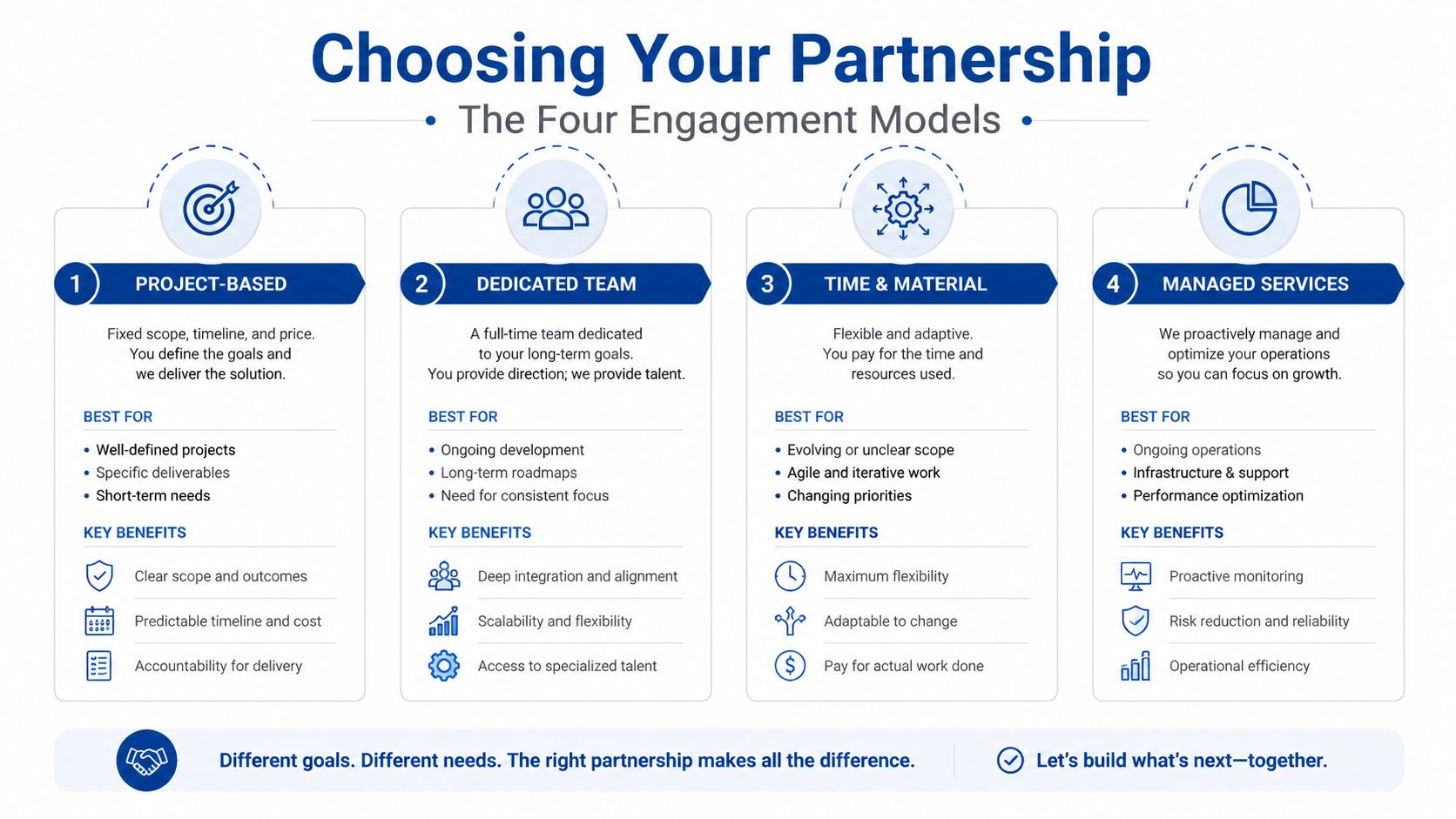
Comparison of Outsourced Product Development Engagement Models
| Model | Best For | Control Level | Cost Structure | Key Benefit |
|---|---|---|---|---|
| Project-Based | Clearly defined deliverables | Lower | Fixed scope or milestone-led | Predictability |
| Dedicated Team | Ongoing product development | Shared | Monthly team cost | Continuity |
| Staff Augmentation | Extending an existing internal team | Higher | Per-person billing | Fast capacity |
| Hybrid | Mixed ownership across strategy and execution | Shared to high | Blended commercial model | Flexibility |
Project-Based
This model fits work that can be bounded cleanly. A defined MVP, a module rebuild, a data migration, or a contained platform upgrade can work well here if requirements are stable and decision-makers are available.
Its strength is commercial clarity. Procurement likes it because the boundaries look clean. Leadership likes it because the budget appears easy to approve.
Its weakness is product reality. If your assumptions change, fixed scope contracts can turn every meaningful improvement into a change request. That creates friction between what the product needs and what the contract allows.
Best for: a well-scoped initiative where core requirements are unlikely to shift.
Dedicated Team
A dedicated team works best when the product will evolve over time and you need continuity across releases. Instead of buying a closed project, you secure a standing product squad that stays with the problem.
This model creates better context retention. The same engineers, QA specialists, and delivery leads learn your domain, architecture, release rhythm, and customer patterns. Over time, that usually improves decision speed and reduces re-explaining.
The trade-off is management discipline. You still need roadmap ownership, prioritisation, and regular decision-making. If nobody on the client side can provide that, the team may stay busy without staying aligned.
Best for: growth-stage products, multi-phase platforms, and businesses with ongoing roadmap needs.
Staff Augmentation
Staff augmentation gives you individual contributors who plug into your process, tools, and leadership. It works when you already know what needs to be built and just need more hands or niche capability.
It fails when companies expect added people to solve strategic ambiguity. They won't. If your product direction is still fuzzy, more developers usually increase throughput, not clarity. For leaders weighing this route, GENTY insights on staff augmentation offer a useful framing of where augmentation fits and where it doesn't.
If you need this model, a resource hiring setup such as LitSpark's resource hiring option is relevant only if you already have internal product and engineering leadership ready to absorb those people effectively.
Best for: internal teams that need fast capacity, specialised skills, or temporary extension.
Hybrid
Hybrid models are common in real product environments because few businesses fit neatly into one box. You might keep product strategy in-house, use an outsourced design and engineering team for delivery, and bring in staff augmentation for a specific mobile or QA need.
This model works because it mirrors how companies operate. Different parts of the product lifecycle need different ownership. Discovery may remain internal. Build may be external. Transition may become shared.
A strong hybrid model has one non-negotiable rule. Decision rights must be explicit.
Best for: companies balancing speed now with internal capability building later.
A quick decision filter
Use this short filter before you sign anything:
- If scope is fixed and success is easy to define, project-based can work.
- If the roadmap will evolve, dedicated team is usually safer.
- If your internal leaders already run delivery well, staff augmentation can be efficient.
- If ownership is split across business, product, and delivery, hybrid usually reflects reality better.
The wrong model creates conflict even with a good vendor. The right model makes governance easier before the first sprint begins.
Decoding the Investment Pricing Models and Realistic Timelines
Most outsourcing budgets go wrong because buyers focus on the quoted rate and ignore the operating model around it. A lower hourly number can still produce a more expensive engagement if knowledge transfer is weak, QA is rushed, or project management sits outside the estimate.
The useful budget question isn't “What is the rate?” It's “What is included, what is variable, and what tends to appear later?”
Fixed price versus time and materials
Fixed price works when scope is stable, acceptance criteria are clear, and business stakeholders won't keep reshaping requirements. In those conditions, it can protect budget discipline. It also forces a useful scoping exercise before work starts.
The problem appears when product learning changes the brief. If the contract is rigid, necessary changes become administrative negotiations. Some vendors protect margin by narrowing interpretation, slowing approvals, or cutting corners in invisible areas such as documentation and testing.
Time and materials handles change better. It reflects reality in product development, where discovery continues during delivery. Teams can refine flows, adjust backlog priority, and respond to new information without rewriting the whole commercial structure.
Its risk is different. Without firm governance, T&M can drift. The model itself isn't the issue. Weak prioritisation is.
The real cost of engagement
A direct developer rate is rarely the full number. According to Insignia Resource's compilation of outsourcing to India statistics, Everest Group data places a mid-level engineer's average outsourcing cost in India at $28 per hour after vendor margins, and Gartner's 2024 pulse survey found that project management, knowledge transfer, and quality rework can inflate agile engagement budgets by 18–27%, pushing true spend 20–30% above direct developer rates.
That's why commercial reviews should inspect the engagement, not just the team.
Ask vendors to break pricing into operational components such as delivery management, QA, DevOps support, sprint ceremonies, reporting, environment setup, release support, and warranty terms. If those items stay vague, the risk stays with you.
What realistic timelines look like
Timelines should be framed by uncertainty, not just effort. A straightforward module build can move quickly. A product with unresolved user journeys, shifting stakeholder input, third-party integrations, and compliance reviews will not behave like a clean sprint plan.
A useful timeline conversation covers:
- Discovery depth: how much ambiguity must be reduced before development starts
- Dependency mapping: which systems, teams, or approvals can block progress
- Review cadence: how often stakeholders can make decisions
- Release shape: whether you're shipping an internal beta, MVP, phased rollout, or broader launch
Looking at portfolio examples from LitSpark or any comparable delivery partner can help you judge whether their past work reflects the complexity and release pace your product needs.
Budget for learning, not just labour. That's where most outsourced product development services either stay healthy or start breaking down.
Your Vendor Selection Checklist Finding the Right Partner
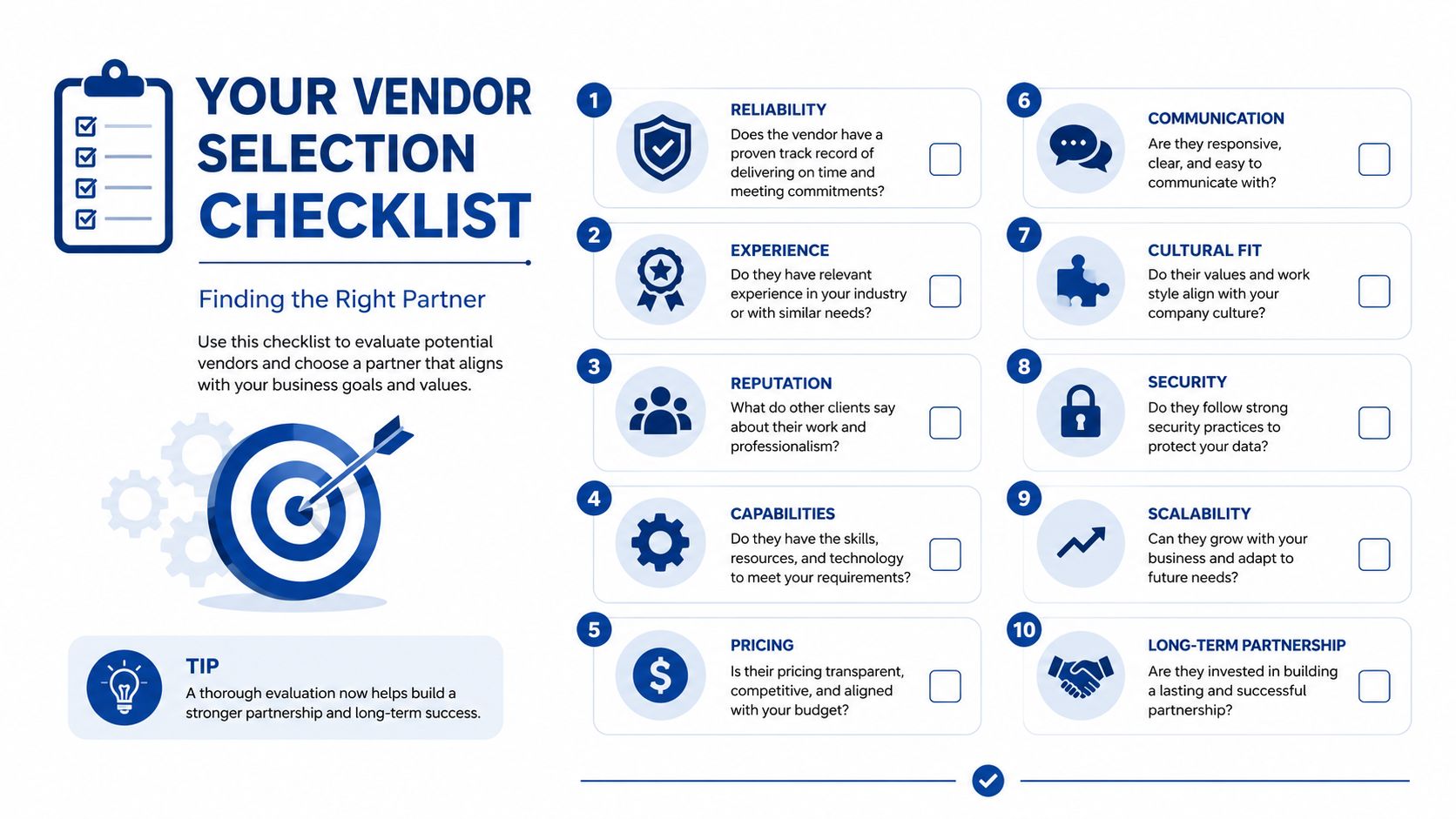
Shortlisting vendors by portfolio alone is where many buyers lose control. A polished case study tells you almost nothing about how a team handles uncertainty, disagreement, defect prevention, or architecture pressure. Those are the issues that determine whether a product partnership holds up after the sales process ends.
Use a checklist that tests operational reality.
Technical depth
Start with the stack, but don't stop there. Ask how the team handles versioning, environments, test coverage, CI/CD, rollback planning, and observability. Modern firms in India commonly work with React, Flutter, Node.js, Python, .NET, Docker, Kubernetes, and cloud platforms, but the important question is whether they apply these tools with discipline or just list them in a capabilities deck.
Look for product-relevant technical thinking:
- Architecture choices: Can they explain why they'd choose one pattern over another?
- Automation maturity: Do they treat testing and deployment as part of engineering, not a separate clean-up phase?
- AI usage: If they use AI-assisted development, can they explain review controls and ownership implications?
Process maturity
You want evidence that quality is repeatable, not heroic. Opsio Cloud's write-up on top IT outsourcing companies in India notes that Indian OPD vendors with ISO 9001 and CMMI Level 3 certifications use structured QA automation, code review protocols, and version control systems that reduce defect rates by 30–40% compared to non-certified providers.
That doesn't mean certification alone guarantees a good outcome. It does mean the vendor has invested in process that can be audited and repeated.
A quick checklist helps here:
- Quality controls: Ask for sample pull request standards, test plans, and defect workflows.
- Delivery rituals: Look for sprint planning, review demos, retrospectives, and release readiness checks.
- Documentation discipline: Architecture notes, handover records, and decision logs matter when people change.
For a broader operational lens beyond software alone, this guide for B2B vendor management is useful because it frames governance and accountability in practical terms.
Business acumen
Here, execution vendors and judgment partners separate.
Give the vendor a problem statement, not a detailed spec. Then listen. Do they ask about target users, commercial priority, activation bottlenecks, retention risks, and rollout constraints? Or do they jump straight to effort estimation?
The right partner will pressure test your assumptions. They may suggest phasing features differently, changing admin workflows, simplifying permissions, or delaying a complex integration until the core user loop is validated.
If your first workshop produces only estimates and no hard questions, keep looking.
A quick visual briefing can help you assess how a partner thinks about delivery trade-offs in practice.
Communication and working style
Communication problems rarely come from accent or timezone alone. They come from missing decision paths, vague ownership, and poor escalation habits. Test this before signing.
Ask each vendor how they handle blocked tickets, conflicting stakeholder feedback, unclear acceptance criteria, and production incidents. Their answers will tell you more than a capability deck ever will.
Use these checks in live conversations:
- Clarity under pressure: Can the delivery lead explain trade-offs without hiding behind jargon?
- Escalation logic: Who decides when scope, schedule, or quality conflict?
- Transparency habits: Will you see risks early, or only after they become delays?
A good partner doesn't just communicate frequently. They communicate usefully.
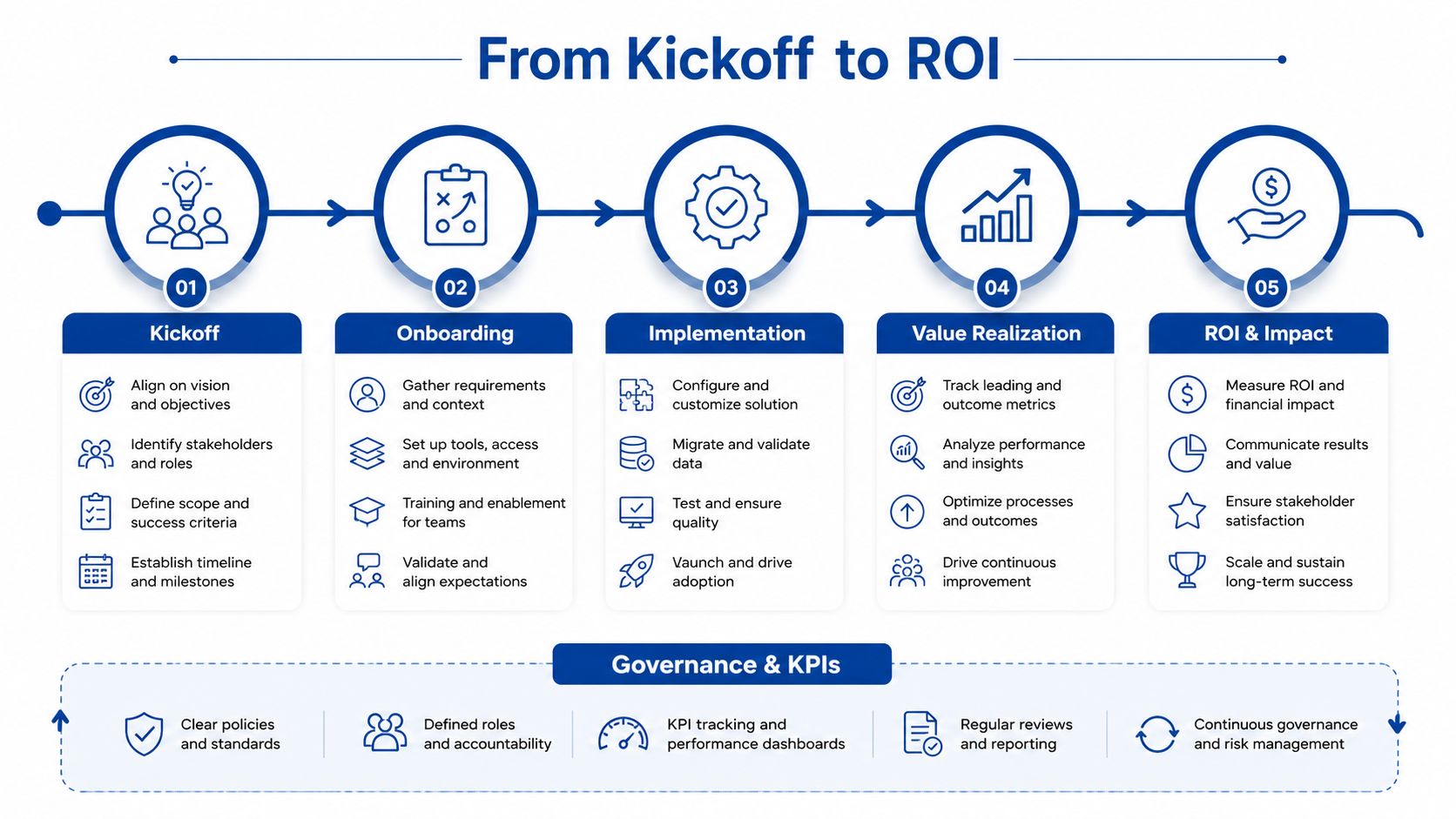
From Kickoff to ROI Onboarding Governance and KPIs
The contract only creates access. It doesn't create alignment. That work starts in onboarding, and weak onboarding can damage a solid vendor choice within the first few weeks.
Teams need context before they need velocity.
Onboarding that reduces rework
The first phase should transfer product understanding, not just credentials and repo access. Share business goals, user segments, current pain points, key workflows, existing constraints, and decision history. If a team knows only the backlog, they'll optimise locally and miss why the backlog exists.
A strong onboarding pack usually includes:
- Product context: problem statement, target users, roadmap assumptions, and open questions
- System context: architecture notes, environments, integrations, release process, and known debt
- Working context: tools, meeting cadence, decision owners, escalation routes, and review standards
Governance that keeps the relationship healthy
Governance shouldn't feel bureaucratic. It should reduce ambiguity. The best setup is usually light but explicit.
Use a rhythm that separates daily movement from strategic decisions. Daily stand-ups deal with execution. Weekly reviews cover scope, risks, and demo output. Monthly steering discussions examine roadmap choices, quality trends, and business signals.
KPIs that reflect product value
A surprising number of outsourced teams are judged almost entirely on effort burned and deadlines met. Those metrics matter, but they're incomplete. A product can ship on time and still create support load, churn, or architecture drag.
Measure success at three levels:
Delivery health
Track sprint predictability, escaped defects, test reliability, deployment stability, and decision turnaround.Product movement
Watch time to release, adoption of key workflows, user feedback patterns, and friction points observed after launch.Technical sustainability
Review code maintainability, backlog of architectural fixes, documentation quality, and ease of onboarding new contributors.
Shared KPIs change behaviour. Teams stop optimising for activity and start optimising for outcomes.
A simple operating cadence
This structure works well for many outsourced product development services relationships:
- Daily: stand-up or async status updates with blockers and ownership
- Weekly: demo, scope review, QA summary, and next-sprint decisions
- Monthly: roadmap review, budget check, and technical risk assessment
- Quarterly: broader business review tied to product direction and capacity planning
The point isn't ceremony volume. It's decision hygiene. When ownership, priorities, and risks stay visible, outsourcing becomes easier to manage and easier to trust.
Common Outsourcing Pitfalls and How to Mitigate Them
Most outsourcing failures don't start with incompetence. They start with assumptions left untested. A founder assumes IP terms are standard. A product lead assumes post-launch support is implied. A team assumes the MVP architecture can stretch into the next growth phase without pain.
Those assumptions are expensive.
Pitfall one, IP ambiguity
Contract language often looks settled until a dispute appears. That's risky because ownership should be explicit from day one. Code, designs, documentation, repositories, credentials, environments, and third-party assets all need clear treatment.
Mitigation is straightforward. Make repository ownership client-controlled. Define IP assignment clearly. Separate reusable vendor accelerators from your product-specific assets. Require handover obligations on termination, not just at project end.
Pitfall two, support costs hidden behind launch
Post-launch work is where many budgets crack. Teams celebrate delivery, then discover that bug fixing, minor enhancements, monitoring, optimisation, and release support were never clearly scoped. The commercial discussion focused on build, not operation.
Mitigate this by defining a support model before development starts. Specify what happens after launch, how defects are classified, how enhancement requests are priced, who monitors incidents, and what transition support looks like if the relationship changes.
Pitfall three, architectural debt from speed-first delivery
This is the most common technical trap. NIX United's guide to outsourced product development benefits and risks notes that 78% of Indian tech founders cite IP ownership, post-launch support costs, and long-term scalability as leading concerns, and 62% of Indian startups that outsourced OPD faced architectural debt or costly re-engineering within 12 months.
The mistake is familiar. Teams optimise for a fast MVP, couple too much logic too early, skip modular boundaries, hardcode workflows that should stay configurable, and defer documentation until it disappears.
Mitigate it by asking for architectural decision records, explicit scalability assumptions, code review standards, and a debt register reviewed regularly with product leadership. Speed is useful. Silent fragility isn't.
A good outsourcing partner doesn't promise zero risk. They make risk visible early enough to manage.
If you're evaluating outsourced product development services and need a partner that can cover MVP builds, product engineering, or flexible team extension, LitSpark Solutions Private Limited is one option to review. The practical test is simple: bring a real product problem, not a polished brief, and judge the quality of the questions, trade-offs, and delivery discipline before you commit.
- outsourced product development services
- product development outsourcing
- dedicated development team
- tech outsourcing india
- litspark solutions