14 min read
Difference Between Hiring and Recruitment: A 2026 Guide
Learn the difference between hiring and recruitment, and how Indian startups and SMEs can choose the right approach for growth in 2026.
By the LitSpark Solutions team · Updated
- AI Automation
- Advertising
- Designing
- Development
- Digital Marketing
- MVP
- Resource Hiring
- Shoot
You have two urgent roles open, a LinkedIn tab showing half-relevant profiles, an Indeed listing collecting applications, and a founder asking why nobody has reached the offer stage. The instinct is to say, “We need to hire.” That diagnosis is often wrong.
The business may need to recruit, not hire. Recruitment builds the pool, sharpens the message, and creates a dependable flow of suitable candidates. Hiring selects one person, secures acceptance, and gets that person productive. Confusing the two leads Indian startups and SMEs to spend all their energy on the final decision while neglecting the pipeline that makes a good decision possible.
India's hiring intent rebounded to 11% in 2026, compared with 9.75% in 2025, the first double-digit figure in two years, according to Indeed's India career guidance. That movement makes talent planning a continuing business activity, not a response reserved for an empty seat.
Table of Contents
- Why Conflating Hiring and Recruitment Slows You Down
- Recruitment and Hiring Defined Through a Real Funnel
- Six Criteria That Separate the Two in Practice
- Who Owns Each Function Inside Startups, SMEs, and Enterprises
- When to Choose Recruitment-Led Pipelines Over Direct Hiring
- Cost, Time-to-Fill, and Quality Metrics That Actually Matter
- How AI and Skills-Based Hiring Are Reshaping the Funnel
- A 7-Point Decision Framework and Action Checklist
Why Conflating Hiring and Recruitment Slows You Down
A founder with two vacancies usually has two different problems. The first is a shortage of qualified people entering the process. The second is a slow or uncertain decision once suitable candidates are already in front of the team. Calling both problems “hiring” hides the point at which the funnel is failing.
Suppose a Bangalore startup needs a product engineer and a performance marketer. The founder writes two job descriptions, shares them in a few groups, reviews applications late at night, and then asks the technical lead to “pick the strongest one”. If the product engineer role attracts weak applicants, the recruitment system is broken. If several good engineers reach the final round but reject the offer, the hiring system is broken.
The remedy differs. A recruitment problem needs better sourcing channels, clearer role positioning, stronger employer branding, and a repeatable screening process. A hiring problem needs faster feedback, sharper interview criteria, realistic compensation, confident offer handling, and disciplined onboarding.
The Indian market makes the distinction practical
Companies are becoming more capability-led rather than volume-led. foundit reported a 15% year-on-year rise in its Hiring Index in December 2025, while also noting that organisations prioritised high-impact roles over bulk hiring in its India hiring trends report. That environment rewards companies that maintain access to scarce skills before a requisition becomes urgent.
The same logic applies geographically. Hiring activity is expanding beyond the usual metropolitan centres, with Tier-2 hubs such as Kochi, Kolkata, Ahmedabad, and Jaipur becoming relevant to talent strategy, as the foundit report indicates. A recruitment plan should therefore decide not only which skills to target, but also where those skills can be found and how candidates in those locations expect to engage.
The useful question isn't “Which word should HR use?” It's “Which stage needs investment today?” Recruitment fills the funnel. Hiring converts the right candidate into an employee.
Recruitment and Hiring Defined Through a Real Funnel
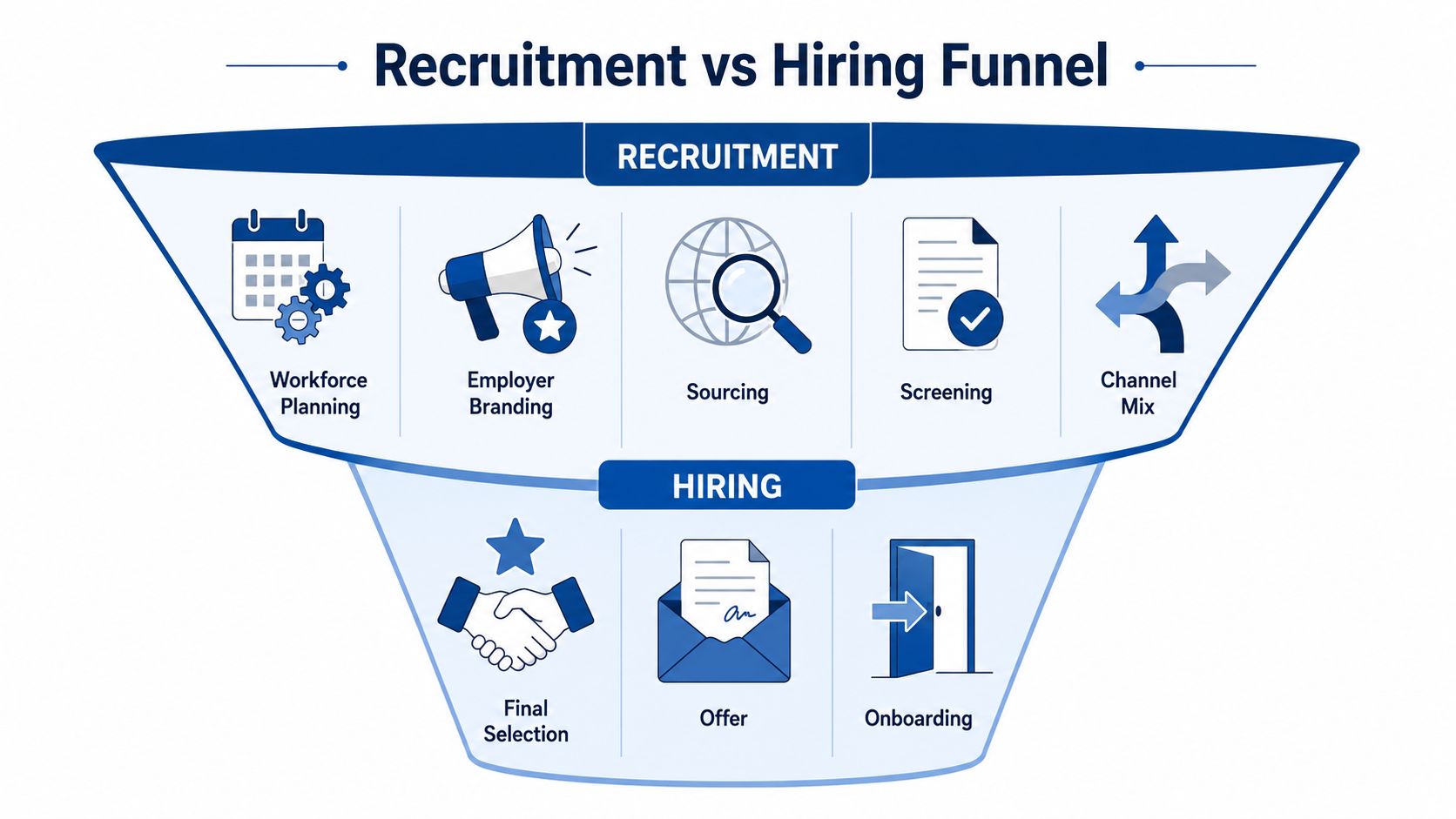
Recruitment is the upstream system that attracts and prepares candidates. It starts with workforce planning and includes employer branding, job descriptions, advertising, professional networks, sourcing, screening, and channel management. SHRM defines recruitment as attracting people in sufficient numbers and with suitable qualifications to apply for jobs, while its recruitment and selection teaching resource describes the wider process of finding, attracting, evaluating, and hiring employees.
Hiring is the downstream conversion event. It begins after qualified candidates enter the process and covers final selection, references where relevant, offer approval, negotiation, offer acceptance, and onboarding. Indian employers generally design these procedures themselves because no specific law prescribes one mandatory recruitment process for private-sector organisations, although employers still operate within the wider labour-code and employment compliance framework described in India's labour law overview.
A senior React developer in Bangalore
Take a Bangalore product company that needs a senior React developer. Recruitment includes mapping the required skills, writing a credible role description, presenting the company's product and engineering culture, publishing the vacancy, and sourcing passive candidates through LinkedIn and GitHub. It also includes reviewing portfolios, checking relevant experience, and deciding whether a coding assessment measures the actual work the person will perform.
Hiring starts when the company has a credible shortlist. The hiring manager runs the final technical and behavioural rounds, the panel compares evidence against agreed criteria, leadership approves the package, and the company presents an offer. Negotiation and joining risk still belong to hiring, not recruitment.
Teams that need a clearer operating model can also review guidance on screening top applicants with WorkSignal, particularly when application review is consuming the time that managers should spend on decision-making.
The one-line distinction: Recruitment creates a qualified choice. Hiring makes, secures, and implements that choice.
A standard HR lifecycle places workforce planning before recruitment, with advertising, CV checks, interviews, and selection feeding the eventual employment decision, as outlined in SHRM's HR lifecycle guidance. Treating the funnel this way gives every role a visible owner and every delay a likely location.
Six Criteria That Separate the Two in Practice
Definitions help only until the first vacancy becomes urgent. Leaders need to compare the work by its operating purpose, owner, cost, speed, and outcome.
| Criterion | Recruitment | Hiring |
|---|---|---|
| Objective | Build a qualified candidate pool | Close a specific vacancy |
| Process | Plan, attract, source, screen, and shortlist | Select, offer, negotiate, and onboard |
| Owner | Recruiter, talent partner, agency, or founder | Hiring manager with HR and leadership |
| Cost structure | Channel, sourcing, employer-branding, and screening spend | Interview time, offer cost, joining support, and onboarding |
| Time focus | Pipeline readiness and stage throughput | Decision speed and offer-to-joining conversion |
| Quality metrics | Source quality, CVs reviewed, and interviews scheduled | Quality of hire, acceptance, retention, and productivity |
Objective and process
Recruitment answers, “Who could do this work, and how do we reach them?” A job description, sourcing map, talent community, or referral campaign belongs here. Hiring answers, “Which person should we employ for this vacancy?” An approved offer letter and onboarding plan belong here.
The distinction matters because a company can have a busy recruitment function without closing roles. It can also close one role quickly while leaving no reusable pipeline for the next similar vacancy.
Ownership and cost
Recruitment often sits with a recruiter, external partner, or founder in a small company. Hiring belongs primarily to the manager who will own the person's output, supported by HR and the leader approving the offer. The artefacts differ too. Recruitment pays for reach and evaluation capacity, while hiring absorbs interview time, compensation decisions, signing incentives where applicable, and onboarding effort.
Recruitment expenditure can support multiple future vacancies. Hiring expenditure is attached more directly to the individual vacancy and the final candidate.
Time and quality
Recruitment should be assessed through candidate flow and bottlenecks. Track where applications arrive, how quickly CVs are reviewed, whether sourcing channels produce relevant profiles, and how many candidates reach interviews.
Hiring should be assessed through conversion and durability. Offer acceptance, joining conversion, quality of hire, and early retention tell you whether the final decision worked. A full funnel can still produce poor employees if the selection bar is inconsistent or onboarding is weak.
The practical conclusion is simple: you don't choose recruitment or hiring as permanent alternatives. You decide which layer deserves the next unit of time and budget.
Who Owns Each Function Inside Startups, SMEs, and Enterprises
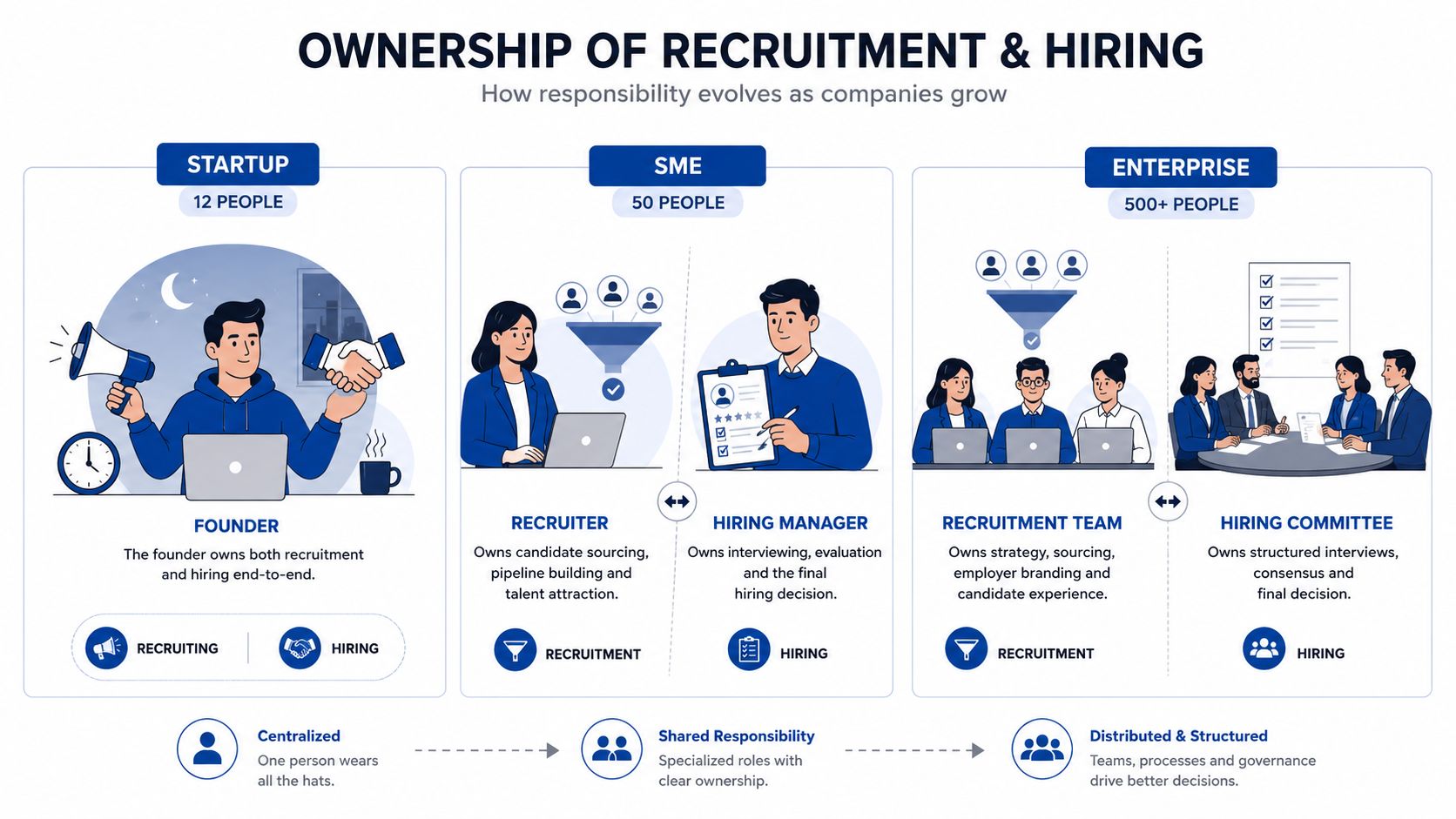
Ownership changes with company size, but the underlying split doesn't. Recruitment builds access to people. Hiring decides who joins and who becomes accountable for the role.
Startup ownership
In a 12-person startup, the founder often owns both functions. That can work for a one-off senior hire, but it fails when recruitment is pushed into evenings and hiring becomes a hurried final call. The founder should define the role and make the final decision, while a named person or external partner maintains sourcing, candidate communication, and interview scheduling.
The founder's job isn't to review every CV. It's to protect the quality of the role definition and the final decision.
SME ownership
In a 60-person SME, the hiring manager should own the outcome, while a part-time HR professional, recruiter, or external partner runs the pipeline. The recruiter keeps the channel mix active, screens against agreed criteria, and presents evidence. The manager conducts structured interviews and provides feedback within an agreed period.
This division prevents the common failure where HR sends profiles without context and managers change the criteria halfway through the process. For practical guidance on how to navigate hiring authority with Underdog.io, focus on decision rights, feedback ownership, and the boundary between candidate generation and selection.
A growing SME should also make its employee proposition visible through a dedicated careers page. Candidates need a direct place to understand the work, expectations, and employer identity before they enter a conversation.
Enterprise ownership
In a 500-plus enterprise, recruitment usually sits with a talent acquisition function that may include sourcing specialists, recruiters, coordinators, and employer-branding staff. Hiring is co-owned by the hiring manager, HR business partner, and the relevant approval group or committee.
The enterprise advantage is specialisation. The risk is fragmentation. A recruiter can fill the top of the funnel while a committee delays the final decision, so service-level expectations must apply to both layers.
A useful hierarchy is:
- Startup: Founder owns hiring, named operator or partner owns recruitment execution.
- SME: Hiring manager owns selection, HR or recruiter owns pipeline performance.
- Enterprise: Talent acquisition owns recruitment, hiring manager and HR share final conversion.
When to Choose Recruitment-Led Pipelines Over Direct Hiring
The right approach depends on whether the business needs a reusable supply of skills or one person quickly. Here are three situations I would handle differently.
A fintech startup building a product line
A fintech company launching a new product shouldn't wait for each engineering vacancy to become urgent. I'd build a six-month skill map covering the technical, product, compliance, and delivery capabilities the launch requires. Then I'd keep sourcing, referrals, communities, and targeted outreach active while converting only the candidates who match an approved near-term role.
This is recruitment-led because the company needs repeated access to related skills. The pipeline also gives the founder information about availability, compensation expectations, and location preferences before the hiring decision becomes time-critical.
An SME facing a support spike
A smaller business scaling customer support for a seasonal demand increase has a different problem. The roles may be similar, the start date may be close, and the business may not need a long-term talent community. I'd use referrals, relevant job portals, a clear screening script, and scheduled interview blocks, then hire directly against the immediate requirement.
That approach doesn't mean skipping recruitment entirely. It means keeping recruitment lightweight while giving most attention to fast selection, offer communication, and joining readiness.
An enterprise opening an engineering hub
An enterprise opening a new engineering hub in Kochi needs both systems. Recruitment should combine campus relationships, LinkedIn outreach, technical communities, and hackathons. Hiring should use structured interview loops, panel scoring, calibrated rubrics, and consistent approval rules.
The same principle applies to other emerging hubs such as Kolkata, Ahmedabad, and Jaipur. Geography should shape the sourcing plan, but it shouldn't weaken the hiring standard. Companies exploring external technical capacity can also assess resource hiring for development teams when permanent recruitment can't keep pace with a delivery deadline.
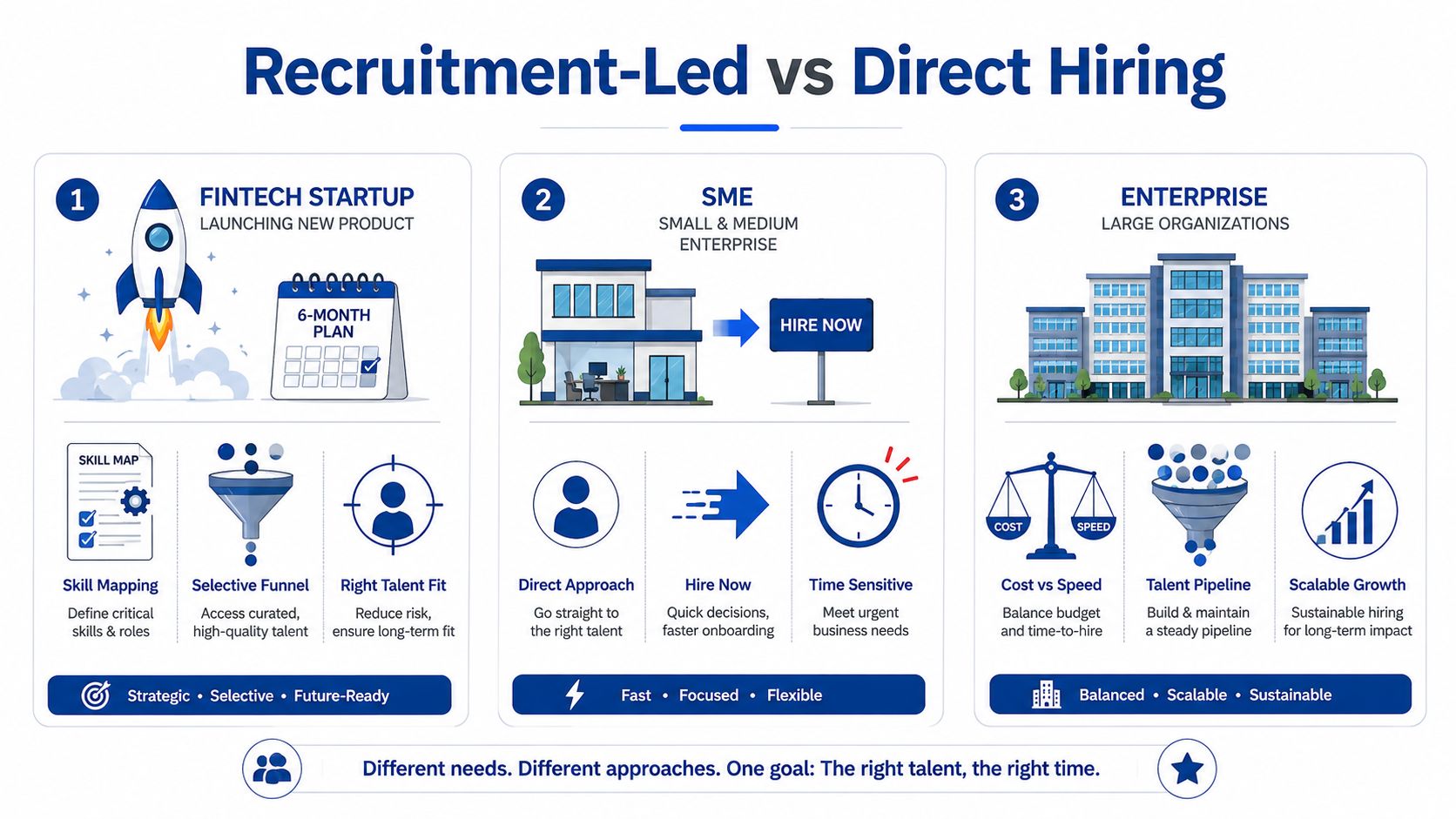
My decision rule: Use recruitment-led pipelines for scarce, repeatable, or strategically important skills. Use direct hiring when the role is immediate, clearly defined, and unlikely to recur soon.
Don't mistake urgency for a strategy. A direct hire may solve today's vacancy, but a pipeline protects the next launch, client commitment, or expansion.
Cost, Time-to-Fill, and Quality Metrics That Actually Matter
A founder doesn't need a dashboard full of vanity measures. Three metric families are enough to locate the problem: cost, time, and quality.
Cost tells you where spend accumulates
Track cost per application and cost per hire, but interpret them differently. Recruitment costs include sourcing channels, job advertising, employer branding, screening capacity, and agency support. Those costs can serve several roles, so they should be assessed against the quality and reuse of the pipeline.
Hiring costs attach more closely to one vacancy. Interview time, assessments, offer negotiation, joining support, and onboarding all consume resources after the candidate has entered the funnel. If application volume is low or channel quality is poor, invest in recruitment. If suitable applications are plentiful but offers fail, improve hiring.
Time needs two clocks
Indian HR metrics guidance places average time-to-hire for professional roles at 40 to 45 days, while top-performing companies compress it to 20 to 25 days, according to Workro's India recruitment analytics guidance. Use those figures as operating reference points, not as permission to rush unsuitable decisions.
Time-to-hire measures the journey to offer acceptance in the cited framework. Time-to-fill is the wider vacancy timeline. Your dashboard should show both the recruitment lead time, including sourcing and screening, and the hiring cycle, including interviews, approvals, offer acceptance, and joining.
Quality exposes false speed
A fast offer isn't a successful hire if the person leaves early or can't reach expected productivity. Track quality of hire, offer acceptance, 90-day retention, hiring manager satisfaction, and time to productivity. India-focused HR guidance separates recruitment activity metrics such as CVs reviewed, interviews scheduled, and source effectiveness from hiring outcome metrics such as quality of hire, offer acceptance, and 90-day retention, as described by Hire22's India HR metrics guidance.
Use this diagnostic:
- Low applications: Fix role positioning, sourcing, employer branding, or channel selection.
- Many applications, few suitable profiles: Fix screening criteria and source quality.
- Good finalists, rejected offers: Fix decision speed, candidate communication, and the offer.
- Accepted offers, weak early retention: Fix role accuracy, onboarding, manager support, and expectations.
How AI and Skills-Based Hiring Are Reshaping the Funnel
AI is improving parts of recruitment, but it hasn't solved hiring. In an India-focused survey reported by Business Standard, 50% of firms use AI for skill assessments and 36% use it for resume screening, as reported in India's 2025 hiring trends coverage.
That use belongs mainly to recruitment. AI can help identify relevant evidence, organise profiles, compare skills against a role specification, and surface candidates from a broader pool. It can support automated lead discovery tools when recruiters need to expand sourcing without manually searching every platform.
The hiring stage still needs judgement. A senior developer may have a non-linear career history that a keyword filter undervalues. A product leader may demonstrate judgement, stakeholder management, and risk awareness in ways that no CV parser can reliably assess. The hiring manager must decide whether the candidate can perform the actual work in the company's environment.
Skills are replacing credential shortcuts
Job listings prioritising competencies over qualifications rose from 4% in 2023 to 14% in 2025, and freshers hiring grew 6% month on month in early 2025, according to foundit and IBEF coverage referenced in the same India hiring discussion. The direction is clear. Recruitment is moving towards demonstrated skills, while hiring must determine whether those skills transfer to the role.
Use AI to reduce repetitive review, not to outsource accountability. A business building its own workflow can evaluate AI automation development services for screening support, assessment flows, and internal talent operations.
Automation should narrow the search. It shouldn't replace the person who owns the hiring decision.
Over-automated hiring creates a dangerous illusion. A dashboard may show shorter screening time and more processed profiles while the company selects weaker candidates for high-impact roles. The correct control is a human review layer, structured evidence, and a clear record of why the selected person fits the work.
A 7-Point Decision Framework and Action Checklist
Use this framework before opening the next requisition. It prevents a company from buying speed when it needs a pipeline.
The seven decisions
Classify the role. Decide whether it's repeatable or one-off. Repeated engineering, support, sales, or delivery roles justify a standing talent pool. A rare executive or specialist appointment may justify a focused search.
Choose breadth or depth. Breadth means reaching enough suitable people across channels and locations. Depth means assessing a smaller group carefully against role-specific evidence. Recruitment usually needs breadth first. Hiring needs depth at the decision gate.
Name separate owners. Assign one person to candidate generation and process movement. Assign the hiring manager responsibility for evaluation, feedback, and the final recommendation. Shared ownership without named accountability creates delay.
Set one metric per stage. Pick a recruitment measure such as qualified profiles per source, then a hiring measure such as offer acceptance or joining conversion. Don't bury an owner under a dashboard that nobody uses.
Decide where AI helps. Use automation for repetitive search, scheduling, profile organisation, and structured assessment support. Keep human judgement for role calibration, senior evaluation, exceptions, and the final decision.
Select the delivery model. Use an internal recruiter when the demand is steady. Use an agency for specialist or confidential searches. Use augmentation when delivery must begin before permanent recruitment is complete. An external partner can supply screened developers or a managed team without forcing the company to treat a temporary capability gap as a permanent headcount decision.
Review quarterly. Reassess the roles that recur, the sources that produce suitable candidates, the stages that stall, and the reasons candidates decline. India's labour market is moving towards ongoing, capability-led planning, so a recruitment model that worked last year may not match the next hiring cycle.
The checklist for this week
- Write the role map: List the skills required now and the skills likely to recur.
- Mark the broken stage: Decide whether the issue is candidate supply, screening, selection, offers, or joining.
- Assign two owners: Put recruitment execution and hiring decisions beside named people.
- Choose the intervention: Improve channels, tighten assessment, speed approvals, or add temporary capacity.
- Review the evidence: Look at source quality, stage timing, acceptance, and early retention before changing the whole system.
LitSpark Solutions Private Limited offers end-to-end recruitment support, screened developer resource hiring, contract-based remote talent, and AI and automation development for businesses that need capability before permanent hiring is complete. If your team needs vetted developers or short-term augmentation while it builds a stronger recruitment pipeline, visit LitSpark Solutions Private Limited and discuss the role, timeline, and engagement model with its team.
- hiring vs recruitment
- recruitment process
- talent acquisition
- SME hiring
- India HR