Resource Hiring12 min read
Resource Augmentation Services: A Practical Guide for 2026
Discover how resource augmentation services help startups, SMEs, and enterprises scale smarter. Learn models, pricing, KPIs, and selection criteria.
By the LitSpark Solutions team · Updated
- AI Automation
- Advertising
- Designing
- Development
- Digital Marketing
- MVP
- Resource Hiring
- Shoot

You're staring at a roadmap that looks achievable on paper, then one missing DevOps engineer, one QA lead on notice, or one data engineer you can't hire fast enough turns the whole plan into a scramble. That's where resource augmentation services stop being a buzzword and start being a practical operating choice, especially in India, where the talent pool is deep but the hiring queue can still slow delivery.
Table of Contents
- The Capacity Problem Every Growing Team Faces
- What Resource Augmentation Services Mean
- Augmentation vs Outsourcing vs Managed Services
- Benefits, Pricing Mechanics, and Hidden Risks in India
- KPIs, SLAs, and a Selection Checklist That Actually Works
- Real-World Use Cases From Startups, SMEs, and Enterprises
- A Decision Framework and Where to Go Next
The Capacity Problem Every Growing Team Faces
A Bangalore product team can have the release plan signed off, the sprint board full, and the business owner asking for a launch date, then hit a wall because the one person who can unblock the work is missing. I've seen that happen with cloud migration, QA automation, and data pipelines. The team is not short on effort, it's short on a specific capability at the exact moment the roadmap needs it.
The core issue is capacity, not headcount
A permanent hire often feels like the “proper” answer, but it solves the wrong problem when the work is temporary, niche, or tied to a deadline. India's IT-BPM sector reached USD 254 billion in FY2024, with exports of USD 199 billion and employment of about 5.4 million professionals, according to NASSCOM, and the country also produces about 1.5 million engineering graduates annually as cited in the industry summary. That depth makes augmentation practical for project-based delivery and short bursts of specialised work.
The hiring process still takes time. One India staffing source puts the average time-to-hire for permanent roles at 39 days, while contract staff can be deployed “in days” in its staffing guidance. When a release is tied to a client demo or a migration window, those extra weeks matter more than most procurement decks admit.
The gap is usually not “we need more people.” It's “we need one person with the right skill, now, and only for this phase.”
Why full-time hiring often misses the moment
A permanent role makes sense when the capability will stay central to the business for years. It works poorly when you need a Kubernetes migration specialist for one quarter, a QA automation lead for a release cycle, or a data engineer to finish a defined sprint. The long-cycle hire can arrive after the pressure point has already passed.
That is why many delivery teams use augmentation as a response to a recurring capacity problem, not as a shortcut. It gives the team the skill it lacks without forcing a permanent org design decision before the need is proven. For teams already weighing whether to build in-house or bring in help, the practical guide for engineering leaders is a useful complement, and the same planning logic applies when assessing resource hiring sources for short-term execution.
What Resource Augmentation Services Mean
Resource augmentation services are a contract-based way to add external professionals to your team for a defined period, while you keep the work inside your own tools, processes, and management chain. The provider supplies the people and handles employment administration, but your team directs the day-to-day work. In practice, that means you are buying capacity with control, not handing over the delivery outcome.
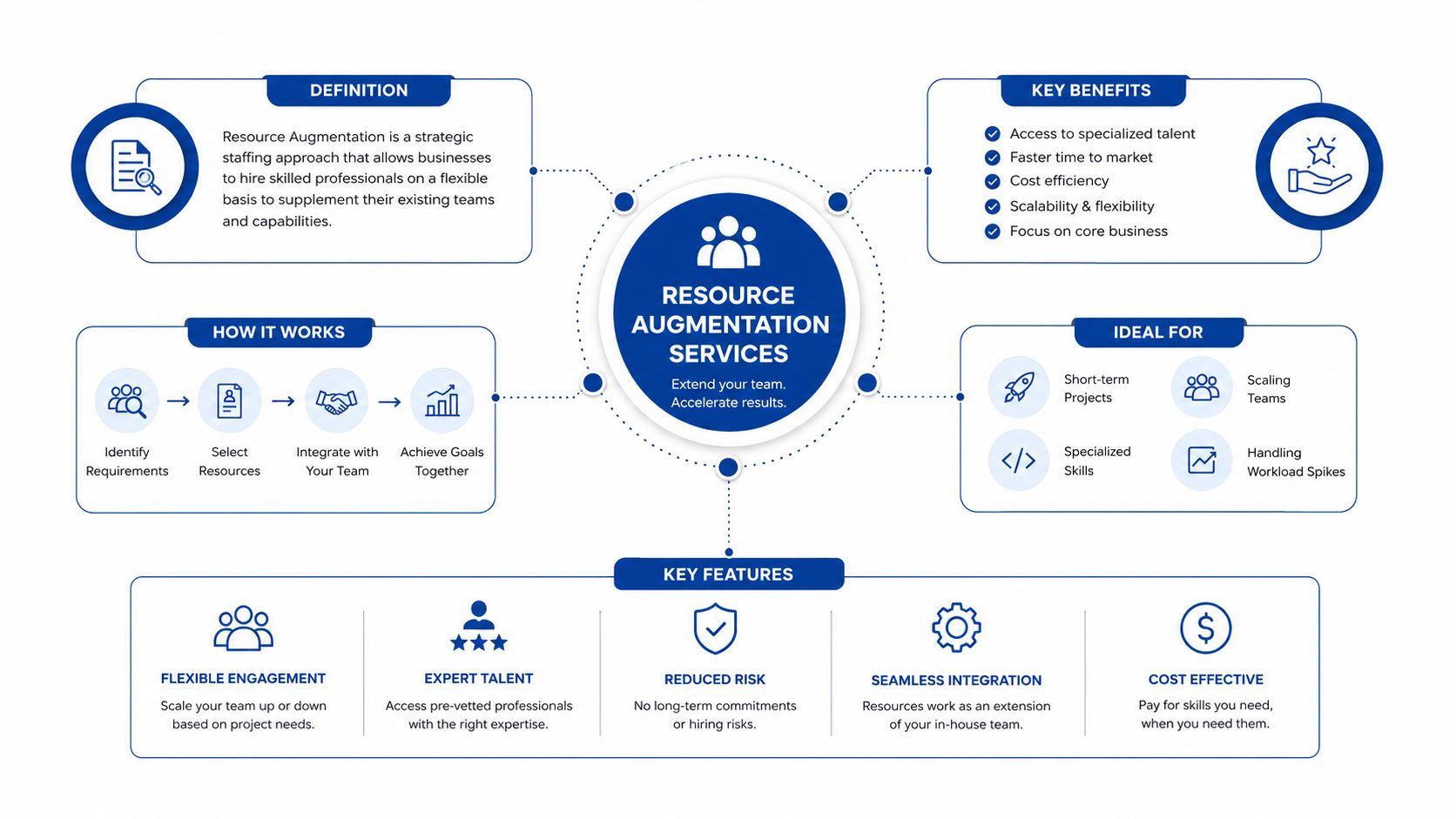
A release team in Bengaluru may need two backend engineers for a product hardening cycle, or a data team in Pune may need a cloud specialist to close a migration gap without changing the org chart. That is the kind of problem augmentation solves. You bring in a specialist for the phase, keep the rest of the team intact, and avoid committing to a permanent seat before the work is proven.
The model fits developers, designers, marketers, testers, and project managers when the scope is clear. It works best when the client already knows the architecture, standards, and release rhythm, but lacks the hands to execute inside that structure. The provider adds the specialist, the client keeps direction, and the team keeps moving.
Why the model is about governance, not just staffing
The augmented specialist is not running a parallel delivery track. They work inside your repositories, your sprint planning, your review gates, and your internal leadership structure. A resource augmentation engagement is therefore a governance-and-control model, not a loose talent marketplace.
That difference matters for trade-offs. If you need to protect product IP, keep code standards consistent, and retain architecture decisions in-house, augmentation gives you that control without forcing a full transfer of responsibility to a vendor. For engineering leaders who want a practical view of how that setup runs day to day, the practical guide for engineering leaders is a useful reference.
Augmentation vs Outsourcing vs Managed Services
The wrong buying decision usually starts with people using these terms as if they were interchangeable. They aren't. Resource augmentation, staff augmentation, full outsourcing, and managed services differ on who directs the work, who owns the output, and how the cost behaves over time.
The control question decides most of the outcome
If your internal team wants to retain architectural control, augmentation is usually the cleaner fit. If the vendor should own delivery and the result matters more than who does the work, outsourcing is closer. Managed services work when an ongoing function needs a provider to own process and performance with formal SLAs. If you compare them only on price, you miss the actual operating trade-off.
| Dimension | Resource Augmentation | Staff Augmentation | Full Outsourcing | Managed Services |
|---|---|---|---|---|
| Delivery control | Client-led | Client-led | Vendor-led | Vendor-led |
| Output ownership | Client retains ownership | Client retains ownership | Often vendor-managed delivery with client-defined scope | Vendor owns the operating function |
| Cost behaviour | Scales with time and skills used | Scales with time and skills used | More outcome-based and scope-based | More subscription-like and ongoing |
| Best fit | Defined capability gaps | Short-term roles inside an internal team | Outcome-based projects | Continuous operational ownership |
A procurement team that wants a deeper lens on staffing cost structures can compare this with the PEO Metrics staffing cost analysis, especially when deciding how much internal oversight they're willing to carry.
Why the models are not substitutes
Augmentation is strongest when the client already has product direction and just needs execution capacity. Outsourcing fits when the vendor should own the build, which is useful for clearly scoped deliverables. Managed services fit recurring functions, such as infrastructure support or ongoing operations, where the buyer wants accountability more than hands-on control.
If the team needs help inside its own sprint rituals, use augmentation. If the team wants a vendor to own the result, use outsourcing or managed services.
Conflating the models creates avoidable friction. A manager who buys augmentation but expects a managed-service style SLA will feel under-served. A product owner who buys outsourcing but expects daily direction will feel ignored.
Benefits, Pricing Mechanics, and Hidden Risks in India
India stays one of the strongest markets for augmentation because the supply side is deep and specialised. The country has a large IT-BPM base, a sizeable industry footprint, and a steady flow of engineering graduates, which is why teams can reach into cloud, cybersecurity, data, and application engineering without waiting through a long hiring cycle. In practice, that means a Bangalore or Pune delivery lead can often place a niche engineer into a client team faster than a permanent requisition closes.
What the pricing usually hides
The visible rate is only part of the cost. One India staffing source says organised providers may charge about ₹650–700 per associate per month for general staffing, while specialised IT staffing margins sit at 8–10% of billing and permanent employment carries a 16.25% statutory burden according to its staffing guidance. Those figures help frame the market, but they still leave out the work around the hire.
Onboarding, access control, compliance checks, code review gates, and manager time all add overhead. A team that forgets those items often compares augmentation against payroll only, then wonders why the final cost is higher than the rate card. If the work touches regulated systems or sensitive customer data, delivery risk usually matters more than the hourly number on the proposal.
The India-specific risks buyers ignore
The first risk is contractor classification and payroll discipline across states. The second is data-access control when external developers work inside sensitive product environments. The third is the dependency trap, where recurring work becomes vendor-owned knowledge because no one documented the decisions well enough to bring the capability back in-house later.
India also has a retention problem in crowded skill pools, especially around cloud, platform engineering, and adjacent specialisms. A recent India-focused paper on GCC growth notes that these ecosystems have intensified competition for specialised talent, with about 1,700 GCC centres and around 1.9 million employees in FY2024 as described in the paper. That pressure shows up in continuity, not just compensation. A blended team can lose rhythm quickly if the provider rotates people too often or if the client has no plan for knowledge transfer.
Where augmentation works best in Indian delivery
The model works best when scope is tight and the exit path is clear. A six-month Kubernetes migration, a short-term QA automation push, or a data-engineering sprint are good fits because the work has a start, finish, and a visible ownership boundary. For cloud-heavy work, a provider with both engineering and delivery discipline, such as cloud and DevOps services, usually makes the operating handoff cleaner than a generalist bench.
The trade-off is simple. Augmentation is a strong choice when you want capability inside your own sprint rituals. It is weaker when the work is open-ended, undocumented, or likely to be repeated for years without an internal owner. If you cannot explain how the work ends, who keeps the documentation current, and who absorbs the knowledge after the contract ends, you are buying future dependency as well as extra capacity.
KPIs, SLAs, and a Selection Checklist That Actually Works
A good augmentation engagement is managed like a delivery partnership, not an ad hoc hire. That means you need a few KPIs that tie directly to work output, a few SLAs that protect you if things go wrong, and a vetting process that tells you whether the partner can operate inside your environment.
What to measure once the team is in motion
The most useful KPIs are usually the least glamorous ones. Sprint velocity tells you whether the added capacity is helping the team move. Defect rate shows whether speed is coming at the cost of quality. Knowledge-transfer milestones tell you whether the engagement is building useful internal capability or just filling seats.
A second set of indicators matters for ramp-up: how fast the specialist becomes productive, how many review cycles they need, and whether they can work within your code standards without constant correction. Those signals tell you more than a generic “are they busy” check ever will.
SLAs and onboarding that keep the contract usable
A sensible SLA set includes replacement terms, response times, code-quality gates, and IP ownership language. None of that is decorative. It protects the client when the first fit is wrong, the work is urgent, or the environment is sensitive.
A practical implementation guide recommends starting with ascertaining requirements, defining the exact number of hires, expertise, and years of experience, then moving into assessment and selection with resume review, technical screening, background and reference checks, and 1–2 client interview rounds in its process guide. Onboarding should then cover system access, stakeholder introductions, KPI setting, and review cadence. That sequence is the difference between a usable engagement and a messy one.
Practical rule: if the vendor won't commit to a ramp-up plan and a replacement path, they're selling you availability, not delivery.
A procurement lead can score each provider on domain fit, vetting depth, replacement SLA, compliance posture, and whether there's a conversion path if the need repeats. That last point matters because recurring demand should usually be converted into a documented capability plan, not left as permanent external dependence.
Real-World Use Cases From Startups, SMEs, and Enterprises
The pattern is easiest to see in actual delivery. Augmentation works when the team knows the target, but the current bench can't cover the skill gap quickly enough. The project shape changes by company size, but the logic stays the same.
A startup needing speed without committing too early
A Bangalore SaaS founder I've worked with needed two full-stack developers for a six-month product launch. The core team had four people already, but the roadmap had more front-end work and integrations than the founders could cover internally. They used augmentation to bridge the launch window, then converted the right people to full-time once the product proved traction.
That's a classic startup fit. You get speed without locking the org into a permanent structure before the product has earned it.
An SME that needed marketing execution with handover
A regional e-commerce brand needed a performance marketing pod to rebuild its ad stack inside a quarter. The internal lead kept ownership of the brand voice and budget decisions, while the augmented specialists handled the rebuild and campaign mechanics. The important part was the handover, because the work only counted if the in-house lead could run it after the contract ended.
For teams comparing specialist vendors in adjacent functions, the same diligence used for augmentation also applies to creative and growth partners. The logic behind how to vet a fractional CMO agency is a useful parallel, because the buyer still needs to separate capability from pitch.
An enterprise with a narrow technical migration window
An established manufacturer brought in a data-engineering squad for a Kubernetes-driven analytics migration. The company did not want permanent headcount for a one-time specialist build, and it didn't want to pull internal engineers off business-critical work. Augmentation bought exact scope and exact duration, while the client kept architectural control and verification gates.
For portfolio visibility, it helps to review a provider's broader work through their portfolio before making the first shortlist. Past delivery is often the best signal of whether they can drop into a real team and stay productive.
A Decision Framework and Where to Go Next
Treat augmentation as a portfolio tool. Use it for volatile, niche, or time-bound work, and add documentation plus conversion paths if the need is likely to repeat. Hire permanent when the capability is core and persistent. Use outsourcing when the vendor should own the outcome.
If your roadmap has a hard deadline, a narrow skill gap, and a team that still wants internal control, augmentation is usually the right first move. If you're trying to build a function that will live inside the company for years, hire. If you want a vendor to own the result, outsource.
LitSpark Solutions Private Limited helps teams add screened Android, iOS, and full-stack developers for contract or full-time engagement with quick onboarding and ongoing management. If you're planning a product build or trying to close a capability gap without slowing delivery, visit LitSpark Solutions Private Limited and compare the engagement model against your current roadmap.
- resource augmentation
- staff augmentation
- IT outsourcing
- hiring models
- dedicated teams