Digital Marketing17 min read
Digital Marketing for SMEs: Your 90-Day Growth Playbook
Your complete guide to digital marketing for SMEs. Learn to master SEO, social, & PPC with a 90-day plan, smart budgeting, and AI tools for real results.
By the LitSpark Solutions team · Updated
- AI Automation
- Advertising
- Designing
- Development
- Digital Marketing
- MVP
- Resource Hiring
- Shoot
Indian SMEs don't have a visibility problem first. They have an execution gap. SMEs contribute over 63% to India’s GDP, yet only 17% have adopted digital marketing, and digitally active SMEs see up to 2.5 times higher revenue growth than their peers according to IBEF. That gap is why digital marketing for smes still gets misunderstood. Too many owners think they need more posts, more ads, or more followers. What they usually need is a tighter system.
The businesses that grow fastest on limited budgets usually do three things well. They pick a small number of channels that match buyer behaviour. They track what those channels produce. They connect marketing activity to operations so leads don't get lost after the click. If you're also exploring tools for implementing AI for lead qualification, that fits this same mindset. Reduce manual filtering, respond faster, and keep sales attention on better-fit enquiries.
This playbook is built for that reality. Not theory. Not vanity metrics. Just what tends to work for Indian SMEs that need leads, repeat business, and cleaner ROI without building a large in-house team.
Table of Contents
- The Digital Divide Facing Indian SMEs
- Mapping Your Customer's Digital Journey
- The Five Core Digital Marketing Channels
- Budgeting and Resourcing Your Digital Growth
- Measuring What Matters for Real ROI
- Your First 90 Days A Practical Roadmap
- Scaling Smart with Automation and Expert Help
- Frequently Asked Questions
- What is the minimum budget to start digital marketing for smes
- If resources are very limited, which channel should an SME prioritise
- How long does SEO take compared with PPC
- Should I outsource or build an in-house marketing team
- What should I track every week
- Do SMEs really need CRM and automation that early
The Digital Divide Facing Indian SMEs
Most SME owners already know they should be online. The central challenge is that many are still treating digital marketing as a side activity instead of a growth function. They post on Instagram when time allows, boost a few posts, maybe run Google Ads for a week, then stop when results feel unclear.
That approach creates uneven outcomes because digital marketing only works consistently when the pieces support each other. Search should feed content. Content should support trust. Ads should accelerate demand that's already being captured somewhere useful. Follow-up should happen without delay. When any one of those breaks, money leaks.
Why the gap is wider than it looks
The visible gap is low adoption. The less visible gap is operational discipline. Plenty of SMEs are present online but still aren't using digital well. They may have a website that doesn't collect leads properly, a WhatsApp number with no routing, or a campaign that generates enquiries that nobody tracks after the first call.
Practical rule: If you can't tell which channel brought your last five qualified leads, your problem isn't reach. It's visibility into performance.
Digital marketing for SMEs differs from enterprise marketing in this specific regard. Larger firms can absorb waste for longer. SMEs can't. A wrong channel mix, weak landing page, or delayed response time doesn't just hurt efficiency. It directly affects monthly cash flow.
What good execution usually looks like
Strong SME setups tend to share a few traits:
- Clear commercial goal: Generate store visits, leads, demo requests, repeat purchases, or distributor enquiries.
- Tight channel focus: One search channel, one trust-building channel, one retention channel.
- Basic measurement: Source tracking, lead status, and conversion review.
- Operational follow-through: CRM, spreadsheet, or workflow that ensures every lead is answered and tagged.
Owners don't need a complicated marketing stack on day one. They need a working system that connects customer intent to business action. That's the difference between random activity and scalable growth.
Mapping Your Customer's Digital Journey
If your physical shop had no signage, no staff, no billing counter, and no follow-up after a customer asked a question, you would expect poor sales. Many SME digital setups look exactly like that. The customer journey is the online version of that shop experience.
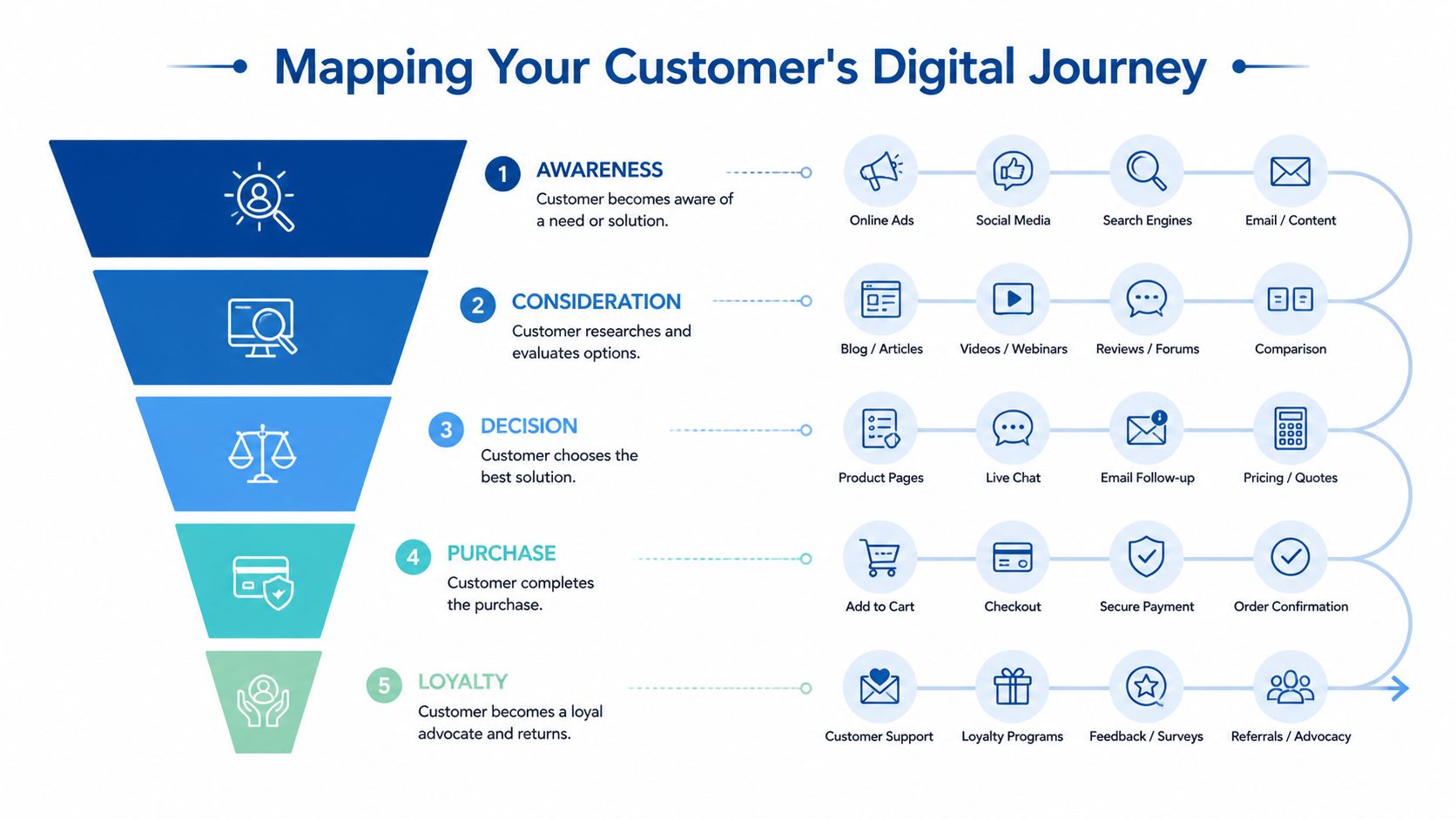
Think like a shop owner
A useful way to map the journey is to ask five questions.
How do buyers first notice you?
Search, Instagram reels, Google Business Profile, referral links, marketplace discovery, LinkedIn posts.What makes them stay long enough to consider you?
Product pages, service pages, reviews, portfolio, short videos, pricing clues, FAQs.What pushes them to enquire or buy?
Offer clarity, trust signals, easy checkout, lead form, click-to-call, WhatsApp button.What happens right after action?
Confirmation message, call back, email, catalogue, demo scheduling, order updates.Why do they return or refer?
Good fulfilment, follow-up messages, support quality, reminders, reorder prompts.
A lot of SMEs spend everything on step one and almost nothing on steps three to five. That creates traffic without conversion, and enquiries without retention. If you need a simple framework for documenting touchpoints, Big Moves Marketing's journey mapping guide is a useful reference.
Two common SME journey maps
For a D2C brand, a customer may first discover the business through Instagram or Google search, land on a category page, browse reviews, add to cart, leave, then return through a remarketing ad or email before purchasing. In that case, creative, landing page quality, cart recovery, and post-purchase retention matter more than raw follower count.
For a B2B service business, the path is slower. A buyer may search for a solution, visit the website, read one service page and one proof page, leave, then come back after seeing a founder’s LinkedIn post or receiving a follow-up email. Here, the goal isn't impulse purchase. It's credibility and consistent follow-up.
A channel isn't good or bad by itself. It either matches the stage of buyer intent, or it doesn't.
A practical way to map it this week
Use a simple sheet with five columns: Stage, Customer question, Touchpoint, Business asset, Owner. Then fill it manually.
For example:
| Stage | Customer question | Touchpoint | Business asset | Owner |
|---|---|---|---|---|
| Awareness | Who offers this nearby? | Google search | Google Business Profile | Founder |
| Consideration | Can I trust them? | Website | Testimonials page | Marketing |
| Action | How do I enquire? | Landing page | Form and WhatsApp CTA | Sales |
| Delivery | What's next? | Email or call | Confirmation workflow | Ops |
| Loyalty | Should I return? | WhatsApp or email | Repeat offer or support check-in | Support |
That exercise usually exposes the missing link faster than any brainstorming session.
The Five Core Digital Marketing Channels
Most SMEs don't need every channel. They need the right mix of channels that fit how buyers discover, compare, and purchase. These five are the core set because they cover intent, trust, reach, speed, and retention.
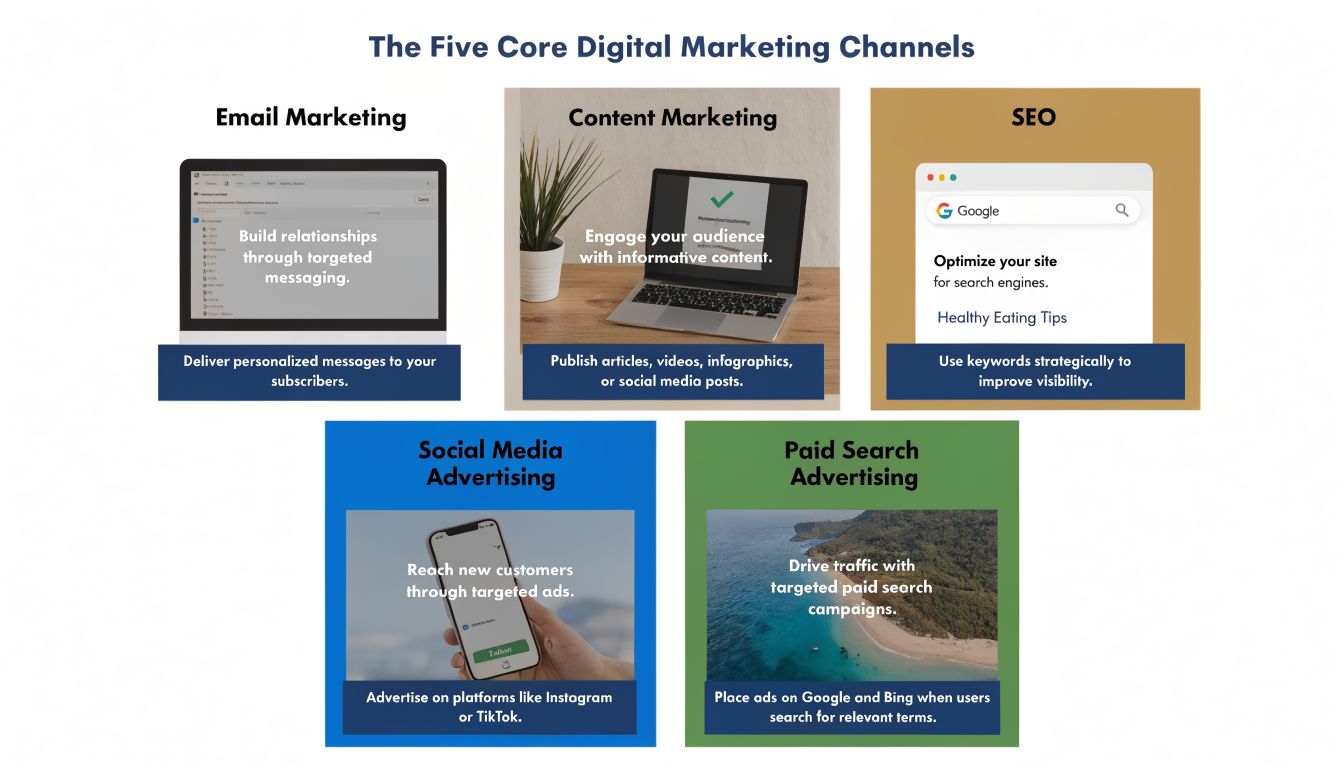
What each channel is good for
SEO
SEO helps buyers find you when they already have intent. For local businesses, that often starts with local search and map visibility. For service firms, it starts with problem-based pages and strong service copy.
Quick win: clean up title tags, service descriptions, and your Google Business Profile categories. If you're a local business, make sure phone, address, and working hours match across platforms.
Content marketing
Content answers buyer questions before a sales call happens. It reduces friction. A buyer who has already read your pricing logic, delivery process, or service scope arrives warmer.
Quick win: publish one practical page or blog post answering a sales question you repeat every week. Good examples include pricing factors, timelines, use cases, or comparisons.
Social media
Social works well for attention, proof, and frequency. It keeps your brand visible between search visits and referrals. For many Indian SMEs, it also acts as a lightweight trust layer because buyers often check Instagram or LinkedIn before responding.
Quick win: stop posting generic festival creatives as your main strategy. Post one customer problem, one proof point, and one behind-the-scenes operational insight each week.
PPC advertising
PPC gives speed. It is useful when you need immediate testing, lead flow, seasonal demand capture, or support for a new product launch. It fails when ad traffic lands on weak pages or when follow-up is slow.
Quick win: build tightly grouped campaigns around high-intent keywords instead of broad terms. Send each ad group to a page that matches the exact offer.
Email marketing
Email remains one of the strongest retention and nurturing channels because you control the audience. It is especially useful for long consideration cycles, abandoned enquiries, repeat orders, and post-purchase education.
Quick win: set up a basic three-part sequence. Confirmation, reminder, follow-up. Most SMEs skip this and lose warm prospects without realizing it.
Why integration changes the outcome
Front-end activity alone doesn't solve growth. Indian SMEs often face a 40% productivity gap because they focus on customer-facing marketing tools without integrating them with backend systems like inventory or CRM. Integrated strategies have been shown to yield 2.5x higher sales growth according to the World Bank analysis.
That shows up in practical ways:
- Ads without CRM integration: leads come in, but no one knows who followed up.
- SEO without stock or service alignment: pages rank for offers you can't fulfil cleanly.
- Social campaigns without remarketing logic: attention builds, then disappears.
- Email without customer tags: everyone gets the same message, including past buyers and dead leads.
If you want a done-for-you option that combines channel execution with broader business support, LitSpark’s digital marketing services cover SEO, social, content, PPC, email, and analytics within a wider digital delivery setup.
Don't judge a channel by clicks alone. Judge it by whether the lead moved into a tracked sales process.
Budgeting and Resourcing Your Digital Growth
Most SMEs ask the wrong budget question. They ask, "How much should I spend?" The better question is, "What am I funding first. Reach, conversion, or follow-up?" If your website is weak and your response process is inconsistent, increasing ad spend just exposes the problem faster.
Two budgeting models that work
The first model is percentage of revenue. This works when the business is stable and management wants a predictable range. It helps avoid random monthly decisions, but it can underfund growth if a business is launching something new.
The second model is goal-based budgeting. This starts with a commercial target, then works backward. If you need more demo requests, store visits, or direct orders, you decide what assets and channels are required to generate them. This model is better when the business is entering a new market, adding a product line, or trying to build a pipeline from scratch.
For lean SMEs, a blended approach usually works best:
- Base layer: fund the assets you own, such as website improvements, landing pages, basic content, email setup.
- Testing layer: allocate spend for one or two acquisition channels.
- Response layer: make sure someone owns follow-up, reporting, and lead handling.
Sample monthly digital marketing budgets for SMEs
These aren't benchmark figures. They're planning examples to help structure thinking.
| Business Type | Google Ads (PPC) | Social Media Ads | Content/SEO Tools | Email Marketing |
|---|---|---|---|---|
| Local bakery | Low | Medium | Low | Low |
| D2C fashion brand | Medium to High | High | Medium | Medium |
| B2B software startup | Medium | Low to Medium | High | Medium |
The trade-off is straightforward. Local businesses often get better short-term value from maps, local search intent, and promotions. D2C brands usually need stronger creative testing and remarketing. B2B firms tend to win through content depth, landing page quality, email nurture, and selective paid search.
Where owners usually overspend and underspend
SMEs often overspend on top-of-funnel activity because it feels visible. Boosted posts, broad ads, and constant redesign work look like momentum. They often underspend on the less glamorous parts that improve outcomes, such as landing pages, CRM hygiene, lead routing, and email follow-up.
A smarter resourcing split looks like this:
- Invest time first in offer clarity, pages, and tracking.
- Spend money next on channels that capture or test intent.
- Add tools carefully only when manual processes are already breaking.
If your in-house team is thin, flexible staffing can be more practical than permanent hiring across every role. A model like resource hiring for specialised digital and technical support can help when you need execution capacity without building a full department.
Measuring What Matters for Real ROI
A campaign can look busy and still lose money. Likes don't pay salaries. Traffic doesn't prove demand. Even leads can mislead if half of them are low intent or never contacted. Digital marketing for smes only becomes reliable when measurement ties activity to revenue logic.
The metrics that deserve attention
You don't need a huge dashboard. You need a handful of numbers that influence decisions.
- Customer Acquisition Cost: how much you spent to acquire a paying customer.
- Customer Lifetime Value: what that customer is worth over time.
- Return on Ad Spend: whether paid media is producing enough value relative to spend.
- Lead-to-customer rate: whether leads are becoming business.
- Qualified lead volume: how many enquiries are commercially relevant.
A local clinic, for example, might get fewer leads from search than from social. But if search enquiries book at a much higher rate, that channel is stronger even with lower volume. A D2C brand may find that one campaign drives purchases while another mostly drives first visits that need retargeting before conversion.
If a report doesn't help you cut waste or back a profitable decision, it isn't a useful report.
Why attribution stops budget waste
SMEs that implement multi-touch attribution to track the entire customer journey can identify which channels drive the highest-quality leads, allowing them to reallocate budgets and directly improve ROI by focusing on proven converters according to Symphonic Digital's guidance on SME marketing attribution.
That matters because buyers rarely convert from a single touchpoint. Someone may click a Google ad, leave, return through branded search, read a service page, then enquire after seeing a remarketing message or email. If you credit only the last click, you may cut a channel that was doing important work earlier in the journey.
A lean measurement stack
For most SMEs, a practical setup includes:
- Analytics platform: track page views, conversions, and traffic source.
- Lead capture tracking: forms, calls, WhatsApp clicks, demo requests.
- CRM or lead sheet: mark status as new, contacted, qualified, proposal, won, lost.
- Weekly review: inspect channel quality, not just channel volume.
The discipline is simple. Keep what produces qualified demand. Fix what leaks conversion. Cut what looks active but doesn't move revenue.
Your First 90 Days A Practical Roadmap
The fastest way to waste an SME budget is to do everything at once. A better approach is to build in phases. The first month creates basic control. The second month creates movement. The third month creates judgement.
Days 1 to 30 build the foundation
Start with the assets that make every later action more useful. That usually means your website, lead paths, tracking, and business profiles.
Use this checklist:
- Claim and clean your profiles: Google Business Profile, LinkedIn page, Instagram, marketplace listings if relevant.
- Fix lead paths: every important page should have one clear call to action. Call, WhatsApp, form, or checkout.
- Set up analytics and conversion tracking: track enquiries, calls, purchases, and primary clicks.
- Create one core page or piece of content: a strong service page, category page, or FAQ article that answers a buyer problem.
- Build a basic lead tracker: even a shared sheet is enough if it includes source, date, owner, and outcome.
At this stage, don't chase volume. Chase clarity. Your goal is to remove the obvious blockers that make marketing underperform.
Days 31 to 60 launch and learn
Now start generating signals. Pick a tight set of channels based on the business model.
For a local service business, that may mean local SEO actions, Google Ads for high-intent terms, and review collection. For a D2C brand, it may mean product-focused paid social, search campaigns for buying intent, and abandoned enquiry or cart follow-up.
Priorities for this phase:
- Launch one search campaign around specific intent.
- Publish consistently on one social platform that buyers check.
- Set up email or WhatsApp follow-up for new enquiries or customers.
- Test one landing page variation if paid traffic is active.
- Review search queries, comments, and sales questions for content ideas.
Don't judge too early based on surface metrics. Early data is for pattern spotting. Which offers attract clicks. Which keywords attract irrelevant traffic. Which page gets visited but fails to convert.
Early campaigns aren't just for sales. They're for learning where intent is strongest and where friction is highest.
Days 61 to 90 optimise and scale
The third phase is where many SMEs either get disciplined or drift back into guesswork. By now you should have enough information to make decisions on quality, not opinion.
Use a simple decision framework:
| Situation | What to do |
|---|---|
| Traffic is coming, but leads are weak | tighten targeting, adjust copy, improve forms |
| Leads are strong, but close rates are low | inspect sales follow-up, pricing communication, trust gaps |
| Social engagement is healthy, but enquiries are low | add stronger offers, clearer CTAs, better landing destinations |
| Email opens happen, but action is low | improve message relevance and next-step clarity |
Three actions matter most in this period:
- Double down on the strongest path: not the loudest one, the one producing qualified outcomes.
- Remove low-quality work: broad campaigns, weak keywords, repetitive posts with no business purpose.
- Document the process: what gets published, who follows up, what gets reviewed weekly.
By day 90, you don't need a perfect machine. You need a repeatable operating rhythm. One that tells you where leads come from, what they cost, how they convert, and which step is breaking when results slow down.
Scaling Smart with Automation and Expert Help
Once the basics are working, the next bottleneck is usually capacity. The founder is approving creatives, the sales team is chasing cold leads, someone is manually sending follow-ups, and reporting lives in three different places. That's when scale starts to feel messy.
What to automate first
Automation works best when it removes repetitive work that doesn't need human judgement every time.
Start with:
- Lead routing: send each new enquiry to the right person or inbox immediately.
- Follow-up sequences: confirmation messages, reminder emails, quote follow-ups, demo reminders.
- Audience segmentation: separate new leads, active customers, repeat buyers, and inactive contacts.
- Basic reporting: centralise campaign data and lead status into one view.
When those are in place, small teams can respond faster and more consistently. That matters because many SME losses happen after the lead arrives, not before. If you want to connect workflows across marketing and operations, business automation services are one practical route.
How to fill the skills gap without overhiring
Most SMEs don't need a full-time SEO specialist, paid ads manager, copywriter, designer, analyst, and automation lead all at once. They need access to those skills at the point of need.
That creates three realistic talent models:
| Model | Best use | Main trade-off |
|---|---|---|
| In-house | daily brand control and fast communication | limited skill depth across channels |
| Agency | broader execution across functions | less embedded operational context |
| On-demand specialists | targeted expertise for specific problems | needs strong coordination from the business |
The right choice depends on maturity. Early-stage SMEs often benefit from flexible specialists because the workload is uneven. A website fix this month, ad account cleanup next month, landing page copy the month after that. Full-time hiring is often too rigid for that pattern.
The key is not to outsource thinking. Keep strategy ownership close to the business. Bring in expert help for execution gaps, technical setup, creative production, or automation work that your current team can't handle cleanly.
Frequently Asked Questions
What is the minimum budget to start digital marketing for smes
Start with a controlled budget that you can sustain for a few months without panic. Fund the basics first. Website fixes, tracking, one landing page, one acquisition channel, and one follow-up channel. A tiny ad budget on a broken funnel is usually wasted.
If resources are very limited, which channel should an SME prioritise
Choose the channel closest to buying intent. For many local or service businesses, that's search. For some D2C brands, that may be paid social if the product is highly visual and impulse-friendly. If customers already know the problem they want solved, search usually deserves priority over awareness-led posting.
How long does SEO take compared with PPC
PPC can produce signals quickly because visibility starts once campaigns go live. SEO takes longer because rankings and page trust build over time. The practical move for many SMEs is to use PPC for immediate testing while building SEO assets that reduce long-term dependence on paid traffic.
Should I outsource or build an in-house marketing team
Don't decide this as a philosophy question. Decide it based on workload and skill gaps. If you need constant daily output, in-house may make sense for some roles. If needs are specialised or uneven, external support is often more efficient.
What should I track every week
Track qualified leads, source, conversion status, cost by channel, and follow-up speed. If you only track reach or engagement, you won't know whether marketing is helping sales or just creating noise.
Do SMEs really need CRM and automation that early
They need a system, not necessarily a heavy platform. A CRM becomes important when enquiries start slipping, multiple people handle leads, or repeat follow-up becomes inconsistent. Automation becomes useful the moment manual work starts causing delays or duplication.
LitSpark Solutions Private Limited helps SMEs combine product development, digital marketing, automation, and flexible technical resourcing under one roof. If your business needs a practical setup that connects campaigns with operations, LitSpark Solutions Private Limited is one option to evaluate.
Made with Outrank tool
- digital marketing for smes
- sme marketing india
- small business marketing
- digital marketing strategy
- litspark