Digital Marketing15 min read
Digital Marketing for Startups: 2026 Growth Guide
Master digital marketing for startups with actionable SEO and content strategies designed to drive measurable growth on a lean budget in 2026.
By the LitSpark Solutions team · Updated
- AI Automation
- Advertising
- Designing
- Development
- Digital Marketing
- MVP
- Resource Hiring
- Shoot
For any startup, digital marketing isn't just a "nice-to-have" item on a checklist; it's the very engine of survival and growth. It’s how you find those crucial first customers, prove your idea has legs, and start scaling—all without the luxury of a massive budget. The key is to focus on smart, high-impact activities that give you quick feedback and build long-term momentum.
Table of Contents
- Why Smart Digital Marketing Is Your Startup’s Lifeline
- Building Your Organic Growth Engine with Content and SEO
- Acquiring Early Customers with Strategic Paid Media
- Turning Leads into Customers with Social and Email
- Measuring What Matters for Startup Growth
- Straight Answers to Your Toughest Startup Marketing Questions
Why Smart Digital Marketing Is Your Startup’s Lifeline
Most marketing advice feels like it’s written for companies with deep pockets. But for a startup, the game is different. You need to get the most bang for every buck. A focused digital marketing plan is what turns a shoestring budget into a growth machine. The goal isn’t to shout from every rooftop; it’s to whisper in the right ears—the ears of your first loyal customers.
This is where the idea of a Minimum Viable Growth Stack comes into play. Think of it as a lean, powerful toolkit of channels chosen specifically for rapid learning and measurable results. Instead of trying to do everything at once, you concentrate your efforts on a few key areas that will actually move the needle. For example, a B2C startup might focus on Instagram ads and email, while a B2B SaaS company might prioritize LinkedIn and SEO. If you're just getting started, this guide on building an early digital marketing foundation is a great resource for laying the groundwork.
The diagram below visualises how these core components fit together, creating a system that balances immediate wins with future growth.
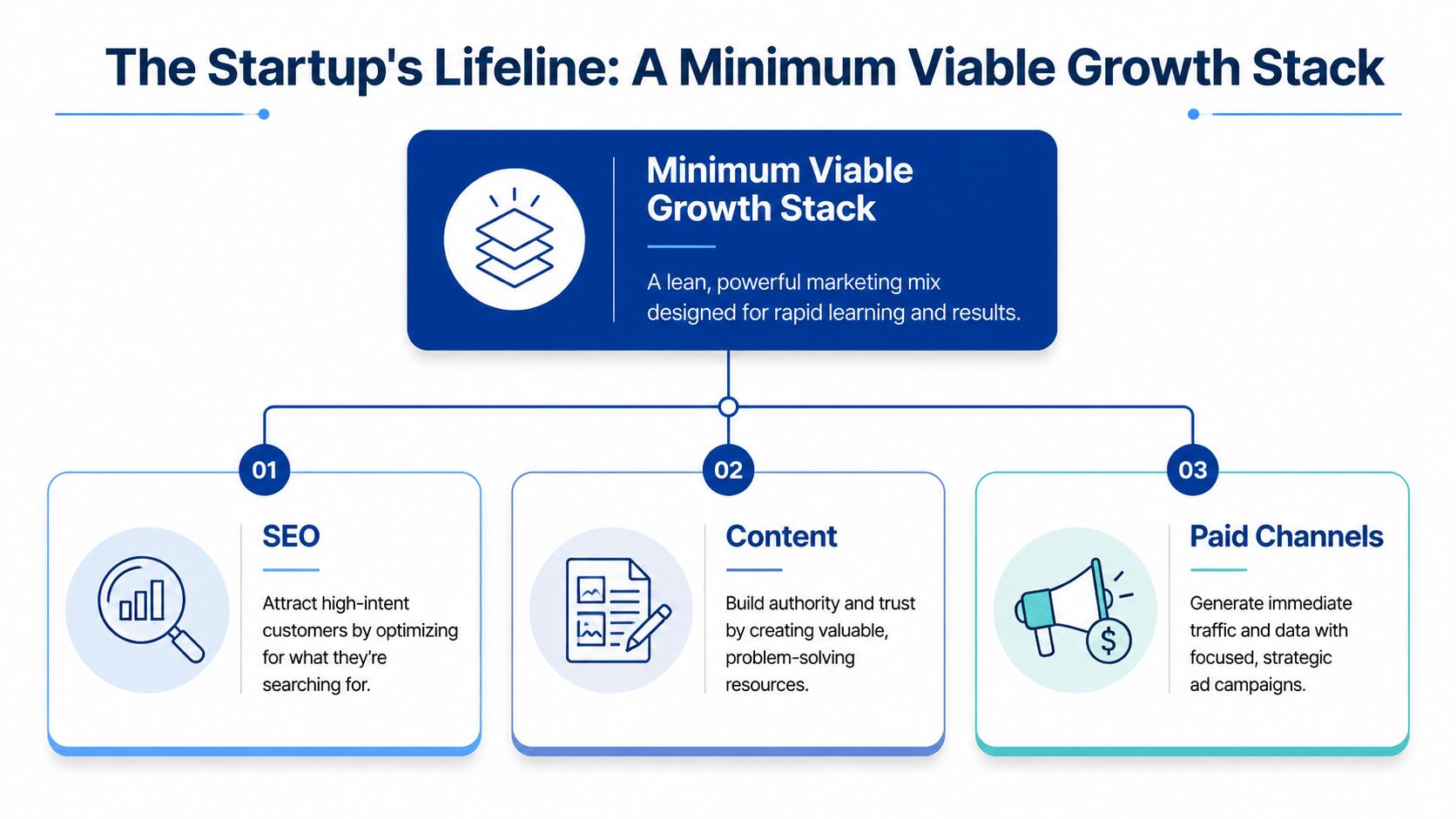
As you can see, a solid startup marketing strategy balances long-term assets like SEO and content with the instant data you get from paid channels.
Actionable Insight: Early-stage digital marketing isn't about launching flashy, expensive campaigns. It's a game of discipline. The real objective is to find your first 100 customers using clever, data-driven tactics, not by simply outspending the competition.
For example, a B2B SaaS founder I worked with found their first 15 paying users not from a $10,000 Google Ads campaign, but from one incredibly detailed blog post ranking for "inventory management software for small jewelry makers." Similarly, a new D2C brand used a tiny $500 budget on highly targeted Instagram lookalike ads to validate their product's appeal, achieving a 3.5x return on ad spend before ordering their next batch of inventory.
This playbook is designed to help you build and run a plan that delivers exactly that—real business results, right from day one.
Building Your Organic Growth Engine with Content and SEO
Let's talk about sustainable growth. Forget pouring your entire budget into ads that disappear the moment you stop paying. The most powerful, long-term asset you can build is an organic growth engine, and it runs on two key fuels: great content and smart SEO.
I'm not talking about old-school keyword stuffing or trying to game the system. This is about establishing your startup as the go-to resource in your niche. It’s about becoming a magnet for people who are already looking for what you do.
Think less about generic keywords and more about the actual problems your customers face. What are they typing into Google at 2 AM? What questions are they asking in forums? A free tool like Google Trends is a fantastic starting point for uncovering these "problem-aware" topics. When you answer these questions, you’re not a salesperson; you're an expert guide.
Create Content That Builds Authority
So, how do you do this effectively? The answer I’ve seen work time and time again is building content clusters.
It’s a simple but incredibly effective model. You start with a massive, comprehensive "pillar page" that covers a broad, important topic from top to bottom. Then, you create several shorter "cluster" articles that dive deep into specific sub-topics, all linking back to the pillar.
Here’s a real-world example. Imagine you’re a B2B SaaS startup with project management software:
- Your Pillar Page: "The Ultimate Guide to Agile Project Management for Small Teams" (4,000 words, covers everything).
- Your Cluster Articles: "How to Run Your First Sprint Planning Meeting" (1,200 words, links to pillar), "Best Tools for Tracking Team Velocity" (1,500 words, links to pillar), and "Common Agile Mistakes to Avoid" (1,000 words, links to pillar).
This structure signals to search engines that you have serious expertise on the subject, which helps you rank for the entire topic, not just one or two keywords. A startup we worked with used this model and saw their organic traffic for their core topic increase by 250% in six months, generating 50+ qualified leads per month from that content alone.
If you're looking for more frameworks on building a strategy like this, you can find a ton of actionable advice on our https://litspark.solutions/blogs.

Why SEO Is a Non-Negotiable Investment
In the current market, content and SEO aren't just "nice to have"—they're fundamental for growth. The competition is fierce, with data showing that nearly 90% of marketers plan to maintain or boost their SEO spend.
And here's why: less than 1% of people ever click past the first page of Google. If you’re not there, you’re practically invisible. The upside is huge. For B2B, organic search drives over 50% of all website traffic. For a startup watching its budget, that's an incredibly efficient channel.
Result Example: A well-executed content and SEO strategy doesn’t just attract traffic; it attracts the right traffic. One of our fintech startup clients saw their cost-per-lead from organic search drop to $15, while their paid ad CPL was over $120. That’s the power of attracting customers who are already qualified because they’re actively seeking the solutions you provide.
To help you connect the dots between your efforts and the results, here's a simple action plan.
Startup SEO Content Action Plan
This table outlines how specific content actions lead directly to tangible SEO benefits and, most importantly, positive business outcomes.
| Action Item | SEO Benefit | Business Outcome |
|---|---|---|
| Research "Problem-Aware" Keywords | Targets high-intent searches. | Attracts qualified leads, not just traffic. |
| Create a Pillar Page on a Core Topic | Establishes topical authority with Google. | Becomes a long-term lead-generating asset. |
| Write Supporting Cluster Articles | Increases long-tail keyword rankings. | Captures highly specific search queries. |
| Build Internal Links Between Content | Improves site navigation and distributes "link equity." | Increases user engagement and session duration. |
| Acquire Relevant Backlinks | Boosts domain authority and trust signals. | Improves overall search engine rankings. |
Each step is a deliberate move to build your brand’s authority and turn your website into a powerful, self-sustaining growth asset.
For those in the SaaS world, mastering SEO is non-negotiable. The strategies can get quite specific, so I highly recommend diving into resources like SubmitMySaas's guide for SaaS founders to gain a competitive edge. Ultimately, investing in your organic engine is an investment in your startup's long-term, scalable success.
Acquiring Early Customers with Strategic Paid Media
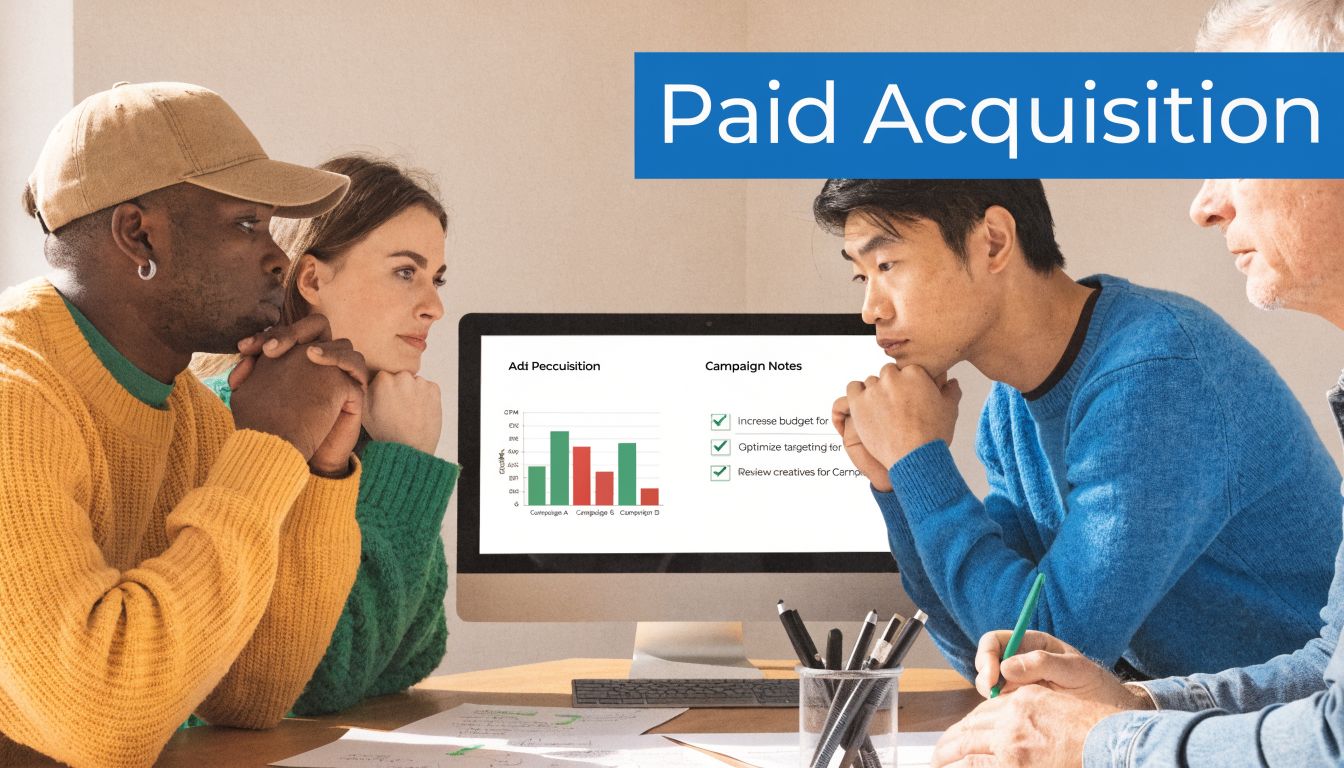
So, your organic marketing efforts are starting to show signs of life. That’s fantastic, but it’s a slow burn. If you want to really kick things into gear, it’s time to talk about paid media. Paid ads deliver two things organic channels can't: speed and immediate data. For a startup, this isn't about outspending the competition. It's about scoring quick wins, proving your model works, and gathering the intel you need to scale intelligently.
One of the first questions I always get from founders is about budget. Forget the old-school advice of earmarking 7% to 10% of revenue for marketing—that's useless when you're pre-revenue. A much smarter way to think about it is to work backwards from your goals. Let's say your Customer Lifetime Value (LTV) is $1,000. To maintain a healthy 3:1 LTV:CPA ratio, your target Cost Per Acquisition (CPA) should be no more than $333. This gives you a clear data point to launch small, laser-focused test campaigns against.
This is especially critical as digital advertising becomes more dominant. Forecasts show that by 2026, paid media will continue to capture a significant share of all marketing spend, a trend highlighted by Marketing Dive. You can't afford to ignore it.
Launch a High-Intent Google Ads Campaign
If you want the fastest path to customers who are actively looking to buy, Google Ads is where you start. These people are literally typing their problems into a search bar. The trick is to not blow your limited budget on broad, expensive keywords like "project management software."
Instead, get granular. Go after high-intent, long-tail keywords—those longer, more descriptive phrases that show someone is much further down the buying journey.
- Avoid: "CRM for sales" (High cost, low intent, massive competition). A client saw a Cost Per Click (CPC) of $75 for this term.
- Target: "CRM for real estate agents with lead tracking" (Lower cost, high intent, less competition). The same client targeted this and achieved a CPC of $8 and a 3x higher conversion rate.
When you target phrases like this, your ad is hyper-relevant. Your click-through rates will be higher, your costs will be lower, and you'll be talking directly to someone whose problem you can solve right now.
Use Retargeting to Close the Deal
Did you know that on average, 98% of your website visitors will leave without taking any action? That’s not a failure; it’s an opportunity. This is precisely where a simple retargeting campaign on a platform like Facebook or LinkedIn becomes your secret weapon.
Actionable Insight: A common mistake startups make is showing the same generic ad to everyone. Instead, create a custom audience of your recent website visitors and serve them a high-value offer that moves them to the next step.
For example, a visitor who viewed your pricing page but didn't sign up could be retargeted with an ad featuring a customer testimonial about value for money. A visitor who read a blog post could be offered a related case study. This strategy keeps your brand top-of-mind and has been shown to increase conversion rates by as much as 150%. At LitSpark, we specialise in crafting and managing these kinds of strategic advertising campaigns that are built around real, measurable results.
Turning Leads into Customers with Social and Email
Getting eyes on your website is one thing, but turning those visitors into paying customers is where the real work begins. The ultimate goal of digital marketing for startups is revenue, and that comes from building genuine relationships. This is exactly where social media and email marketing stop being just boxes to tick and become your most powerful conversion engines.
Think of your social media not as a megaphone for your product features, but as your startup's community hub. For instance, a B2B SaaS startup recently got incredible engagement and 30+ demo requests by running a simple LinkedIn poll asking, "Which of these manual reporting tasks wastes the most time?" It’s a double win: you get priceless product feedback while identifying warm leads.
The same principle applies to B2C. An e-commerce brand can use Instagram Stories to show raw, behind-the-scenes footage of their products being crafted. That’s not a sales pitch; it's a move toward transparency that builds a level of trust a glossy ad could never achieve. In this game, authenticity is your most valuable currency.
Nurturing New Leads with Email
Once you’ve earned someone's attention on social, email is your direct line to nurturing that interest. The biggest mistake you can make is to immediately bombard a new subscriber with sales offers. Instead, your job is to guide them with a thoughtfully structured welcome series that provides real value from the very first click.
Data Point: Your goal isn't to close a sale in the first email. It's to kick off a conversation and prove that subscribing to your list was the right call. A well-crafted welcome series can achieve open rates of over 50% and click-through rates 5x higher than a standard newsletter, directly impacting lead-to-customer conversion.
Here’s a simple, incredibly effective 3-part welcome sequence you can implement right away:
Email 1 (Immediately After Sign-up): The Welcome and Delivery. Say thank you for subscribing and instantly give them what they signed up for, whether it’s a guide, checklist, or a discount code. Result: High open rates (often 60%+) and immediate value delivery.
Email 2 (2 Days Later): Educate and Build Trust. Share your most-read blog post or a 2-minute video case study. Frame it as "If you liked the guide, you'll love this." Result: Establishes credibility and nurtures the lead with zero sales pressure.
Email 3 (4 Days Later): Introduce Your Solution. After providing value twice, you've earned the right to talk about your product. Gently introduce your service or product, framing it as the natural solution to the problems you've been discussing. Result: Moves qualified leads towards a purchase decision.
This simple sequence is how you turn a list of cold leads into a warm, engaged audience that's actually excited to hear from you—and, when the time is right, ready to become a customer.
Measuring What Matters for Startup Growth
I’ve seen countless startups get completely fixated on the wrong numbers. Chasing social media likes and follower counts feels good, but those vanity metrics won't keep the lights on. When you're building a business, the only data that truly counts is the data that helps you make better decisions.
The trick is to move beyond just looking at what happened last month. You need to understand why it happened and, more importantly, what you’re going to do about it next. For example, if website traffic is up but conversions are down, the data is telling you there’s a mismatch between your ad copy and your landing page experience.
Building Your Growth Dashboard
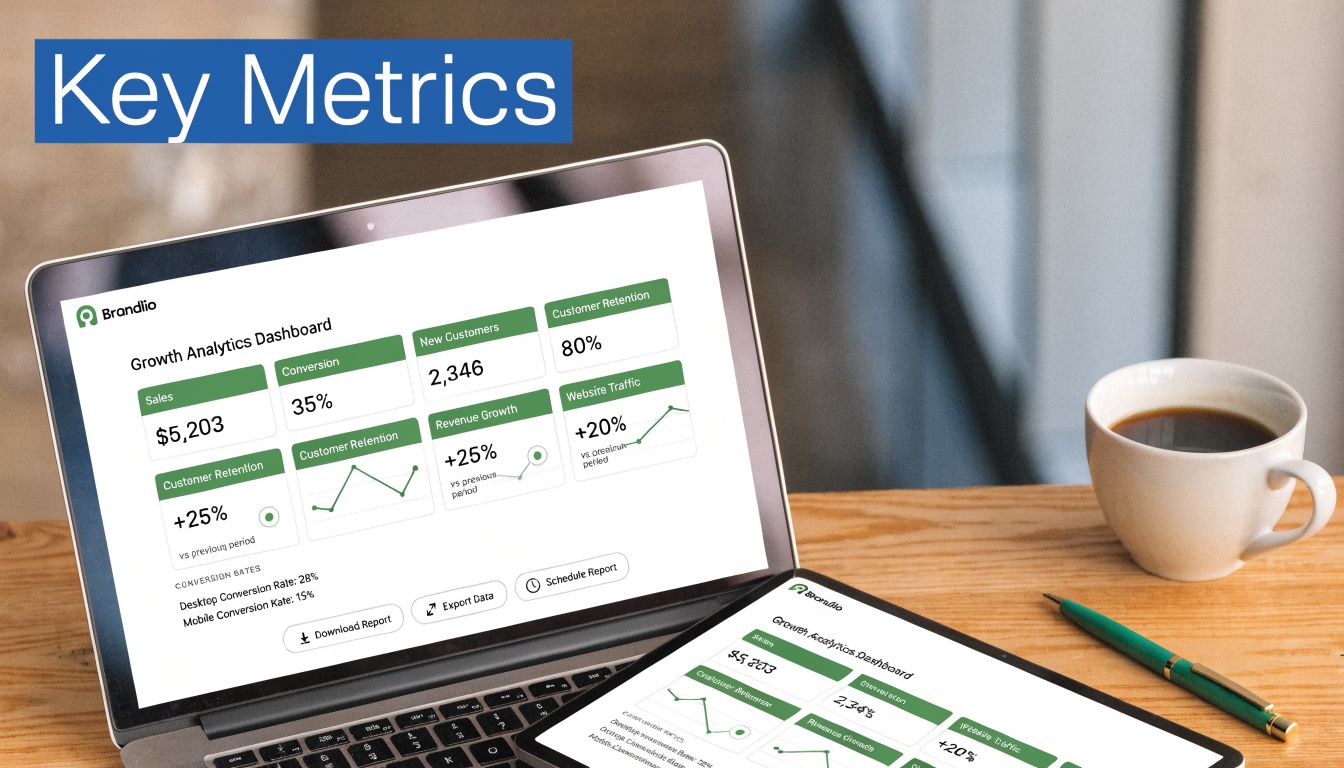
You don’t need a massive budget for this. A free tool like Looker Studio (formerly Google Data Studio) is more than enough to get started. It can pull information from Google Analytics, your ad accounts, and even spreadsheets to build a live ‘Growth Dashboard’.
Begin by focusing on just three core Key Performance Indicators (KPIs):
- Cost per Acquisition (CPA): How much are you spending to get one paying customer? You absolutely must know this number for each channel (e.g., Google Ads CPA: $250, LinkedIn Ads CPA: $400).
- Customer Lifetime Value (LTV): What’s the total revenue you can realistically expect from a customer over their entire time with you? For a SaaS business, this might be
(Average Monthly Subscription) x (Average Customer Lifespan in Months). - Conversion Rate by Channel: What percentage of visitors from Google organic (e.g., 2.5%) versus Facebook Ads (e.g., 1.2%) sign up for a trial? This tells you where your most valuable traffic comes from.
Actionable Data: The real insight comes when you compare these numbers. A healthy, scalable startup should be aiming for an LTV to CPA ratio of at least 3:1. If you're spending $500 to acquire a customer who will only ever generate $750 in revenue (a 1.5:1 ratio), you're on a fast track to running out of money. That business model simply isn't sustainable.
If you find your ratio is below that crucial 3:1 mark, you now have a clear action plan. To improve a 1.5:1 ratio, you can work on increasing your LTV (e.g., adding a higher-tier plan) or focus on driving down your CPA (e.g., pausing the underperforming ad channel and doubling down on the one with a lower CPA).
This is how measurement becomes a strategic tool, not just a reporting task. For a deeper dive into making these metrics drive your success, learn more about our full-service digital marketing solutions that connect data directly to results.
Straight Answers to Your Toughest Startup Marketing Questions
Every founder I’ve ever met wrestles with the same core marketing challenges. Forget the jargon and complex theories for a moment. Here are the direct, no-fluff answers to the questions that are likely on your mind right now.
How Much Should My Startup Actually Spend on Marketing?
You’ve probably heard the old "7-10% of revenue" rule. Let's be honest: for a pre-revenue startup, that's completely useless advice.
Actionable Framework: Use a "Test and Invest" budget. Start by defining your target Customer Acquisition Cost (CPA). If your product is $50/month and you estimate customers stay 12 months (LTV = $600), a healthy CPA is under $200. Allocate a small test budget (e.g., $1,000) to one or two high-potential channels. Run a hyper-specific Google Ads campaign on a few long-tail keywords. If you acquire 5 customers for $1,000 (a CPA of $200), you’ve proven the model. Now you have the data to justify reinvesting profits and scaling that specific channel. If it fails, you've only risked $1,000 and gained valuable data.
What's the Best Marketing Channel for a B2B SaaS Startup?
For most B2B SaaS companies just starting out, the winning combo is LinkedIn and SEO. It’s a classic strategy for a reason: it perfectly balances short-term wins with long-term growth.
LinkedIn (Short-term): Don't just post company updates. Use it to build personal authority. A founder I know got his first 10 enterprise clients by spending 30 minutes a day connecting with VPs of Marketing and sharing short, insightful video tips on a specific marketing problem. He never sent a sales pitch; they came to him.
SEO (Long-term): At the same time, you need to be creating a library of content that answers the very specific, often technical, questions your ideal customers are searching for. Think "how to integrate salesforce with quickbooks" not "best CRM". This turns your website into an authoritative resource and, over time, a powerful machine for generating high-intent organic leads.
Result Example: Use LinkedIn to generate 5-10 qualified demo requests this quarter while your SEO efforts build an asset that will bring you 50+ qualified leads per month within a year, for free.
When Is the Right Time to Hire a Marketing Agency?
Hiring an agency on day one is usually a mistake. The right time is when you, the founder, have hit a ceiling.
You know you're there when you’re spending more time tinkering with ad campaigns or writing blog posts than you are on building your product or talking to customers. You've proven there is a demand by acquiring your first 20-50 customers yourself, but your growth has plateaued because you lack the specialized skills or hours to scale. For example, you know your Google Ads are working (e.g., you have a positive ROAS), but you don't know how to optimize them further.
That's the perfect moment to bring in an agency. It's not about offloading work you don't want to do; it's a strategic move to accelerate your growth. You're investing in a dedicated team of specialists to turn your proven $1 into $10, without the cost and time it takes to build an in-house department from the ground up.
Ready to stop asking questions and start seeing results? LitSpark Solutions Private Limited is the expert team that can accelerate your journey. We blend data-driven marketing with full-stack development to help you build and scale intelligently. Find out how we can help at https://litspark.solutions.
- digital marketing for startups
- startup marketing
- growth strategies
- startup SEO
- PPC for startups