Development14 min read
Mobile App Development Cost in India: A 2026 Breakdown
Get a realistic mobile app development cost in India for 2026. Our guide breaks down hourly rates, project costs, hidden fees, and how to get an accurate quote.
By the LitSpark Solutions team · Updated
- AI Automation
- Advertising
- Designing
- Development
- Digital Marketing
- MVP
- Resource Hiring
- Shoot
A viable, market-ready mobile app in India typically costs ₹6,00,000 to ₹10,00,000 in 2026. That range moves mostly on complexity: the number of screens, integrations, workflows, platforms, and the operational discipline needed to ship something stable.
Most buyers ask the wrong first question. They ask, “What's the cheapest way to build my app?” The better question is, “What level of product am I funding?” A rough prototype, a usable MVP, and a launch-ready product can all be called “an app”, but they don't carry the same engineering load, design effort, testing depth, or business risk.
The Indian market is attractive because pricing is still materially lower than Western markets, but its key advantage isn't low cost alone. It's the ability to build with experienced teams, disciplined delivery, and room in the budget for the parts that often get ignored: product thinking, QA, release management, and post-launch support. That's where many app budgets break.
If you want a realistic view of mobile app development cost in India, don't look only at coding hours. Look at the full system around the build.
Table of Contents
- Why India Is the Smart Choice for App Development in 2026
- The Core Drivers of Your App Development Budget
- Decoding Indian App Development Rates and Pricing Models
- Sample App Costs in India 2026 Estimates and Calculator
- Beyond the Build Uncovering Hidden and Ongoing Costs
- Your Hiring Blueprint Agency vs Freelancer vs In-House
- How to Get a Smart App Development Quote
Why India Is the Smart Choice for App Development in 2026
India remains a strong choice because the cost gap is large enough to matter strategically, not just tactically. Mobile app development in India costs 60% to 70% less than equivalent services in the US or UK, and senior developers at strong Indian agencies bill ₹2,000 to ₹4,000 per hour ($25 to $50), compared to $100 to $250 per hour for US-based developers according to this India app development cost analysis.
That difference changes what a business can afford to build. A founder can fund a sharper MVP instead of a barebones demo. An SME can include better UX, stronger testing, or a real admin panel instead of cutting those pieces out. A product team can budget for iteration rather than treating launch as the finish line.
Cost matters, but execution matters more
Cheaper development isn't useful if the app needs rework after launch. The better Indian firms don't win on hourly rate alone. They win because they combine design, engineering, QA, and delivery management in a way that keeps the project moving without constant client firefighting.
That's the practical value of India in 2026. You're not just buying labour. You're buying execution bandwidth at a cost structure that still makes sense for startups and mid-sized businesses.
Practical rule: If one quote is dramatically lower than the rest, check what has been removed. It's usually design depth, QA coverage, project management, documentation, or post-launch support.
Why buyers still get budgeting wrong
Many buyers compare India with the US or UK and stop there. The more useful comparison is between two Indian proposals that look similar on the surface but are built very differently underneath. One includes discovery, edge-case handling, release prep, and structured QA. The other is mostly raw coding.
That's why a realistic budget conversation has to move beyond “hourly rate” and into scope architecture. The next question isn't whether India is affordable. It is. The core question is how to use that affordability without under-scoping the product.
The Core Drivers of Your App Development Budget
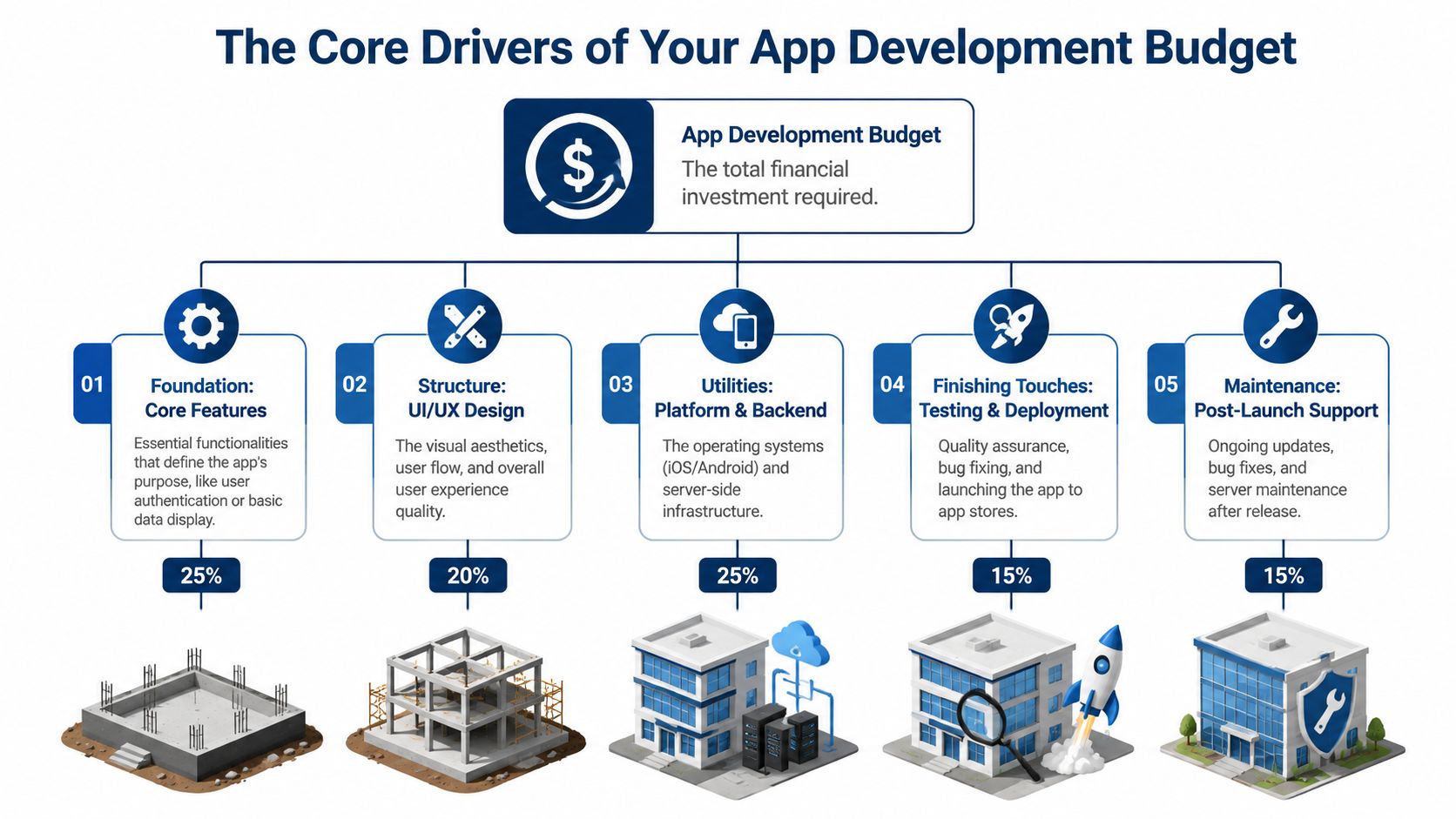
If app pricing feels inconsistent, it's because people often compare unlike-for-unlike projects. The clearest way to understand budget is to treat an app like a house build. Every cost line follows from what you're building, how many systems need to work together, and how polished the final result needs to be.
Think of it like building a house
Core features are the foundation. User login, profile management, catalogue browsing, search, booking flow, or order history define the base structure. More workflows mean more screens, more backend logic, and more testing paths.
UI/UX design is the structure and interior planning. A rough interface can be built quickly. A clean product with intuitive flows, strong onboarding, and well-resolved edge states takes more time. If you're comparing consumer apps, design quality affects retention, support burden, and conversion.
Platform and backend are the utilities. A single-platform app is simpler than a product that has to run across iOS and Android with a backend, admin panel, notifications, payment handling, and integrations. Complexity rises fast once the app stops being a front-end shell and becomes an operational system.
For teams budgeting brand-heavy apps, onboarding-driven flows, or regulated UX, this external guide on fintech mobile app design expenses is worth reviewing because design cost often gets separated from engineering in proposals, even though the business impact is tightly linked.
Where advanced features change the budget fastest
The market often groups advanced work into one broad bucket. That's not how budgets behave in real projects. Most guides lump AI, bots, and custom integrations into a single advanced category, but the cost impact is uneven: real-time features such as on-demand booking start at ₹8L and can exceed ₹25L before adding more complex AI, which can push costs over ₹35L, as outlined in this discussion on Indian app feature costs.
That distinction matters. Real-time systems are expensive because they affect architecture. Live location updates, dispatching, booking states, socket behaviour, conflict handling, and admin monitoring all multiply engineering and QA effort. AI can be expensive too, but in many business apps, real-time behaviour creates the bigger cost jump earlier.
A booking app with live availability and operational workflows is usually harder to build well than a content app with a simple recommendation layer.
Here's how I usually frame the main cost drivers for clients:
- Feature depth: More user actions means more logic, more states, and more failure points.
- Integration load: Payments, CRM sync, analytics, maps, chat, and internal tools all raise implementation and testing effort.
- Design ambition: A sharper interface improves outcomes, but it needs proper wireframing, flows, revisions, and interaction design.
- Platform scope: One platform reduces cost. Two platforms increase reach, QA load, and release work.
- Operational maturity: Dashboards, permissions, moderation tools, and audit trails don't look flashy, but they're what make an app usable for the business team.
This is why two apps with similar screen counts can still land in very different budget bands.
Decoding Indian App Development Rates and Pricing Models
Rates matter, but they only become useful when you connect them to delivery model and project shape. A senior engineer's rate tells you something about capability. It doesn't tell you whether the quote includes product discovery, QA coverage, release management, or ownership of the final outcome.
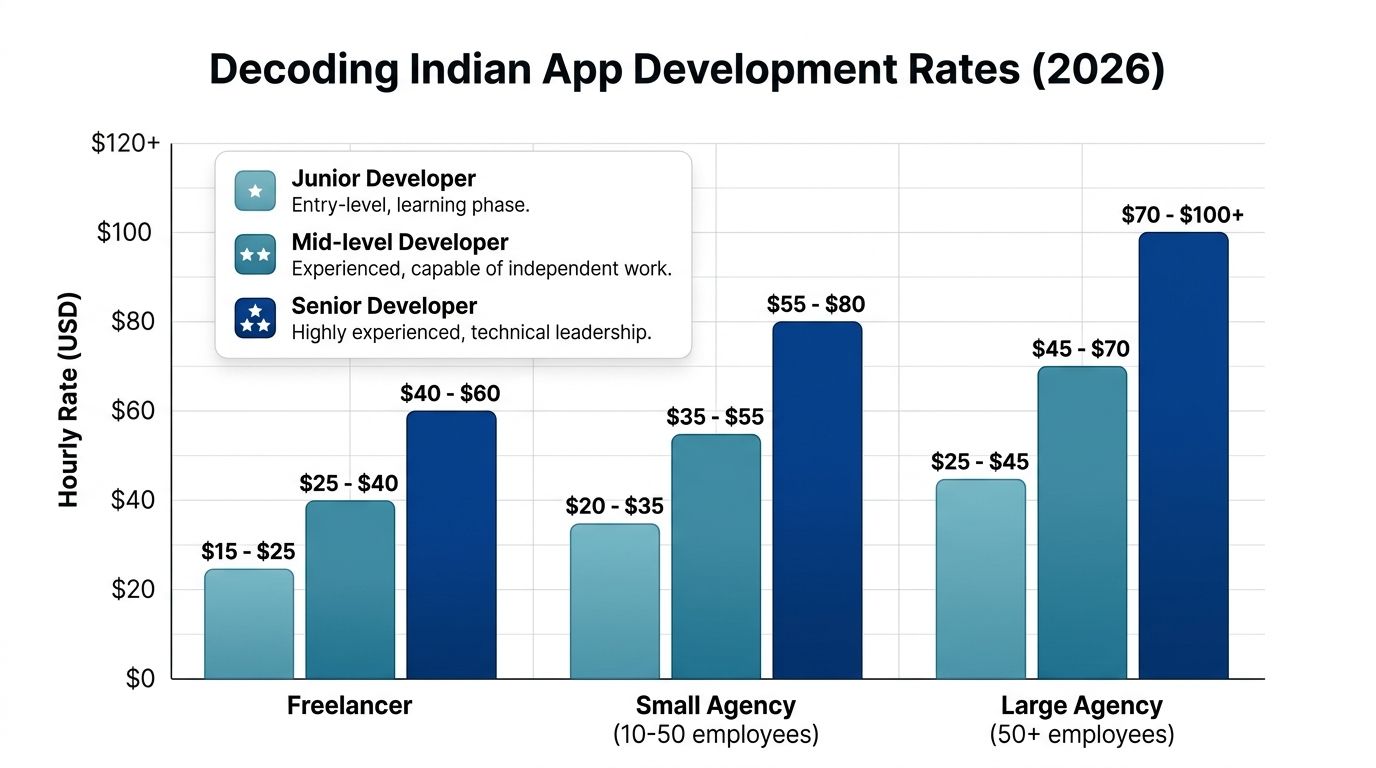
To anchor the market clearly, this rate chart is helpful:
What agency rates actually tell you
In India, senior developers at reputable agencies bill ₹2,000 to ₹4,000 per hour ($25 to $50), which is 60% to 70% lower than US rates of $100 to $250 per hour. That differential drives total project cost for mid-complexity apps into the $15,000 to $40,000 range compared to $80,000 to $150,000 in the US, based on this analysis of 330 app projects in India.
That sounds straightforward, but buyers often misuse hourly rates in two ways.
First, they assume lower hourly cost means lower total cost. It doesn't if the team is slow, under-managed, or inexperienced with similar products.
Second, they compare a freelancer's coding rate with an agency quote that includes design, QA, and PM. Those aren't equivalent purchases.
If you're evaluating vendors for execution rather than just staffing, review a provider's mobile app development services with that lens. The useful question is whether the team is charging only for coding, or for owning delivery.
A practical way to read pricing:
| Provider type | Best for | Main budget risk |
|---|---|---|
| Freelancer | Small, tightly defined work | Missing process and QA |
| Small agency | MVPs and focused business apps | Capability may vary by stack |
| Established agency | End-to-end builds with lower delivery risk | Higher quote, but broader coverage |
Which pricing model fits which project
The pricing model often matters more than the rate card.
Fixed price works when the feature list is stable, decisions are fast, and the business is happy to lock scope early. It's useful for contained MVPs, internal tools, or version-one products with limited ambiguity. The mistake is using fixed price when the product is still evolving weekly.
Time and material suits products where requirements will change as users react. This model is better for startups validating workflows, businesses replacing legacy operations, or teams integrating with moving third-party systems. It gives room for learning, but it needs disciplined prioritisation.
Later in the process, this video gives a practical perspective on how budgeting conversations often unfold with real app builds:
Dedicated team makes sense when the app is one part of a broader roadmap. If your product needs ongoing releases, backend work, QA cycles, and business-side iteration, a retained team usually produces better continuity than repeatedly quoting separate chunks of work.
Don't choose a pricing model based on which looks cheapest at proposal stage. Choose the one that matches how much uncertainty still exists in the product.
Sample App Costs in India 2026 Estimates and Calculator
The easiest way to make pricing practical is to map it to actual business scenarios. Most buyers don't want abstract ranges. They want to know where their product likely sits.
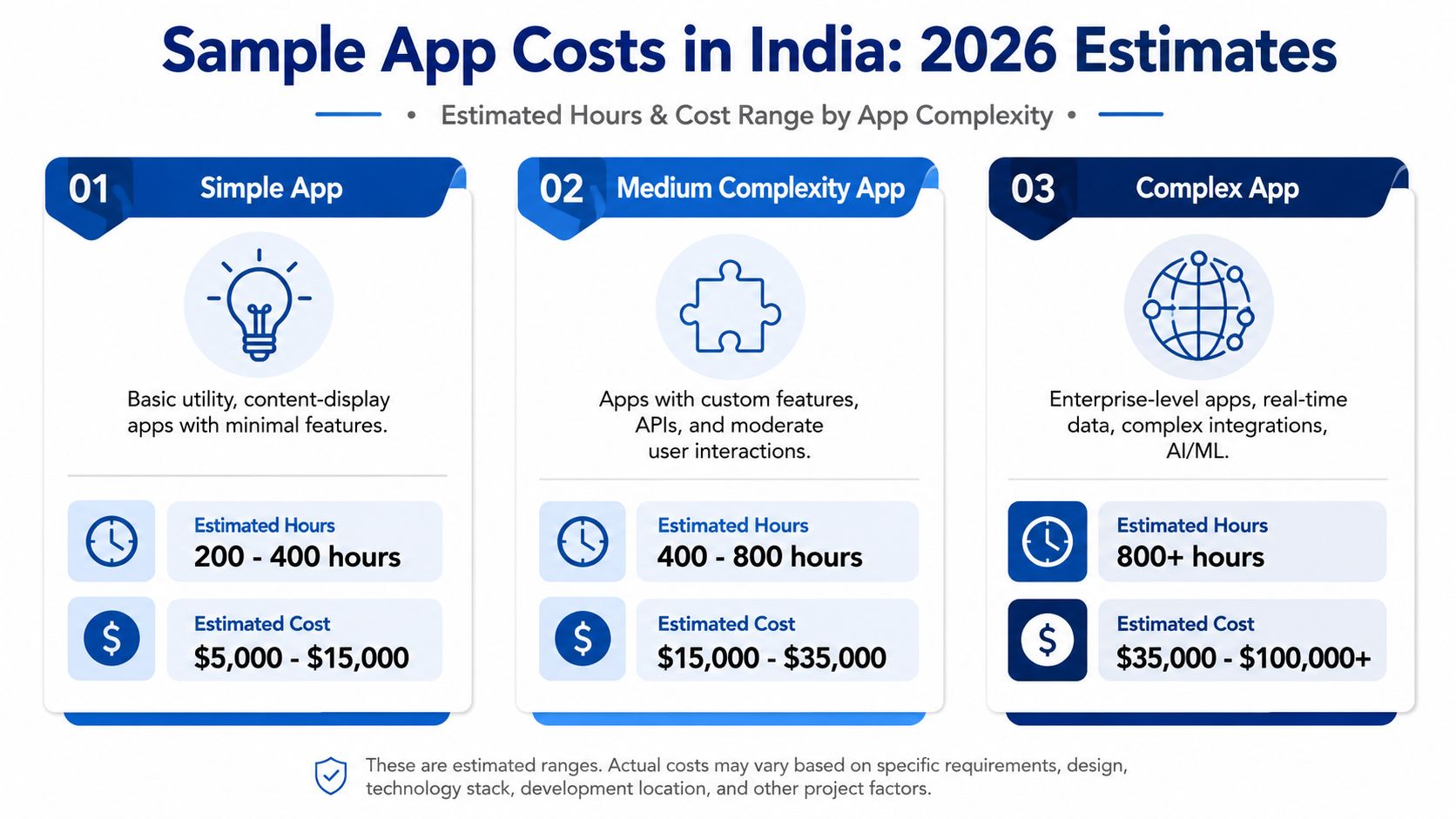
For 2026, a basic app with 8 to 12 screens ranges from ₹3,00,000 to ₹12,00,000 ($5,000 to $15,000), a mid-complexity app with 20 to 30 screens and API integrations costs ₹6,00,000 to ₹40,00,000 ($15,000 to $40,000), and enterprise platforms start around ₹60,00,000, according to this 2025 vs 2026 India pricing breakdown.
Three practical budget scenarios
A simple app is usually a utility, content, or early MVP product. Think account creation, a small number of screens, basic data handling, and limited backend complexity. This tier suits founders who need to validate demand before expanding.
A mid-complexity app is where many real business products sit. It may include payments, dashboards, multiple user roles, API integrations, and a more complete business workflow. This is often the band where buyers underestimate effort because the app still looks “moderate” on the surface.
A complex app becomes a platform. It may include real-time state changes, advanced admin controls, multiple systems talking to each other, or enterprise-grade workflows. At this level, architecture and testing discipline drive the budget as much as raw coding.
Here's a practical reading of those categories:
| App type | Typical business use | Likely budget fit |
|---|---|---|
| Simple | MVP, utility app, internal pilot | Early validation |
| Medium | Commerce, booking, field ops, business workflows | Launch-ready product |
| Complex | On-demand, multi-role operations, enterprise systems | Scale and process automation |
For founders who want to launch fast without overbuilding, a focused MVP development route is usually the smartest starting point. The point isn't to build less. It's to build only what proves the business case.
Mini App Cost Calculator
Use this as a practical filter. It won't replace a proper estimate, but it will help you see which complexity band your app is leaning towards.
| Feature | Simple App (Typically Included) | Medium App (Typically Included) | Complex App (Typically Included) |
|---|---|---|---|
| User login and profile | Yes | Yes | Yes |
| Static content or basic catalogue | Yes | Yes | Yes |
| Push notifications | Sometimes | Yes | Yes |
| Payment gateway | Rarely | Yes | Yes |
| Admin panel | Basic or absent | Yes | Yes |
| Multiple user roles | Rarely | Yes | Yes |
| Third-party API integrations | Limited | Yes | Yes |
| Real-time booking or live tracking | No | Sometimes | Yes |
| Advanced analytics or workflow logic | No | Sometimes | Yes |
| AI-driven functionality | No | Rarely | Sometimes |
A simple scoring method works well in early calls:
- Mostly left column: You're likely in simple MVP territory.
- Mostly middle column: You're likely budgeting for a mid-complexity app.
- Several right-column requirements: You're moving into complex-platform territory.
If your app needs multiple user roles, payments, admin workflows, and real-time behaviour, don't budget as if it's “just an MVP”. That combination usually pushes the product into a much heavier delivery bracket.
One more useful benchmark: for a lean, single-platform MVP in India in 2026, a reputable product studio typically charges ₹6.5 lakh to ₹15 lakh, with post-launch monthly operational costs of ₹40,000 to ₹1.5 lakh depending on scale and infrastructure, according to this MVP-to-scale breakdown.
That operating cost matters because a shipped app still needs infrastructure, monitoring, updates, and support. Many early budgets stop at launch. That's where trouble starts.
Beyond the Build Uncovering Hidden and Ongoing Costs
The most common budgeting mistake in app projects isn't choosing the wrong stack. It's assuming the development quote is the full budget.
The overlooked multiplier
The hidden 20% to 30% cost multiplier for non-development phases such as design, QA, and project management is rarely emphasised. This gap leads startups to underbudget by ₹1 to ₹3 lakh on average, because 20% to 30% of total project cost is allocated to these critical phases, according to this India-focused analysis of hidden app costs.
That number matches what experienced teams see in practice. If a proposal looks unusually cheap, it often means one of three things has been trimmed:
- Design has been reduced: fewer wireframes, fewer revision cycles, weaker UX thinking.
- QA has been reduced: less device testing, fewer edge cases, more bugs discovered after release.
- Project management has been reduced: poor coordination, slow decisions, missed dependencies.
These aren't optional extras. They protect the build.
Operational costs after launch
Once the app is live, the cost model changes from project spend to operating discipline. Teams need to budget for hosting, third-party services, release updates, bug fixes, and support workflows. The exact amount depends on traffic, infrastructure choices, and product shape, so it's better to treat these as recurring operating lines rather than one-time surprises.
What usually catches businesses off guard isn't just cloud cost. It's the cumulative effect of many small systems: payment providers, notifications, maps, analytics, reporting, moderation tools, and release maintenance.
A quote that excludes QA and launch support may look efficient on paper, but the business usually pays for that missing work later through delays, production issues, and rework.
A healthy app budget has two layers. One funds the build. The other funds the product's ability to keep working after real users arrive.
Your Hiring Blueprint Agency vs Freelancer vs In-House
Who builds the app changes the risk profile as much as the cost profile. A cheaper build model can be right for one product and completely wrong for another.
How the trade-offs work in practice
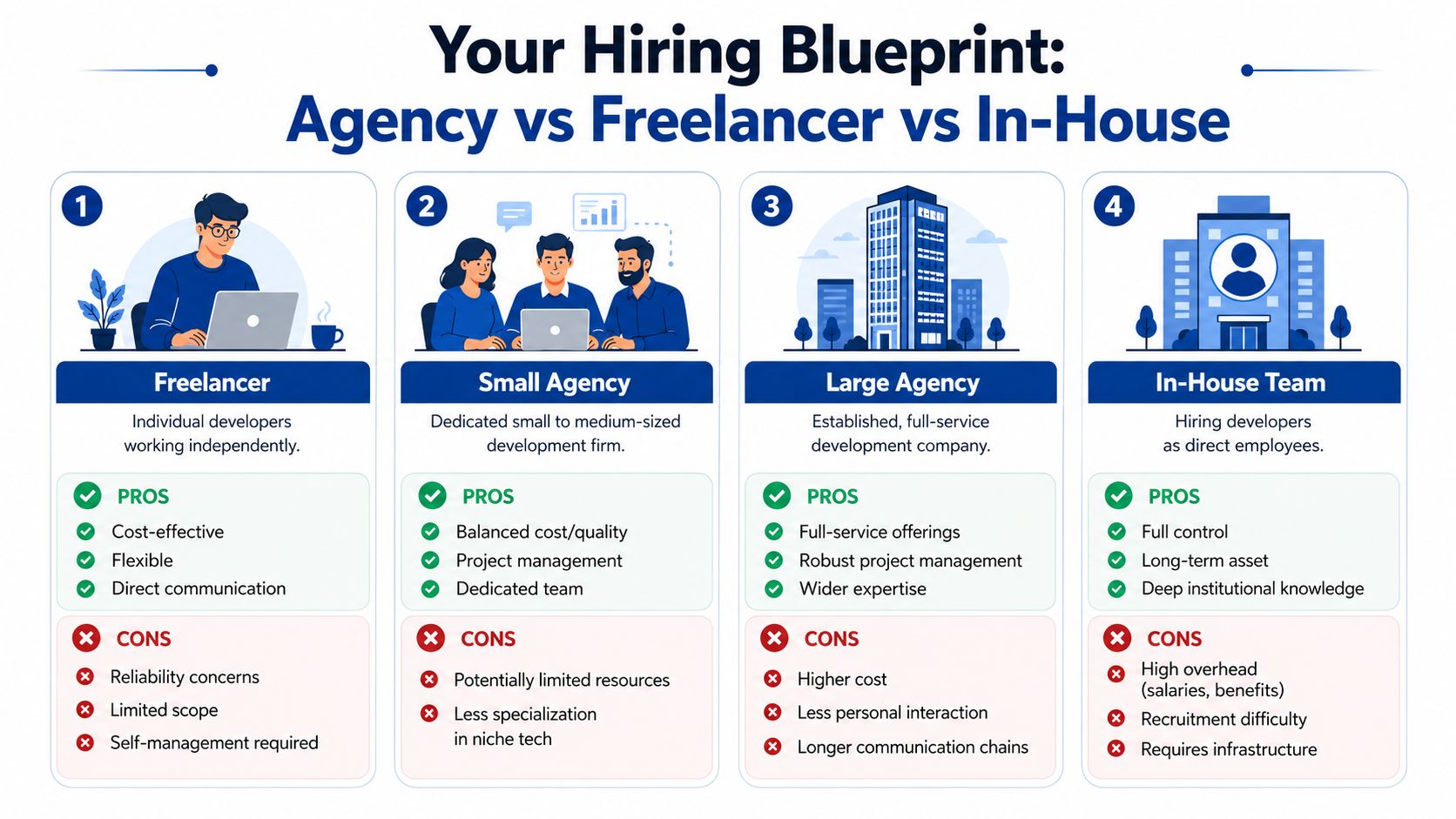
A freelancer works best when scope is narrow and the client can manage delivery closely. If you already have product decisions made, designs ready, and a tight feature list, a strong freelancer can be efficient. The risk is that the client becomes the project manager, QA lead, and release owner by default.
A small or mid-sized agency is often the best middle ground for startups and SMEs. You get coordinated design, engineering, testing, and delivery. The outcome is usually better when the product needs cross-functional ownership, not just code output.
A large agency suits programmes with multiple stakeholders, broader governance needs, or deeper integration requirements. You'll usually get stronger structure, but also more process and a higher commercial floor.
An in-house team makes sense when mobile product development is becoming a permanent internal capability. The control is valuable, but hiring, retention, tooling, leadership, and delivery maturity all become your responsibility.
A simple way to choose
Use the hiring model that matches your actual management bandwidth.
- Choose freelance if your scope is small and your internal team can lead delivery daily.
- Choose an agency if you want one partner accountable for design, build, testing, and release.
- Choose in-house if the app is a long-term product function, not a one-time initiative.
- Choose augmentation if you already have a product team and need specialist execution capacity quickly.
If your situation is closer to the last case, a structured resource hiring model for mobile and full-stack talent often gives better continuity than trying to assemble independent contractors one by one.
The cheapest hiring path is often the one that demands the most management effort from your side. If your team can't absorb that load, the savings disappear quickly.
How to Get a Smart App Development Quote
A good quote starts with business clarity, not technical jargon. The strongest briefs are simple. State the user, the problem, the core workflow, the must-have features, and what success looks like after launch.
Keep the first version focused. If the product can launch without a feature, move it out of version one. Ask every vendor to separate must-have, should-have, and later features. That one step usually improves estimate quality more than long requirement documents do.
When comparing proposals, don't read only the final price. Check whether the quote includes design, QA, PM, release support, and post-launch handling. If two vendors price the “same” app very differently, the missing work is usually sitting in those lines.
For a helpful outside perspective on building cleaner estimates, this guide on mastering software cost estimation is useful because it frames estimation as a scoping discipline, not just a pricing exercise.
A smart quote should help you make a product decision, not just a purchasing decision.
If you want a transparent estimate grounded in actual delivery experience, LitSpark Solutions Private Limited can help you shape the scope, identify actual cost drivers, and turn your app idea into a practical build plan. Whether you need an MVP, a full product team, or dedicated developers, the goal is the same: a proposal that reflects the actual work required, not an attractive number that breaks later.
- mobile app development cost in india
- app development india
- hire indian developers
- app cost calculator
- litspark solutions