13 min read
Order Management System Ecommerce: The Complete 2026 Guide
Discover how an order management system ecommerce brands rely on can streamline fulfillment, reduce RTO losses, and scale operations across every channel.
By the LitSpark Solutions team · Updated
- AI Automation
- Advertising
- Designing
- Development
- Digital Marketing
- MVP
- Resource Hiring
- Shoot
Indian D2C brands can lose 18–25% of revenue through manual processing, return-to-origin failures, disconnected inventory, and reconciliation gaps, as documented in India-focused ecommerce operations guidance. That changes the way an order management system for ecommerce should be evaluated. It isn't merely a dashboard for routing orders. It should protect the margin on every order from checkout through settlement, including the unglamorous work of COD confirmation, returns, courier claims, and payment matching.
Table of Contents
- Why Every Growing Ecommerce Brand Needs an OMS
- Core Architecture and Features of a Modern OMS
- How an OMS Protects Margins Beyond Order Routing
- Selecting the Right OMS for Your Business Stage
- Implementation Roadmap and Rollout Checklist
- Common Pitfalls and Best Practices for OMS Adoption
- KPIs and Metrics to Track After Go-Live
- Where OMS Is Heading Next for Indian Ecommerce
Why Every Growing Ecommerce Brand Needs an OMS
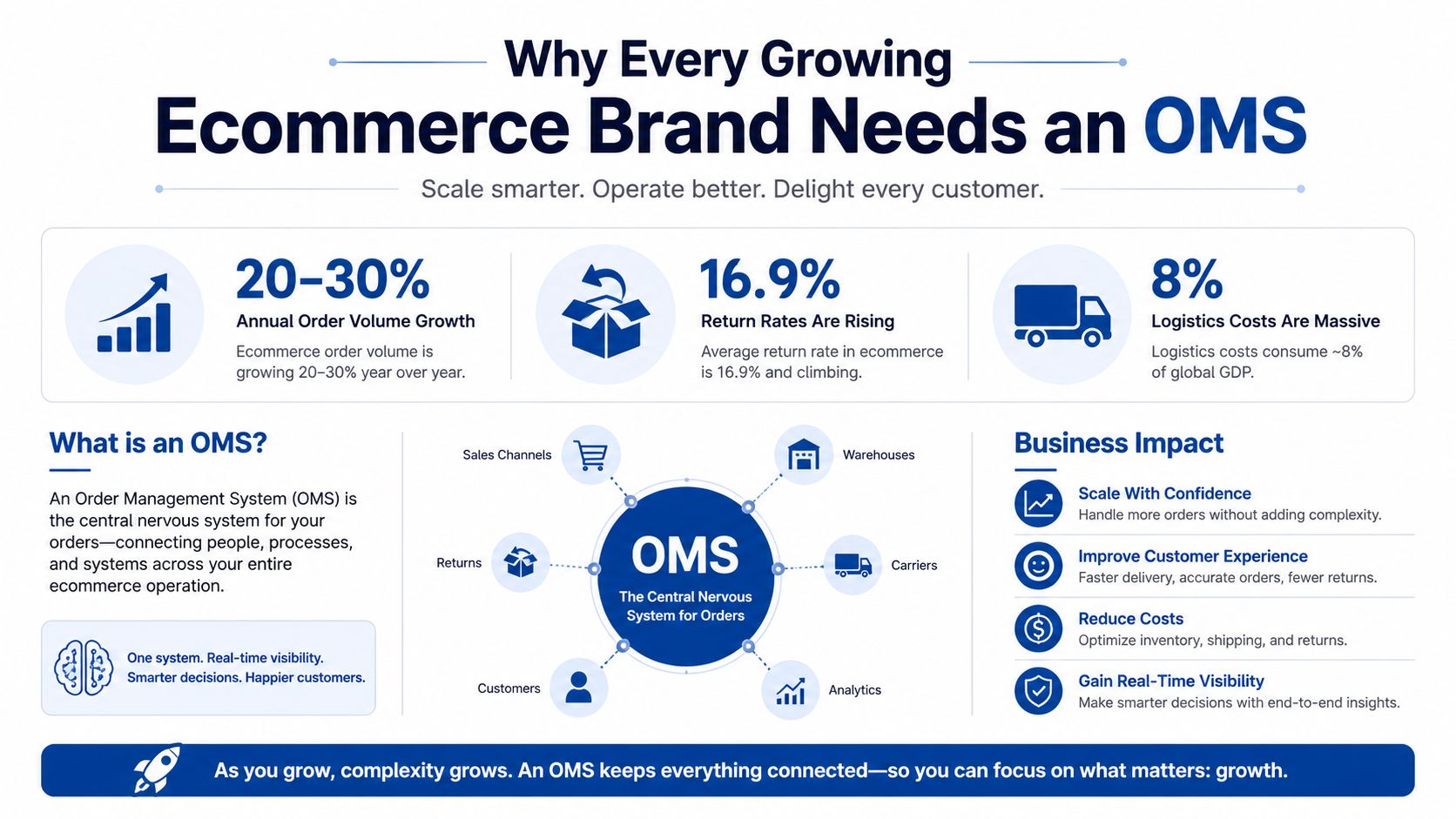
India's ecommerce operations are expanding across both major metros and smaller demand centres. A 2023 industry report recorded 26.2% year-on-year order-volume growth in FY2023, alongside 23.5% annual GMV growth. Tier I regions grew by 31.1% YoY, while Tier II and Tier III cities expanded by 23.3% and 22.4% respectively, according to this India ecommerce order-management analysis. That growth creates a coordination problem, not just a sales opportunity.
Returns add pressure. The same report placed the overall return rate at 10.4% in FY2023, up from 9.8% in FY2022. COD orders had a 20.9% return rate, compared with 19.3% the previous year. At the national level, the government's 2025 assessment put logistics costs at 7.97% of GDP, or ₹24.01 lakh crore, using a hybrid methodology based on data from more than 3,500 industry stakeholders and official sources including MOSPI, RBI, and GSTN, as explained in this India logistics cost assessment.
What an OMS actually controls
An OMS is the central operating layer for the customer order. It captures orders from websites, marketplaces, social channels, and offline sources, then applies business rules for inventory allocation, warehouse fulfilment, shipping, tracking, cancellations, returns, refunds, and exceptions.
That makes it different from a storefront, a CRM, or a warehouse management system. A storefront takes the order. A warehouse system manages physical warehouse work. An OMS coordinates the complete order journey and passes the right instructions to each connected system.
A brand selling through Shopify, Amazon, and Flipkart may begin with spreadsheets and separate marketplace dashboards. That approach breaks when stock movements, cancellations, partial shipments, or returns need to be reflected across every channel at the same time.
Practical rule: If one team member is copying order data between systems, the business has already created a control point that can fail.
The point where manual processes stop working
An India-focused OMS guide identifies 200+ daily orders across two or more channels as a typical point at which D2C brands need an OMS, as outlined in this guide to moving beyond spreadsheets. The exact threshold varies by product complexity, warehouse structure, and return volume, but the operational signs are consistent:
- Inventory disputes: The storefront says an item is available, while the warehouse has already reserved it for another channel.
- Delayed exceptions: Teams discover failed deliveries, payment mismatches, or stockouts only after a customer complains.
- Manual reconciliation: Finance staff match COD remittances, prepaid settlements, refunds, and cancellations in separate files.
- Unclear ownership: Customer support, warehouse staff, finance, and logistics partners each see a different order status.
For brands at this stage, an OMS isn't a luxury layer. It provides one order record, one inventory view, and a controlled workflow for every handoff. Businesses assessing automation can also review LitSpark's business automation services when their existing stack needs custom workflow integration.
Core Architecture and Features of a Modern OMS
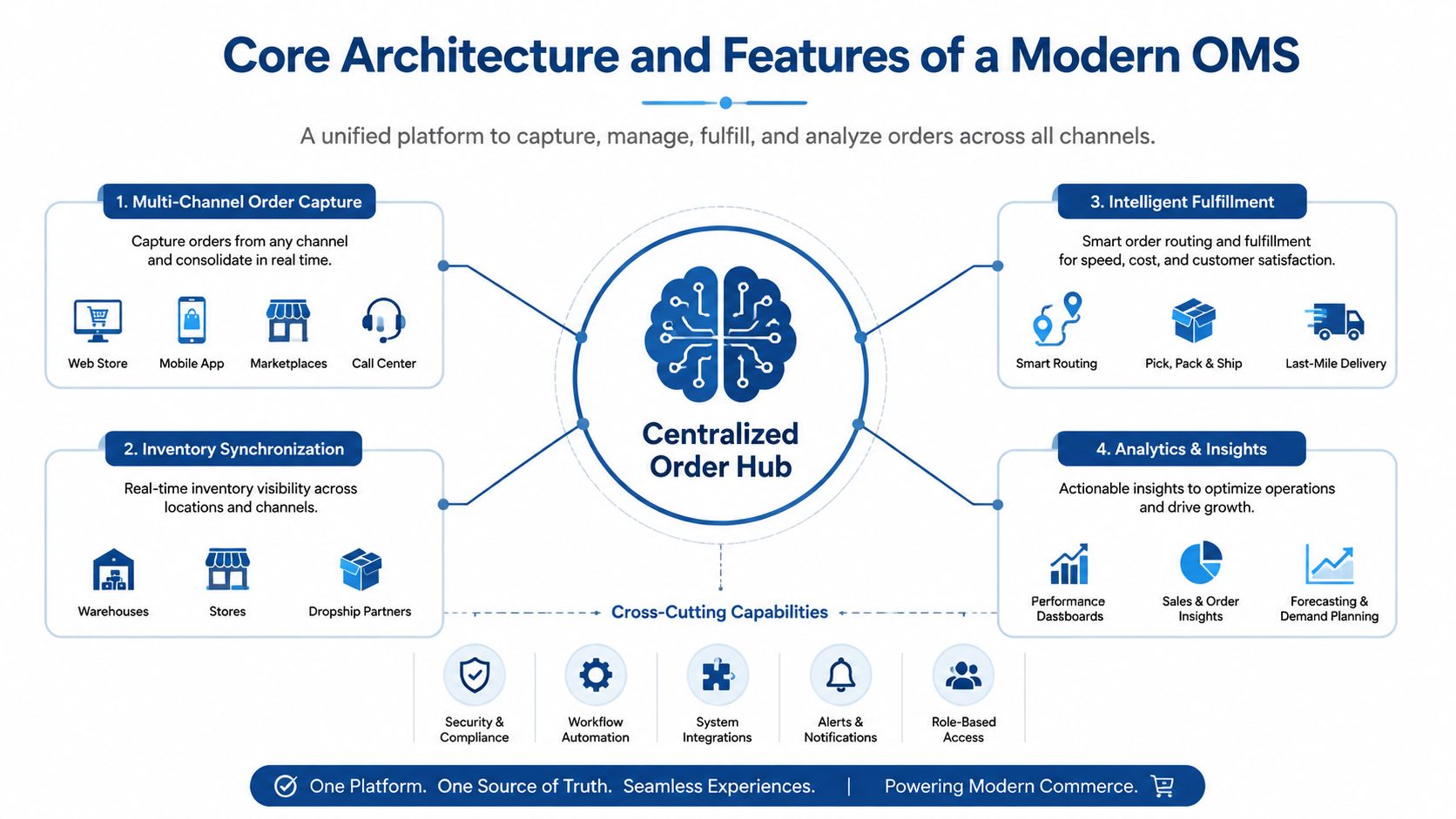
A useful OMS architecture has one centre, the order record, and several connected operating modules. Each module should update the same operational truth rather than create another isolated dashboard.
Start with a unified order hub
The first layer captures orders from Shopify, WooCommerce, Amazon, Flipkart, and other channels. It normalises product identifiers, customer details, payment status, tax information, delivery addresses, and fulfilment rules into a common format.
Every channel uses its own status language and operational constraints. The OMS should translate those differences into a consistent internal workflow, then send the appropriate update back to each channel.
Keep inventory synchronised
Inventory synchronisation is more than displaying an available quantity. A dependable system distinguishes sellable stock, reserved stock, damaged units, stock in transit, and stock held for a marketplace SLA.
Suppose a brand has one hundred units of a SKU across a warehouse and a retail location. A customer buys through Amazon while another buys through Shopify. The OMS should reserve the appropriate quantity, update both channels, and prevent a third channel from selling units that are no longer available. The system should also support safety buffers where channel commitments make a full stock release risky.
Route orders using explicit rules
Routing rules decide which node fulfils the order. Common inputs include inventory location, promised delivery date, shipping serviceability, product dimensions, payment method, and warehouse workload.
The cheapest warehouse isn't always the right warehouse. A slightly longer internal movement may be preferable if it avoids a split shipment or protects the delivery promise. Routing needs to optimise the whole order, not just the first dispatch decision.
Connect warehouse, carrier, and returns workflows
The OMS should generate pick-pack-ship instructions, transmit labels to shipping aggregators, receive tracking events, and flag exceptions. It should also carry the order context into returns, so the team can verify eligibility, arrange reverse pickup, inspect the item, approve the refund, and close the financial record.
Teams building more advanced workflows can explore Amazon ops with AI agents for ideas on how automation and agent-based controls may support marketplace inventory work.
The architecture only works when data flows in both directions. A carrier event should update the OMS, the customer communication layer, and the marketplace status. A warehouse exception should influence allocation and customer support, not remain trapped in a local screen.
How an OMS Protects Margins Beyond Order Routing
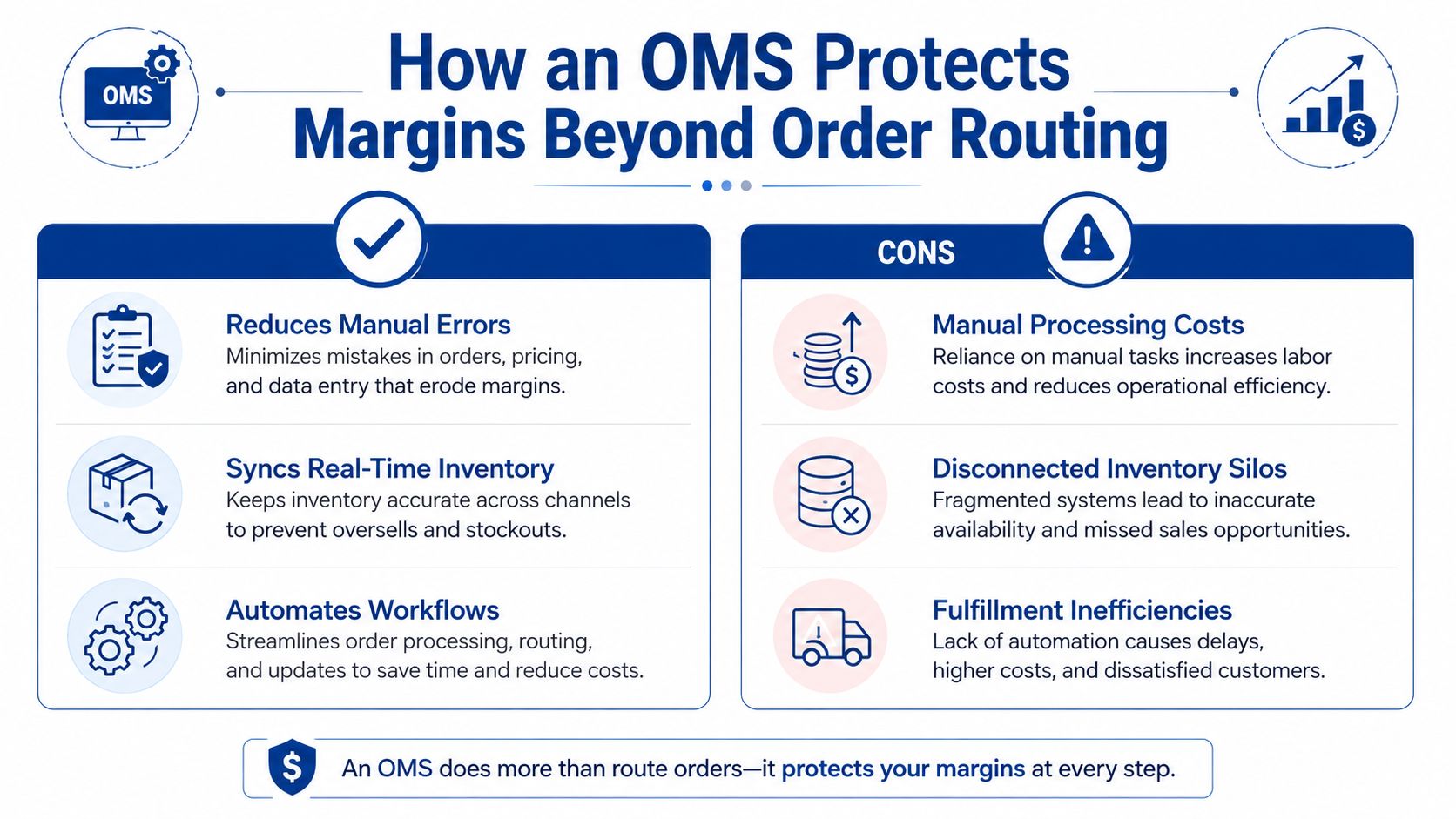
The most important OMS question isn't, “How many channels can it connect?” It's, “Which leakage does it stop?” An OMS becomes a margin-protection system when it links operational events to financial outcomes.
Manual processing creates avoidable errors. Disconnected inventory creates overselling, cancellations, and emergency transfers. Weak RTO controls consume forward shipping, reverse logistics, packaging, and support time without producing a completed sale. The India-specific estimate that these failures can erode 18–25% of D2C revenue makes profitability a more useful evaluation lens than headcount savings alone, as detailed in this analysis of D2C operational mistakes.
Build controls around COD and RTO
India-focused benchmarks place RTO at 20–30% for prepaid orders and 30–40% for COD orders, according to this India ecommerce RTO benchmark guide. An OMS can't eliminate every failed delivery, but it can make the decision process more disciplined.
Useful controls include automated COD confirmation, address validation, pincode serviceability checks, customer risk flags, order-age alerts, and configurable hold rules. A high-risk COD order might require confirmation before warehouse release. A repeat failed-delivery address might be routed to a review queue instead of passing straight into fulfilment.
The point isn't to reject customers indiscriminately. It's to spend fulfilment resources where the likelihood of successful delivery justifies the cost.
Track profit at SKU and order level
Revenue reporting can hide loss-making products. An OMS connected to settlement and cost data can associate a SKU or order with discounts, payment fees, shipping charges, returns, claims, and marketplace deductions.
That view helps teams spot products that sell frequently but produce weak contribution margins. It also supports better routing decisions, because a small reduction in distance or split shipments can matter more for low-margin products than for premium items.
Reconcile money and recover claims
Payment reconciliation should match captured payments, COD remittances, refunds, cancellations, and marketplace settlements to the original order. Auto-claims should create a controlled process for courier damage, loss, or delivery disputes, with evidence attached to the relevant shipment.
Without this link, operations may show “delivered” while finance still has an unresolved settlement, or a damaged parcel may be written off because nobody owned the claim. The OMS should make those leakages visible, assign responsibility, and preserve the audit trail.
Selecting the Right OMS for Your Business Stage
The right OMS depends on operational complexity, not on the length of a vendor feature list. A startup with two channels needs dependable capture, inventory control, shipping, and returns. An enterprise with warehouses, stores, local fulfilment nodes, and marketplace SLAs needs orchestration, permissions, resilience, and detailed data governance.
Start with total cost of ownership. Include subscription fees, implementation, integration work, support, training, data cleanup, custom development, and the internal time required to operate the platform. Then model value through reduced manual work, fewer preventable cancellations, better settlement recovery, lower split shipments, and more controlled returns.
The India multichannel order-management market was estimated at USD 650 million in 2025 and is projected to reach USD 934 million by 2032, implying a 6.2% CAGR, according to India multichannel order-management market projections. That growth gives buyers more choice, but it also makes disciplined comparison essential.
Compare the operating fit
| Criteria | Startup (Under 500 Orders/Day) | Growth Stage (500–5000 Orders/Day) | Enterprise (5000+ Orders/Day) |
|---|---|---|---|
| Channel coverage | Shopify, WooCommerce, and priority marketplaces | Multiple marketplaces, storefronts, and sales campaigns | Marketplaces, owned commerce, offline retail, wholesale, and local nodes |
| Inventory model | Central stock view with reservations | Multi-warehouse allocation and safety buffers | Store-level, warehouse, in-transit, pooled, and node-based orchestration |
| Data flow | Reliable scheduled or near-real-time updates | Real-time inventory and order events should be preferred | Event-driven architecture, resiliency, auditability, and integration monitoring |
| Fulfilment | Basic routing, shipping labels, and status updates | Rule-based allocation, split-shipment controls, and exception queues | Complex allocation, SLA governance, wave fulfilment, and operational permissions |
| Finance controls | Basic COD and refund visibility | Settlement reconciliation, claims, and SKU-level reporting | Deep reconciliation, P&L integration, tax controls, and financial audit trails |
| Support | Guided onboarding and responsive support | Dedicated implementation ownership and workflow configuration | Solution architecture, service-level commitments, and change management |
A startup shouldn't pay for enterprise orchestration it won't use. An enterprise shouldn't select a lightweight tool just because the initial interface looks easier. Teams validating a new commerce workflow can consider LitSpark's MVP development services when a custom proof of concept is more appropriate than immediate platform commitment.
Implementation Roadmap and Rollout Checklist
OMS implementation succeeds when the team treats it as an operating-model change, not a plug-in installation. The project needs an accountable operations lead, ecommerce owner, warehouse representative, finance lead, customer support representative, and technical integration owner.
Phase one, discovery and requirements
Document every order state from payment through refund. Map channels, warehouses, stores, carriers, ERP connections, tax requirements, COD rules, cancellation policies, return eligibility, and settlement files.
The deliverable should be a signed process map and exception register. Do not configure the platform until the team agrees what “ready to ship”, “delivery failed”, “return received”, and “refund approved” mean.
Phase two, data and integrations
Clean SKU codes, warehouse locations, customer fields, tax data, inventory balances, and historical orders before migration. Connect Shopify or WooCommerce, marketplaces, ERP, WMS, and shipping aggregators in a controlled sequence.
Test both inbound and outbound events. A successful order import is insufficient if cancellations, inventory reservations, tracking updates, refunds, and carrier exceptions don't return correctly.
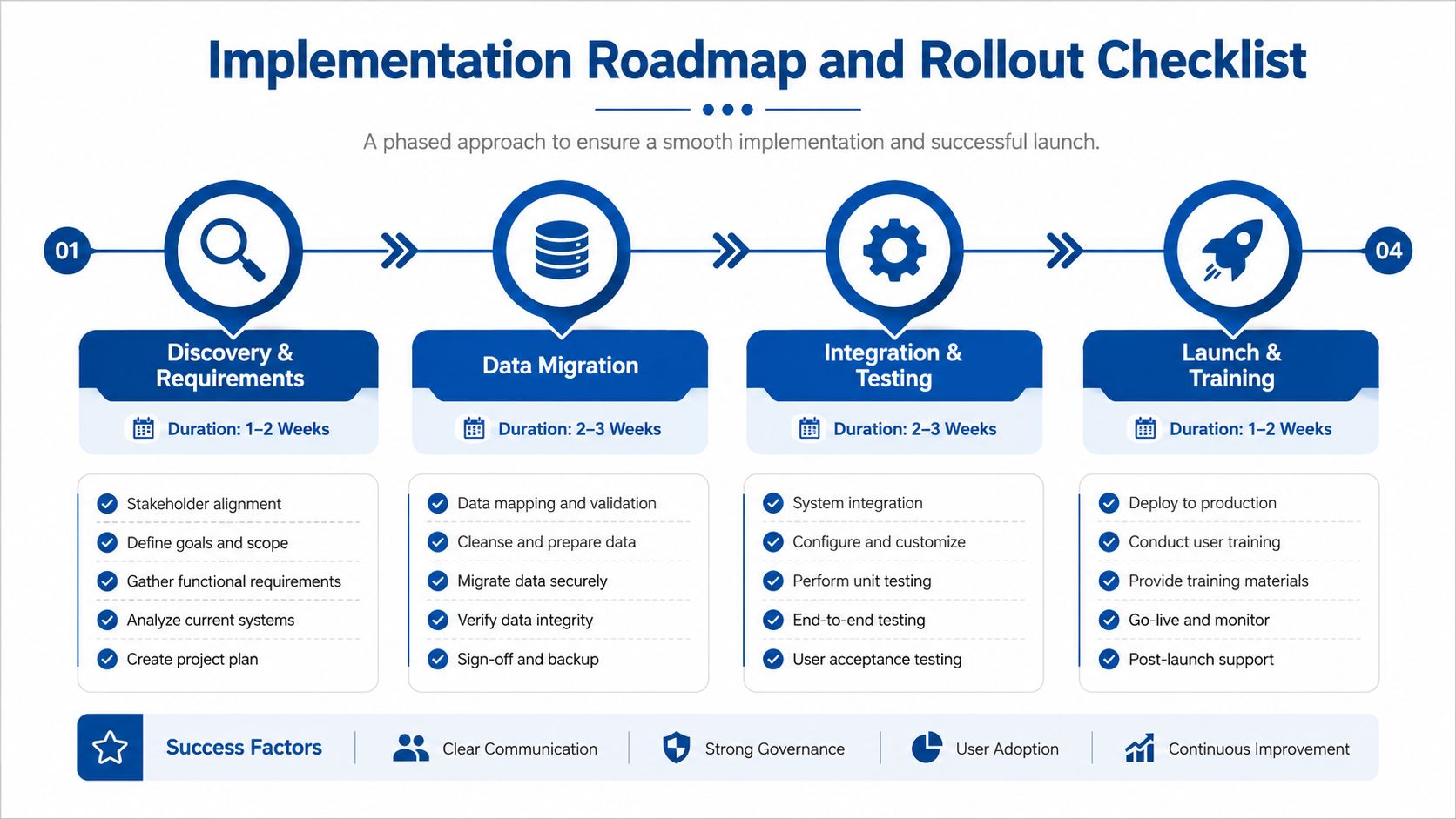
Phase three, warehouse configuration and acceptance testing
Configure pick paths, packing rules, shipping service selection, barcode processes, partial fulfilment, holds, cancellations, and return inspection. Use realistic test orders, including COD, prepaid, multi-item, out-of-stock, exchange, failed delivery, and damaged parcel scenarios.
Warehouse staff and customer support must perform user acceptance testing. Technical sign-off alone misses practical problems such as unclear screens, duplicated labels, or a return status that finance can't interpret.
Phase four, soft launch and full go-live
Start with one channel, one warehouse, or a controlled product group. Compare OMS inventory and status data with the existing process, monitor exceptions closely, and define a rollback method before expanding.
After full launch, review order queues, integration failures, stock variances, RTO signals, settlement mismatches, and refund ageing daily. A cloud and DevOps team can support observability, deployment discipline, and integration reliability through LitSpark's cloud DevOps services.
Common Pitfalls and Best Practices for OMS Adoption
Many OMS projects fail before the software goes live because the business treats configuration as the hard part. The harder work is deciding how the business should behave when stock is fragmented, a carrier misses a scan, a customer changes an address, or a return arrives without the original packaging.
Pitfall one, underestimating data migration
Bad SKU mappings and duplicate product records create errors that look like software failures. Clean the catalogue first, define one product identifier, reconcile opening inventory, and document ownership for future changes.
Pitfall two, postponing returns design
Returns aren't a post-launch enhancement. Indian ecommerce guidance linked to the Consumer Protection E-Commerce Rules 2020 says sellers should disclose return, refund, exchange, and warranty terms before purchase, including the return window, refund method, shipping responsibility, and return initiation steps, as set out in this India return-policy guide.
Configure those rules in the OMS, storefront, support scripts, and warehouse process. A customer shouldn't receive one policy on the product page and another from the support team.
Pitfall three, treating inventory as one pool
A brand selling through marketplaces, stores, warehouses, and kirana fulfilment nodes needs location-aware inventory. Live store-level synchronisation, pooled demand forecasting, reservation rules, and node-specific serviceability should govern what each channel can sell.
The risk isn't limited to overselling. Poor orchestration can fragment stock, create unnecessary transfers, and force a warehouse to fulfil an order that a nearby store could have shipped more efficiently.
Pitfall four, assuming go-live ends the project
An OMS needs ownership after launch. Review failed integrations, stock adjustments, routing outcomes, carrier performance, and user permissions regularly. The most valuable rules often emerge after the team sees real exceptions, so maintain a controlled change backlog instead of letting staff create workarounds in spreadsheets.
For refunds, India-focused guidance commonly recommends returning money to the original payment source. COD refunds are commonly handled through bank transfer or UPI after quality checks, and one India D2C guide recommends a category-appropriate return window of 7 to 15 days from delivery, as described in this returns and reverse-logistics guide.
KPIs and Metrics to Track After Go-Live
An OMS dashboard should connect customer experience, warehouse execution, carrier economics, and margin. A single blended average hides the operational detail needed to fix problems.
Track these measures by channel, payment method, warehouse, SKU category, and carrier:
- Order-to-dispatch time: Separate payment confirmation, allocation, picking, packing, and handover so delays have an accountable owner.
- Perfect order rate: Combine correct item, correct quantity, on-time dispatch, successful delivery, and clean documentation.
- Split-shipment percentage: Monitor how often one customer order becomes multiple parcels and identify the inventory or routing rule causing it.
- RTO rate: Segment by COD and prepaid, channel, pincode, courier, product, and confirmation outcome.
- Average cost per shipment: Include forward shipping, packaging, handling, and reverse movement where relevant.
- Last-mile cost as a share of order value: This deserves special attention because last-mile delivery accounts for roughly 60% of total logistics cost per parcel, according to India ecommerce logistics research.
- Return processing turnaround: Measure the time from return request to pickup, receipt, inspection, refund approval, and payment completion.
Build exception views, not only scorecards. If RTO rises for COD orders from one channel, the operations team should see the associated pincodes, carriers, confirmation attempts, and warehouse decisions. If dispatch time increases at one location, the dashboard should expose queue age and stock availability rather than just displaying a red percentage.
A useful KPI is one that tells a manager what decision to make next.
Review the dashboard in a weekly operations meeting, then link each recurring issue to a routing rule, training action, carrier change, or product-policy decision.
Where OMS Is Heading Next for Indian Ecommerce
The next generation of OMS platforms will move beyond order routing and inventory synchronisation. They'll connect SKU-level P&L, settlement reconciliation, courier performance scoring, returns analytics, and claim recovery so teams can see whether an order was merely delivered or delivered profitably.
Omnichannel orchestration will become more important as brands combine marketplaces, owned storefronts, offline retail, warehouses, and local fulfilment nodes. Store-level inventory, pooled demand forecasting, and proximity-based allocation can help brands use distributed stock without exposing every unit to every channel.
The macroeconomic incentive is substantial. India's logistics sector was valued at USD 215 billion in 2021, while the government's 2025 assessment placed logistics costs at 7.97% of GDP, as reported in this India logistics policy context. Those conditions favour systems that reduce unnecessary movement, improve exception handling, and make fulfilment economics visible.
Brands should prepare by standardising SKU and location data, defining return and refund rules, measuring contribution margin by channel, and selecting integrations that expose reliable events. AI can assist with demand signals, risk scoring, and exception prioritisation, but it won't compensate for unclear ownership or fragmented master data.
LitSpark Solutions Private Limited helps ecommerce teams build and connect digital commerce workflows, including storefronts, APIs, automation, and order synchronisation across sales channels. Visit LitSpark Solutions Private Limited to discuss an OMS implementation, custom integration, or automation roadmap aligned with your fulfilment and margin goals.
- order management system
- ecommerce OMS
- order fulfillment
- multichannel ecommerce
- D2C operations