Resource Hiring12 min read
Hire Faster with Talent Acquisition Consultants
Learn how talent acquisition consultants source, screen, and hire faster. Includes pricing benchmarks, KPIs, and real ROI examples for 2026.
By the LitSpark Solutions team · Updated
- AI Automation
- Advertising
- Designing
- Development
- Digital Marketing
- MVP
- Resource Hiring
- Shoot

You're probably staring at a hiring board that looks fine on paper and broken in reality. The open roles are piling up, hiring managers are losing patience, and someone keeps saying, “We just need more CVs.” That's the trap. In Indian hiring, the problem usually isn't volume, it's whether the hiring process is designed to produce the right shortlist, the right offer acceptance, and the right retention.
That's where talent acquisition consultants either earn their fee or waste your time. The good ones reshape the hiring funnel, challenge lazy role definitions, and widen access to candidates you're currently missing. The weak ones forward résumés, recycle job descriptions, and disappear when the offer stage gets messy.
Table of Contents
- What Talent Acquisition Consultants Do
- The Full-Cycle Hiring Workflow a Consultant Runs
- TA Consultants vs In-House Teams, RPO, and On-Demand Talent
- Redesigning the Funnel Around Hidden Workers
- How to Evaluate and Contract a TA Consultant
- Pricing Benchmarks, KPIs, and a Simple ROI Model
- Common Misconceptions and a 30-60-90 Day Operating Plan
What Talent Acquisition Consultants Do
A Bangalore startup with 12 unfilled tech roles does not need another recruiter who forwards what is already on Naukri. It needs someone who can sit with the hiring manager, turn a messy requirement into a search strategy, and keep the funnel moving until offers are accepted. That is the job of a talent acquisition consultant.
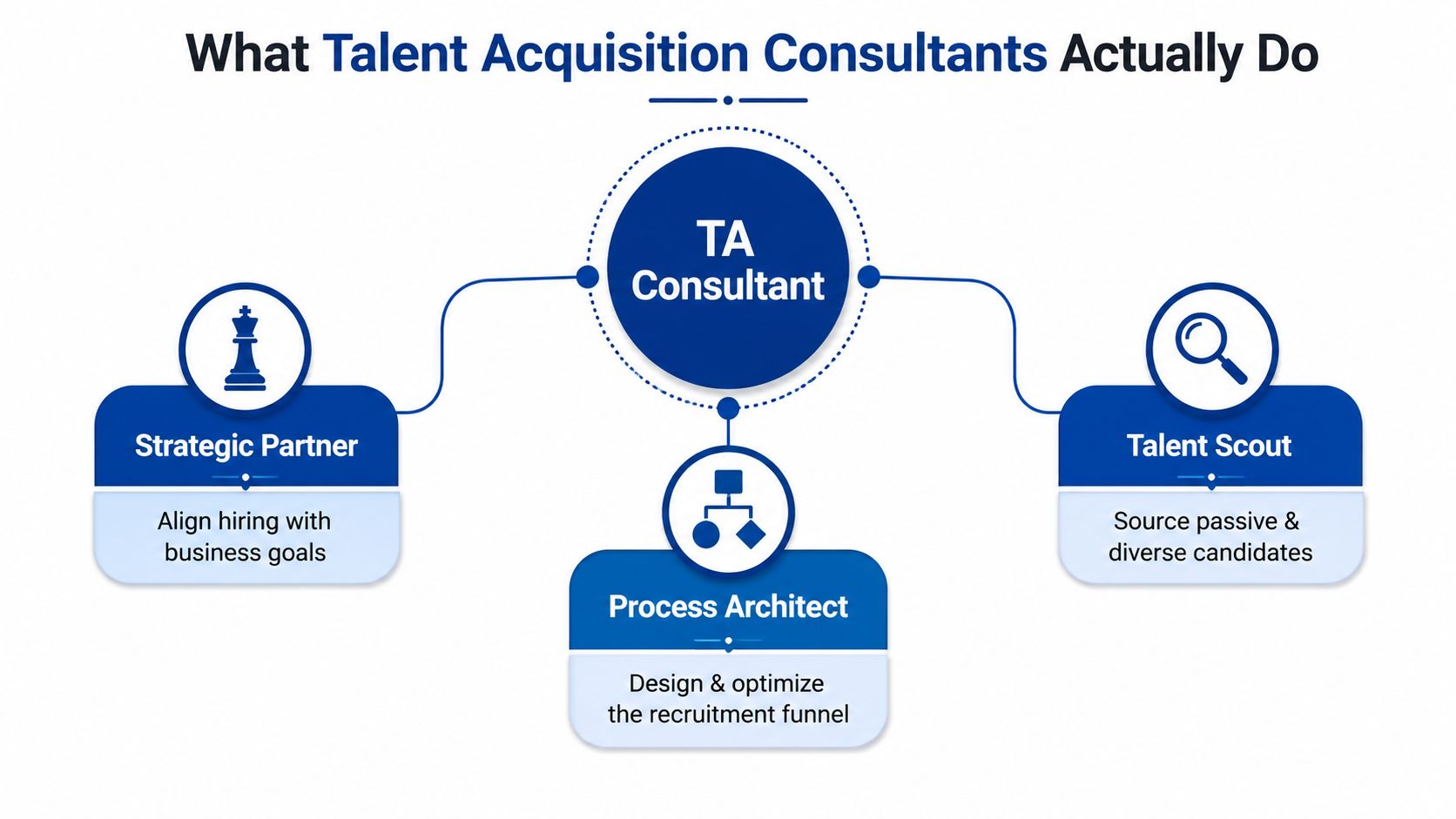
The process owner, not the CV courier
Practical rule: if the consultant cannot explain the hiring intake, the funnel stages, and the reporting cadence, you are not buying talent acquisition, you are buying email forwarding.
A good consultant is a process owner who helps run intake, sourcing, screening, interview coordination, offer support, and performance reporting. Role descriptions make that clear. They call for stakeholder needs analysis, ATS tracking, and distribution of hiring metrics with the talent acquisition lead, which goes well beyond “recruitment support” Velvet Jobs.
That framing should drive every vendor conversation. It forces clarity on who owns the requisition, who owns candidate movement, and who owns the data trail. It also stops the consultant from hiding behind vague language when a hiring manager changes the brief halfway through.
Where the consultant sits in the hiring stack
| Funnel Stage | Typical Owner | TA Consultant Adds |
|---|---|---|
| Intake | Hiring manager, HR lead | Sharpens role scope and success criteria |
| Sourcing | Recruiter or agency | Maps passive talent pools and search strategy |
| Screening | Recruiter, panel | Structured filters and shortlist quality |
| Interviews | Hiring manager, coordinator | Scheduling discipline and feedback flow |
| Offer | HR, compensation team | Offer positioning and acceptance support |
| Reporting | TA lead | Funnel metrics and bottleneck diagnosis |
A consultant who only posts jobs and waits for applicants is not doing the job. The work is to use the brief, search the market, and identify people who are not actively applying, then bring them into a controlled process. That is where hidden-worker sourcing matters, and where weak consultants usually underdeliver.
If you want help with flexible hiring capacity, LitSpark's resource hiring service fits the same conversation, because the core question is whether you need a process builder, a sourcing engine, or both.
If you are using outside support to accelerate AI hiring with outsourcing(https://www.thirstysprout.com/post/benefits-of-hr-outsourcing), the consultant still has to own funnel quality. Speed means nothing if the shortlist is thin, generic, or built from the same public profiles everyone else is chasing.
The Full-Cycle Hiring Workflow a Consultant Runs
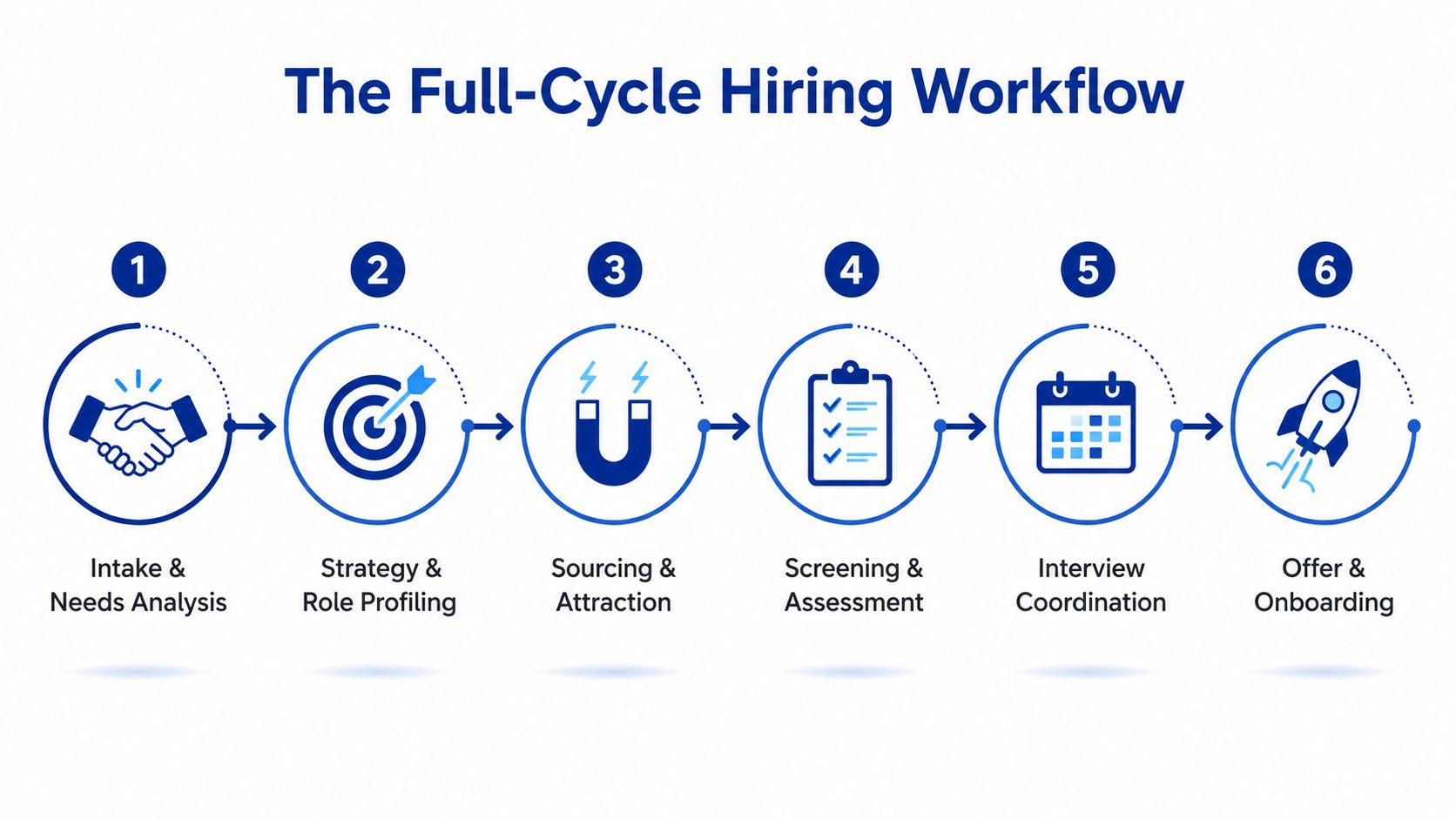
The practical work starts before the first candidate is contacted. A competent consultant begins with an intake call that turns a broad request into a hiring brief, then translates that brief into searchable terms, screening rules, and a pipeline plan. Workable's role description is clear on this, consultants prepare hiring plans, source through social networks and niche platforms like GitHub and Behance, and track KPIs such as time to fill and source of hire Workable.
Intake, search, and tracking
A senior Android role is not “Android developer, 5 years experience.” It becomes a set of search terms, adjacent skill markers, likely employer targets, and disqualifiers. The consultant should then run the search through the right channels, track the requisition in an ATS such as iCIMS, and keep the hiring manager honest about what the market can supply Velvet Jobs.
This is also where data discipline matters. Job profiles in the market expect consultants to handle Boolean search, ATS administration, and recruiting reports, because the job is to turn a fuzzy role description into a structured sourcing plan Indeed. If your consultant can't explain the Boolean logic behind a shortlist, the shortlist is probably luck.
What you should demand week to week
A decent consultant should leave a paper trail, not just opinions. Ask for these artefacts:
- Job intake form, so everyone agrees on must-haves, nice-to-haves, and deal-breakers.
- Sourcing report, so you can see which channels are working and which are dead.
- Hiring plan, so weekly activity maps back to target dates and role priorities.
- ATS status update, so candidate movement is visible and delays aren't hidden.
Institutional hiring guidance also shows that the consultant's job can include review and approval steps, conditional offers, and background checks, which makes the role closer to governance than casual sourcing University of California, Santa Cruz.
A small but important point. If a consultant can't explain why a shortlist target exists, the number is meaningless. A quota of 40 shortlists is only useful if it supports the offer target and the quality bar, otherwise you're paying for noise.
TA Consultants vs In-House Teams, RPO, and On-Demand Talent
The wrong way to buy hiring support is to ask, “Who's cheapest?” The better question is, “Who owns the outcome, how fast can they move, and what happens when the role changes midstream?” Talent acquisition consultants, in-house teams, RPO, and on-demand talent platforms split apart on those questions, not on sales pitches.
Four hiring models compared
| Criterion | TA Consultant | In-House TA | RPO | On-Demand Talent |
|---|---|---|---|---|
| Cost structure | Flexible, often project or retainer based | Fixed payroll cost | Contracted service model | Variable, tied to engagement |
| Speed to hire | Good for urgent, specialised roles | Depends on team load | Strong for process scale | Strong for rapid augmentation |
| Employer brand ownership | Shared with your team | Fully internal | Shared, often process-heavy | Usually tactical, depends on scope |
| Candidate quality | Strong when niche search is disciplined | Strong if the team has domain depth | Consistent at volume | Strong when roles are well-defined |
| Flexibility for seasonal hiring | High | Medium to low | Medium | High |
The decision rule is blunt. Use an in-house team when hiring is steady and your employer brand is already doing some of the work. Use RPO when volume and process consistency matter more than individual role nuance. Use a consultant when the role is hard to fill, politically sensitive, or important enough that a bad hire will hurt the business.
On-demand talent is different again. It suits teams that need execution capacity now, especially when a startup or SME needs to fill gaps without building a full recruiting layer internally. LitSpark Solutions Private Limited fits that model because it offers flexible resource hiring alongside development and digital services, which is useful when a company wants delivery capacity and hiring support without adding permanent overhead. If your hiring motion depends on faster pipeline creation, the same logic applies to lead generation support and to AI automation development, because both can reduce manual work that slows recruiters down.
Bottom line: if the hire is generic, keep it in-house. If the hire is large-scale and repeatable, look at RPO. If the hire is scarce, urgent, or strategically awkward, bring in a consultant or on-demand support.
Redesigning the Funnel Around Hidden Workers
Most recruiting pitches still behave as if the only good candidates are the ones with pristine CVs and uninterrupted careers. That's lazy. Accenture defines hidden workers as people with employment gaps, care responsibilities, disabilities, fewer formal qualifications, relocation needs, or disadvantaged backgrounds, and India has a large labour market where those profiles are easy to miss if your funnel is built around narrow filters Accenture.
The consultant's real value here
A strong consultant doesn't just “source diverse talent.” They redesign the funnel so hidden workers can get through it. That means removing degree obsession where skills matter more, loosening rigid tenure thresholds, and rewriting interview rubrics so a career break doesn't automatically look like a defect.
The best Indian examples are practical, not ideological. A D2C brand hiring floor supervisors, for instance, may get better pipeline depth by accepting broader retail or operations experience instead of insisting on one fixed company lineage. Internal candidates, boomerang hires, and referral flows can also be part of that design when the consultant is thinking in terms of funnel expansion rather than job-board harvesting.
What to change before you source
- Cut unnecessary filters: Remove degree rules and pedigree bias when the job can be done through skills.
- Rewrite interview scorecards: Assess actual role behaviours, not just prior brand names.
- Widen sourcing pools: Include internal mobility, former employees, referrals, and indirect labour markets.
- Use skills language: Convert job requirements into observable capabilities, not decorative titles.
A consultant who can't do this is stuck in transactional recruiting. A consultant who can do this changes the economics of the search because the shortlist stops depending on a tiny, overused talent pool.
The same logic applies if you're looking at AI-led recruitment or skills automation. LitSpark's AI automation development work is relevant here because better systems make it easier to structure the search, not because software magically fixes weak hiring judgment.
How to Evaluate and Contract a TA Consultant
Don't evaluate a consultant on polished slides. Evaluate them on how they think, what they measure, and what they'll be accountable for after the kickoff call. A serious buyer should run a six-step process and refuse to skip any of it.
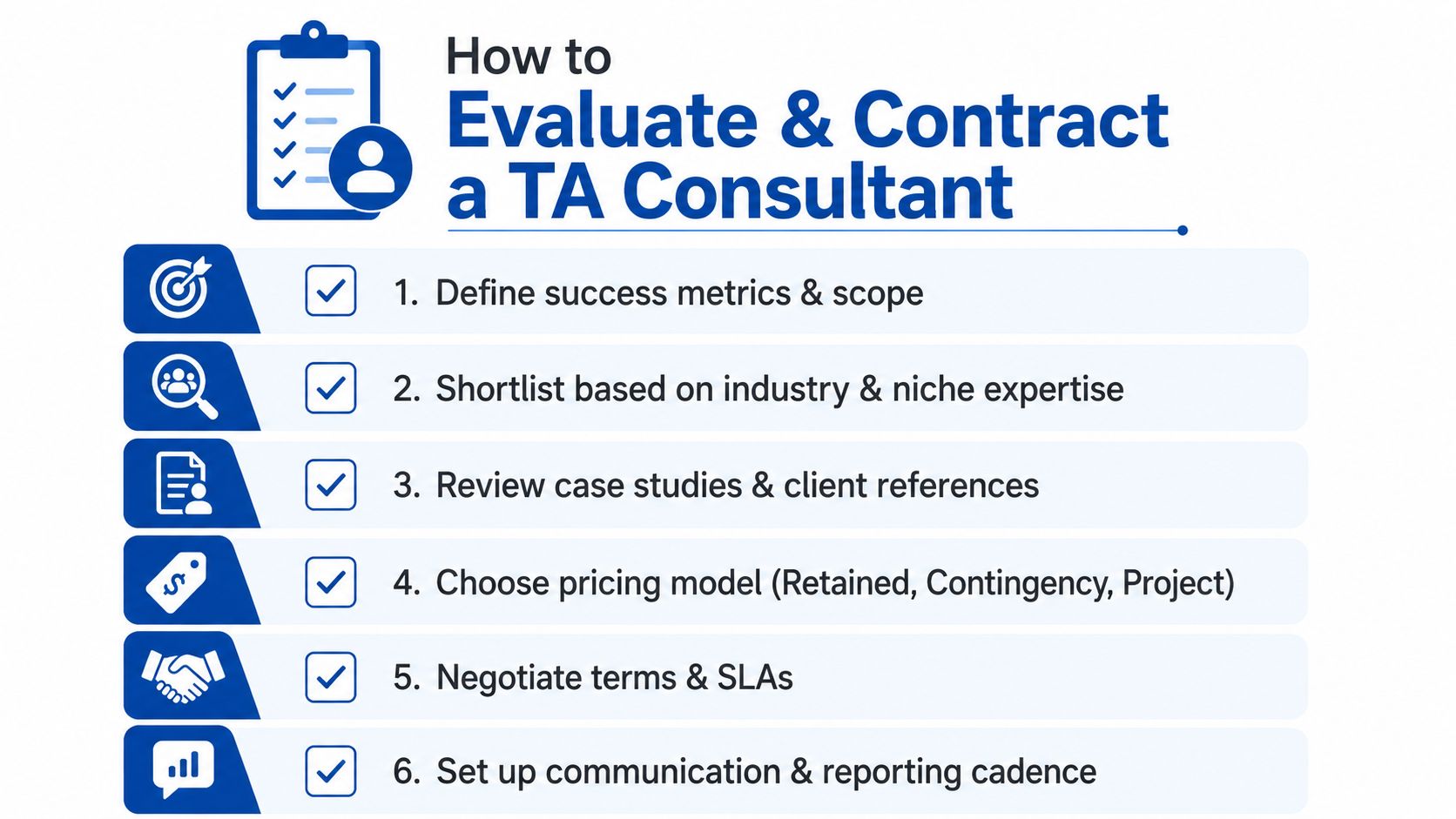
The six-step buying process
- Define success metrics and scope. Ask what role families they've handled, what a good outcome looks like, and which metrics they'll own.
- Shortlist by niche expertise. A consultant who has worked on sales hiring is not automatically good at AI/ML or backend engineering.
- Review references for process depth. Don't ask only whether the client was happy. Ask whether the consultant improved funnel quality.
- Choose the pricing model deliberately. Contingency, retainer, and hybrid models each create different incentives.
- Write SLAs and reporting cadence into the contract. Set expectations for shortlist timing, feedback turnaround, and update frequency.
- Run a paid pilot. One role family is enough to test speed, quality, communication, and market understanding before you commit.
If you need a practical starting point, it's worth browsing consulting contract templates before you draft your own terms, because the details around confidentiality, replacement guarantees, and reporting are where bad engagements usually fall apart.
Clauses worth insisting on
- Confidentiality: Candidate and company data stays protected.
- Metric reporting: The consultant must report funnel progress in a usable format.
- Replacement support: If a hire fails within the agreed window, the vendor needs to state the remedy.
- ATS visibility: If the consultant is operating blind, your team is too.
An embedded checklist keeps the conversation grounded, but contracts do the essential work. If a consultant refuses to define deliverables, won't share sourcing logic, or avoids ATS access, walk away.
Pricing Benchmarks, KPIs, and a Simple ROI Model
You don't need fake precision to evaluate hiring economics. You need a baseline and a disciplined way to compare outcomes. A useful reference point is the USD 4,700 average cost-per-hire and 44-day median global time-to-hire used in benchmark research Wifitalents.
The KPIs that matter
Indian hiring teams should focus on offer-acceptance rate, time-to-fill, 12-month retention, and quality-of-hire. Those are the metrics that tell you whether the consultant is building a workable hiring system or just creating activity Chris Edward Consulting. If a vendor cannot talk about downstream retention and fit, they're not thinking like a consultant.
Pricing matters too. If you're comparing retainers, contingency fees, or project-based scopes, a good reference on fee structures is the guide to HR pricing models, because the shape of the fee changes the consultant's behaviour.
A simple ROI model for 10 senior tech hires
| Metric | In-House Recruiter | TA Consultant |
|---|---|---|
| Time-to-fill | Slower when the recruiter is overloaded | Faster when the consultant is dedicated |
| Offer-acceptance rate | Can slip if market intel is weak | Better when compensation and pitch are calibrated |
| 12-month retention | Depends on process quality | Better when intake and screening are tighter |
| Quality-of-hire | Varies with internal bandwidth | Stronger when the search is specialised |
The simple formula is this. Compare the fully loaded internal cost of the recruiter, plus vacancy drag and mis-hire risk, against the consultant fee plus the quality uplift in hiring outcomes. For a hard-to-fill engineering slate, the consultant wins when faster ramp-up and better acceptance reduce the cost of vacancy more than the fee adds to the budget.
Rule of thumb: if the consultant reduces one failed search cycle and shortens the vacancy window on scarce roles, the fee can justify itself quickly. If they can't move acceptance or quality, the fee is just a decoration.
On-demand talent can beat both models when the need is temporary and the cost of delay is high. In that case, the unit economics improve because you're buying speed and execution without committing to permanent headcount.
Common Misconceptions and a 30-60-90 Day Operating Plan
The biggest mistake Indian companies make is treating consultants like they own the employer brand. They don't. Your team owns that. Consultants support it, shape the narrative, and keep the process moving, but they can't rescue a broken employee value proposition.
Another mistake is confusing shortlist volume with hiring success. A pile of CVs is not a hiring outcome. Lower fees can also be expensive if the consultant drags the process, weakens the funnel, or leaves you with bad-fit hires that churn fast.
A simple operating cadence
First 30 days: lock the role intake, success metrics, reporting format, and decision rights.
Next 30 days: review source quality, shortlist quality, and manager feedback speed.
Final 30 days: judge retention risk, offer acceptance, and whether the pipeline is broadening or shrinking.
If the consultant is delivering clean process, strong candidate quality, and honest reporting, keep going. If they are only sending CVs, switch the model. For many Indian startups and SMEs, a consultant is the right move for scarce, high-stakes roles, in-house hiring is the right move for steady repeat hiring, and on-demand talent is the faster, more cost-effective route when you need capability without building permanent recruiting overhead.
LitSpark Solutions Private Limited helps businesses with AI and automation, digital execution, and flexible resource hiring, which makes it relevant when hiring needs and delivery needs collide. If you want support that combines tech capability with practical hiring support, visit LitSpark Solutions Private Limited and see how their resource hiring and digital services can fit your team's next move.
- talent acquisition consultants
- hiring strategy
- recruitment consulting
- RPO services
- India hiring