Digital Marketing20 min read
Traditional vs Modern Marketing: Which Wins in India 2026?
Analyse traditional vs modern marketing with data on ROI, KPIs, and targeting. Get actionable strategies for startups, SMEs, and enterprises in India.
By the LitSpark Solutions team · Updated
- AI Automation
- Advertising
- Designing
- Development
- Digital Marketing
- MVP
- Resource Hiring
- Shoot
In India, the old debate has effectively ended. Digital advertising became the country's largest advertising segment in August 2025, taking 46% of the ₹1 lakh crore advertising market, while traditional media fell to a combined 46 to 47% share according to Digiaccel's analysis of traditional and digital marketing in India. For business leaders, this is not a media trivia point. It changes how reach, conversion, and accountability should be managed in 2026.
The central question in traditional vs modern marketing is not which approach sounds more current. It is which mix delivers measurable growth, stronger trust, and lower waste in the Indian market you serve. A Bangalore SaaS firm, a D2C brand selling nationally, and a retail chain expanding into tier-2 towns should not make the same channel decisions.
The strategic mistake I see most often is binary thinking. Some teams stay anchored to print, radio, outdoor, and events because those channels built the brand. Others overcorrect toward digital and assume every audience is ready to discover, trust, and buy online. Both approaches miss the underlying operational issue: can you connect budget to business outcomes?
| Area | Traditional marketing | Modern marketing | What it means for Indian businesses |
|---|---|---|---|
| Communication model | One-way broadcast | Two-way interaction | Modern channels let teams respond and refine messaging faster |
| Common channels | TV, print, radio, billboards, direct mail | SEO, Google Ads, Meta Ads, email, social media, content | Channel choice should follow buyer behaviour, not habit |
| Measurement | Often delayed and partial | Real-time and trackable | Budget decisions improve when campaigns can be adjusted quickly |
| Targeting | Broad demographic reach | Behavioural, intent-based, location-based targeting | Better fit for niche offers and segmented demand |
| Cost structure | High upfront commitments | Flexible and scalable | Useful when testing messages, offers, and audiences |
| Best use case | Mass recall, local trust, offline audiences | Lead generation, e-commerce, measurable growth | Most Indian firms need a hybrid model, not a purity test |
Table of Contents
- The Tipping Point in Indian Marketing
- Defining the Two Worlds of Marketing
- Comparing KPIs ROI and Targeting
- The Hybrid Advantage Why Traditional Is Not Obsolete
- Your Roadmap to Marketing Modernisation
- Marketing Strategy by Business Size
- Answering Your Top Marketing Questions
The Tipping Point in Indian Marketing
Digital accounted for 46% of India's ad market by August 2025, while TV and print together were down to roughly 46% to 47%, according to Digiaccel's India market breakdown. For Indian businesses, that is more than a media trend. It changes how quickly demand can be created, tested, and traced back to revenue.
The speed of this shift is the real signal. Digiaccel also notes that traditional media held nearly 65% share in FY2020. In roughly five years, India moved from clear traditional dominance to digital leadership. A transition of that scale usually changes planning discipline before it changes creative preference. Annual channel allocations, fixed far in advance, begin to underperform when customer attention moves faster than the budget cycle.
The commercial implication is straightforward. A brand that still places most of its spend into channels with delayed feedback is not simply buying reach. It is accepting slower learning, weaker attribution, and a higher probability of carrying ineffective media for an entire quarter.
Three decisions usually break first:
- Budget allocation: Historical splits built around TV, print, and outdoor often overstate broad exposure and underfund channels that capture active intent.
- Operating speed: Digital campaigns can be revised in days or hours. Traditional campaigns usually lock media and creative earlier, which raises the cost of being wrong.
- Attribution: Once multiple channels are live, the key question is no longer which channel got the last click. It is which mix increased qualified leads, store visits, or sales at an acceptable cost.
A common mistake in India is to treat this transition as an all-or-nothing shift. That creates waste in both directions. A D2C skincare brand selling nationally may gain more from search, creators, retargeting, and marketplace ads than from print. A regional hospital, real estate developer, jewellery chain, or education brand may still see strong returns from local radio, outdoor, print inserts, and on-ground visibility because trust and geography still shape conversion.
Consumer behaviour is also fragmenting. As noted earlier from the same Digiaccel analysis, nearly 23% of Indians now consume content only through digital channels, bypassing linear TV. If even a portion of your addressable market discovers brands through search, short video, social platforms, marketplaces, and messaging apps first, top-of-funnel planning must reflect that path.
The more effective response is a hybrid model supported by measurement discipline. Keep traditional media where it improves credibility, local recall, or reach efficiency. Use digital to test audiences, capture intent, and optimise creative. Then measure contribution with tools the finance team can audit: unique phone numbers by channel, QR codes on print and outdoor, city-level holdout tests, branded search lift after offline bursts, coupon codes, and CRM source tracking from lead to closed sale.
Guesswork is what makes modernisation expensive. A measured transition is more efficient.
Practical rule: Do not cut traditional channels because they look old. Cut or reduce channels only after you can compare cost per qualified lead, cost per store visit, or revenue contribution against digital alternatives in the same market.
Defining the Two Worlds of Marketing
Traditional vs modern marketing is often framed as old versus new. That framing is superficial. The more useful distinction is broadcast versus feedback.
Traditional marketing pushes one message to a broad audience. A TV commercial, a newspaper ad, a radio spot, an outdoor hoarding, or a flyer drop all operate on the same basic logic: publish once, reach many, and infer impact later. That remains powerful when the goal is mass recall, local visibility, or authority through presence.
Modern marketing operates differently. It runs on interaction, intent, and data. Search, social media, content, email, PPC, influencer collaborations, and marketplace advertising all create feedback almost immediately. You can see what people clicked, where they dropped off, which creative they ignored, and which audience segment converted.
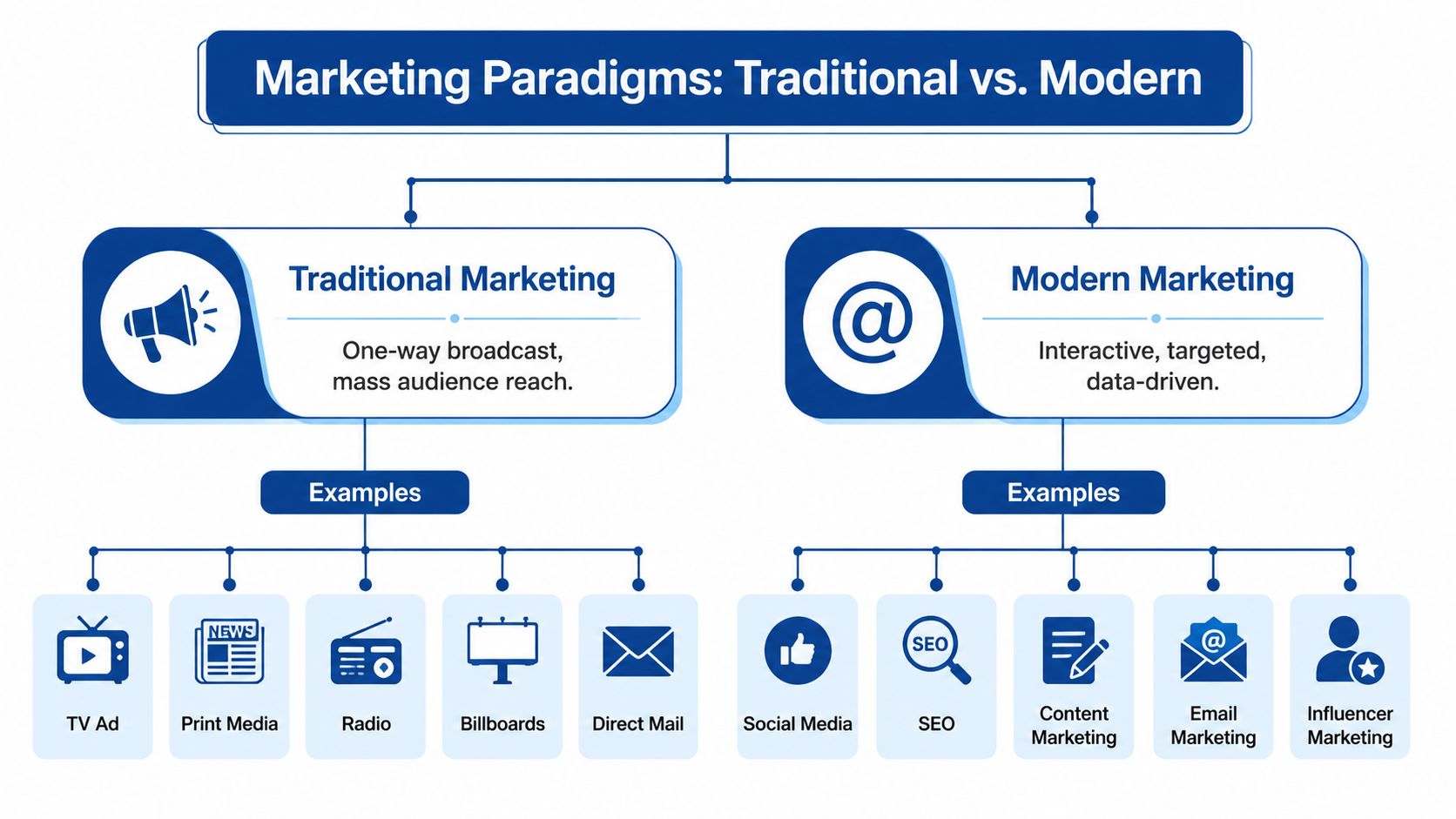
Traditional marketing in practical terms
Consider a front-page newspaper placement in a major English daily. It offers broad exposure and can reinforce credibility, especially when a brand wants to be seen by a wide urban audience. A regional radio campaign can also build repetition in a city or district where commute listening still matters.
The constraints are equally clear:
- Feedback is delayed: Performance is usually inferred from enquiries, store footfall, or sales movement after the campaign.
- Targeting is broad: You can select publication, geography, or programme context, but not user intent.
- Creative changes are harder: Revising a print or radio campaign usually requires more planning than editing a live ad set.
Modern marketing in practical terms
Now compare that with a Google Ads campaign targeting users in Bengaluru searching for “AI development services” or “warehouse management software”. The audience is smaller, but the intent is far stronger. A Meta campaign can retarget people who visited a pricing page but did not fill a form. An email workflow can re-engage leads who downloaded a brochure and then stopped responding.
A comparative study on Indian marketing performance indicators found that modern marketing strategies outperform traditional ones in brand awareness, customer engagement, and lead conversion rates, while also enabling real-time analysis of metrics such as CTR, conversion rates, and CLV through platforms like Google Ads, Meta Ads, and Amazon Ads in this comparative analysis published for the Indian context.
Traditional marketing buys exposure. Modern marketing buys learning as well.
That second benefit matters. Even when a digital campaign underperforms, it still generates usable insight. It may reveal weak messaging, the wrong audience, a pricing objection, or a poor landing page experience. Traditional campaigns can be highly effective for awareness, but they do not usually return the same level of operational intelligence.
Comparing KPIs ROI and Targeting
A campaign that cannot be measured precisely is difficult to scale responsibly. For Indian businesses deciding how to divide budgets between traditional and modern marketing, the real comparison is not channel versus channel. It is control versus uncertainty across three operating questions: which KPIs connect to revenue, how quickly can ROI improve after launch, and how accurately can spend reach likely buyers?
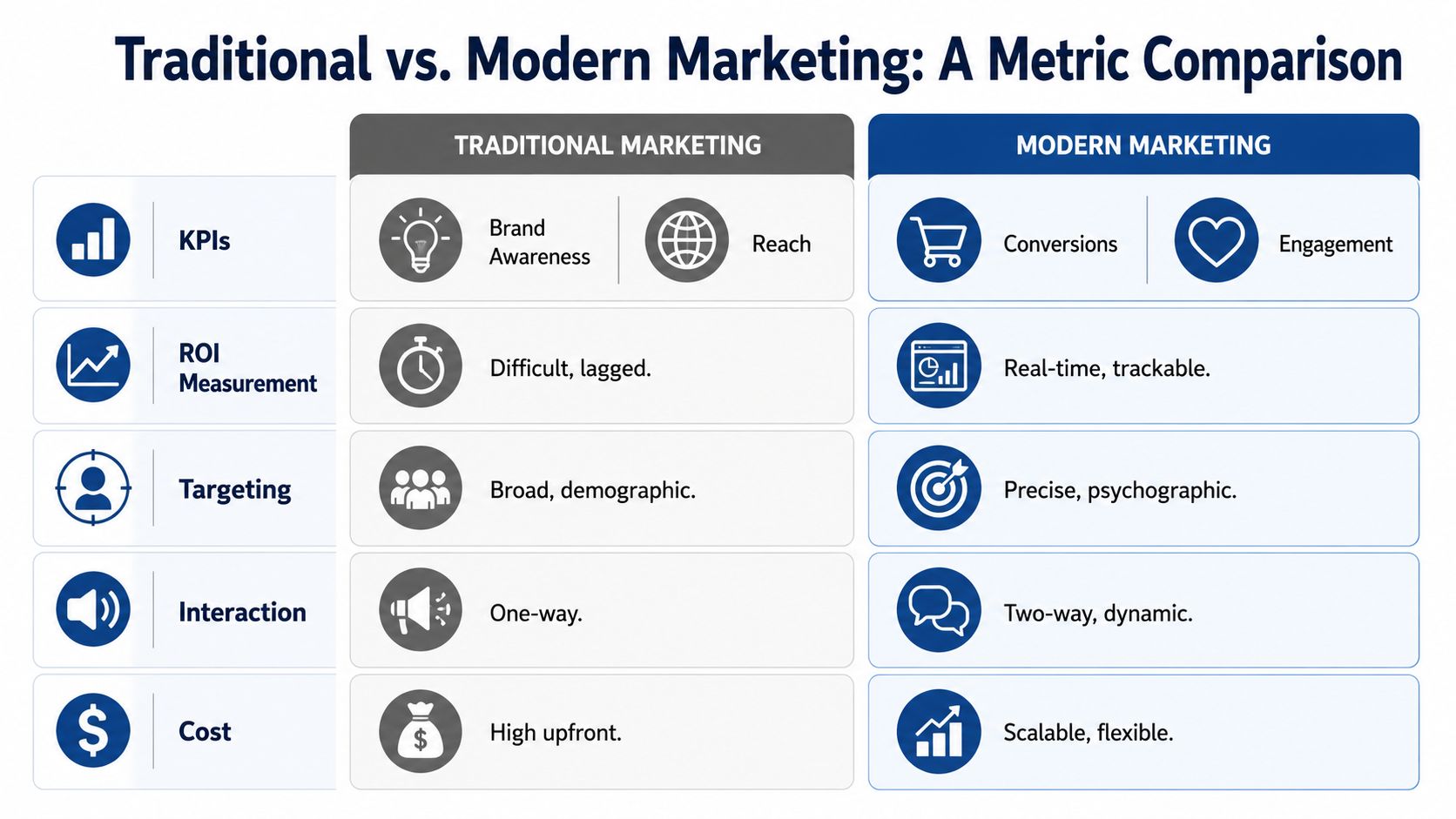
Measurement decides strategy
Traditional campaigns usually report proxy indicators such as circulation, estimated reach, share of voice, and recall. Those metrics are not useless. They help explain market presence. They are less effective at showing which placement, offer, or message produced qualified enquiries.
Modern marketing shifts reporting closer to commercial outcomes. Impressions and clicks matter only as leading indicators. The stronger KPI set is cost per qualified lead, conversion rate, repeat purchase rate, customer lifetime value, and assisted conversions across the full path from first visit to sale. That changes internal decision-making because marketing begins to function less like a visibility activity and more like a revenue system.
Brand Chanakya's 2026 comparison of performance and traditional marketing in India reports that performance marketing delivers real-time ROAS, a 3.5x higher lead conversion rate than traditional marketing, and a faster launch model with lower upfront commitment. The practical implication is larger than the headline number. If a campaign underperforms on day three, the team can still change bids, creative, audience filters, or landing pages before significant waste accumulates.
That flexibility matters in India's fragmented demand environment. A coaching brand in Kota, a D2C skincare brand selling across Maharashtra, and a B2B SaaS firm targeting logistics companies in Bengaluru all need different demand signals. A single metric like reach cannot tell these businesses whether they are buying attention or buying profitable intent.
A useful working split looks like this:
- Traditional KPI stack: Reach, frequency, recall, circulation, footfall lift
- Modern KPI stack: Cost per lead, lead-to-sale rate, ROAS, repeat rate, attribution path
- Management consequence: Modern campaigns can be adjusted during the spend cycle, not only after it ends
A short explainer is useful here:
ROI changes when campaigns can move fast
ROI is shaped by feedback speed as much as by media cost. Traditional formats often require advance booking, production timelines, and fixed inventory commitments. Once a print insertion, radio burst, or outdoor buy is live, mid-campaign correction is limited. If the message is weak, the loss is not only media spend. It is also the missed time window.
Digital campaigns behave differently. A retailer in Ahmedabad running Meta ads for a festive promotion can test two offers in parallel, identify which audience segment converts, and reallocate budget within days. A B2B exporter using Google Ads can compare high-intent search terms against broader awareness terms and pause expensive keywords that generate clicks but no qualified calls. Faster correction compresses waste.
That is why modern marketing often produces stronger performance in lead generation and demand capture. The advantage is not magic targeting software. It is shorter decision loops.
Decision filter: If the offer, pricing, or audience still needs validation, fixed media commitments increase risk.
Traditional ROI still has a place, but it should be judged differently. A local newspaper insertion or FM radio campaign may support dealer confidence, franchise visibility, or walk-in traffic in markets where digital attribution is incomplete. The mistake is treating every offline result as unmeasurable and every digital result as fully attributable. Neither assumption is correct.
A better hybrid model is to assign each channel a measurement method before launch. Use unique phone numbers, coupon codes, QR-led landing pages, store-level lift analysis, branded search trends, CRM source fields, and post-purchase surveys that ask, "Where did you first hear about us?" That will not produce perfect attribution. It will reduce guesswork enough to improve budget allocation quarter by quarter.
Targeting is where modern marketing usually creates the largest efficiency gain
Targeting often affects wasted spend more than creative quality. Traditional media is effective when a business needs broad recognition across a city or region. It becomes expensive when only a small fraction of the audience is actually in-market.
Modern marketing allows segmentation by search intent, prior site behaviour, funnel stage, geography, device, product interest, and previous engagement. For an Indian business selling industrial automation software, that means reaching procurement or operations audiences already researching relevant terms instead of paying for mass visibility among people with no buying role. For a D2C brand, it means separating first-time prospecting from cart-abandoner retargeting and repeat-customer upsell campaigns.
The commercial effect is straightforward. Better targeting reduces irrelevant impressions, improves conversion efficiency, and gives sales teams fewer low-quality leads to chase.
| Decision area | Traditional marketing | Modern marketing |
|---|---|---|
| Best at | Broad visibility and repeated market presence | Precision targeting and response capture |
| Weakest at | Fine-grained attribution and narrow buyer selection | Building offline familiarity in some local markets |
| Optimisation cycle | Slow, often tied to booking windows | Fast, with daily or intra-week changes |
| Audience logic | Demographic and geography-led | Intent, behaviour, and funnel-stage led |
| Reporting style | Post-campaign inference | Live dashboarding tied to actions |
For Indian businesses in 2026, the implication is practical rather than ideological. If growth depends on accountable lead flow, modern channels should carry the primary performance target. If the category depends on local trust, dealer networks, or older audiences, traditional channels may still deserve budget, but with explicit measurement rules attached. The firms that waste less are usually not the ones choosing one side. They are the ones defining which channel must deliver awareness, which must deliver conversion, and how both will be credited in the same reporting system.
The Hybrid Advantage Why Traditional Is Not Obsolete
Declaring traditional marketing dead is lazy analysis. A stronger conclusion is more conditional. Traditional channels are weaker for real-time optimisation, but they can still be highly effective when trust, local familiarity, and repeated offline presence shape buying behaviour.
That is especially relevant outside the largest metros. For India's tier-2 and tier-3 markets, hybrid strategies such as radio plus social media outperform pure digital for small-town brands in 2025, with 68% higher trust retention among older demographics versus 42% for digital-only, according to OCP Academy's India-focused review of digital and traditional marketing.
Trust still has a geography
Older audiences in smaller towns often do not reject digital. They simply do not grant it instant credibility. A local radio mention, print insertion, shopfront branding, or event sponsorship can provide legitimacy that a standalone Instagram campaign may struggle to establish.
That creates a useful strategic sequence. Traditional media can create recognition and trust. Digital channels can then capture response, continue the conversation, and track downstream action more effectively.
A practical hybrid playbook
Consider a regional retail business running a festival promotion. Radio announces the offer in the local language. In-store posters carry a QR code. The QR code leads to a WhatsApp opt-in for an exclusive coupon. Meta retargeting then reminds people who engaged but did not visit the store.
That model works because each channel handles the job it does best:
- Radio or print builds familiarity: The message feels local and credible.
- QR codes or promo codes bridge attribution: Offline exposure gets connected to a digital action.
- WhatsApp or social retargeting deepens response: The business follows up with more relevant messaging.
Do not ask whether traditional or modern marketing wins in isolation. Ask which channel should create trust and which should capture intent.
The companies that get this right do not treat hybrid as compromise. They treat it as sequencing. Broad offline credibility first where needed. Targeted digital conversion next where possible.
Your Roadmap to Marketing Modernisation
Most Indian businesses do not need a dramatic channel overhaul. They need a controlled transition from assumption-led marketing to evidence-led marketing. The most reliable roadmap starts with visibility, moves into testing, and only then scales.
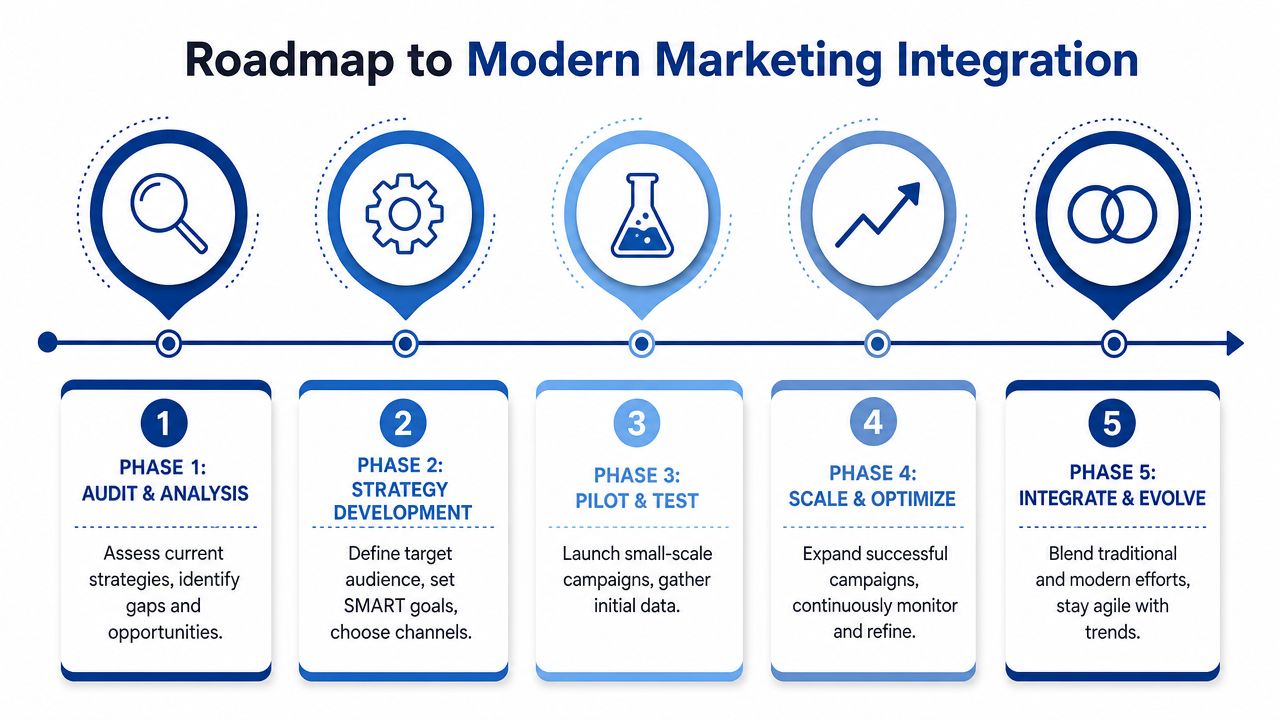
Phase one to three
Phase 1 is audit and attribution readiness. Start by listing every active channel, current spend bucket, campaign objective, and observable result. If a campaign cannot be tied to enquiries, sales conversations, store visits, or repeat purchase behaviour, classify it as low-visibility spend rather than guaranteed value.
A useful audit checklist:
- Channel review: Separate brand-building channels from lead-generation channels.
- Tracking review: Add QR codes, unique promo codes, dedicated landing pages, call tracking workflows, and CRM source tagging where possible.
- Creative review: Check whether the same message is being pushed everywhere without regard to audience intent.
Phase 2 is KPI redesign. Many firms still judge campaigns by vanity signals because those are the only numbers available. Replace vague reporting with a smaller operating dashboard. For digital channels, that usually means conversions, lead quality, cost efficiency, and stage progression through the funnel. For offline channels, use bridge metrics such as code redemptions, tracked enquiries, or visits to dedicated campaign URLs.
Phase 3 is pilot testing. Do not move your full budget at once. Run contained experiments in channels that generate signal quickly. Search campaigns are useful for capturing existing demand. SEO and content support long-term compounding visibility. Retargeting helps recover interest that would otherwise disappear after the first website visit.
Operating principle: Small pilots are not a sign of caution. They are how disciplined teams buy insight before they buy scale.
Phase four and five
Phase 4 is scale and optimise. Once a campaign proves that it can generate qualified action, increase investment in stages. Expand keywords, audiences, regions, or creatives one at a time so you can still identify what changed the result. Teams often break performance by scaling too many variables together.
This is also the point to add automation. AI-assisted tools can help classify leads, segment audiences, personalise email flows, summarise call notes, and identify patterns in campaign performance. Automation works best after tracking discipline is in place. Without clean data, it only speeds up confusion.
Phase 5 is integration. The mature state is not digital-only. It is coordinated marketing where each channel has a clear role. Search captures active intent. Social builds engagement and retargeting pools. Email nurtures demand. Offline channels support trust where buyer behaviour still favours physical presence or local familiarity.
A sensible modernisation roadmap usually includes these decisions:
- Keep only the traditional channels that support a distinct business purpose.
- Shift performance expectations toward trackable channels.
- Build one reporting view across campaigns, CRM activity, and sales outcomes.
- Review creative by audience segment rather than by channel alone.
- Revisit the mix regularly because buyer behaviour changes faster than annual plans.
Marketing modernisation is not about replacing every old tactic. It is about ending blind spend.
Marketing Strategy by Business Size
The right answer in traditional vs modern marketing changes with team size, sales complexity, and cash discipline. A founder-led startup needs speed and learning. An SME needs efficiency plus local relevance. A large enterprise needs coordination across multiple teams, markets, and attribution layers.
Startups
Startups should lean heavily toward modern channels because they need feedback before they need broad fame. Search, SEO, content, LinkedIn outreach, email sequences, and tightly targeted paid social campaigns usually provide the clearest path to message testing and early demand capture.
The key is sequencing. Start with one core audience, one clear offer, and one conversion action. If users are not clicking, filling forms, booking demos, or buying, the startup learns quickly and can revise the offer or landing page without wasting months on broad awareness campaigns.
A startup's channel logic should look like this:
- Search and SEO: Capture active need and build discoverability around category terms.
- Content marketing: Explain the problem, educate the buyer, and improve trust before sales outreach.
- Retargeting and email: Recover visitors who showed interest but did not act.
Traditional tactics can still make sense in selective situations, such as trade events, local launch activations, or industry print placements where a niche audience gathers. But for most startups, modern channels should do the heavy lifting because they reveal whether product-market fit is forming.
SMEs
SMEs usually need a more balanced model. They often serve a mix of repeat local customers, referral-driven business, and digital discovery. That makes them strong candidates for hybrid execution.
A local manufacturer, clinic, retailer, or service company can combine offline visibility with digital tracking. Store signage, local print, or radio can support familiarity, while Google Business Profile optimisation, search ads, WhatsApp workflows, and review generation convert that familiarity into measurable response.
The biggest SME mistake is fragmentation. One agency handles creative, another runs ads, the website is not built for conversion, and leads sit in spreadsheets. The fix is not only better media buying. It is tighter operational flow from impression to enquiry to follow-up.
Use this decision lens:
| SME scenario | Better traditional use | Better modern use |
|---|---|---|
| New locality launch | Local radio, print inserts, outdoor presence | Maps visibility, local search ads, WhatsApp capture |
| Steady lead generation | Events or community presence | Search, retargeting, email nurture |
| Repeat customer growth | In-store material and local partnerships | CRM campaigns, remarketing, loyalty messaging |
Enterprises
Enterprises face a different problem. They rarely lack channels. They lack integration. Multiple brands, regional teams, sales layers, and agency partners often create reporting silos that make true attribution difficult.
For enterprise teams, modern marketing should anchor a full-funnel measurement model. Paid media, content, CRM, analytics, product usage, and sales activity should feed one decision process. Traditional media may still play an important role for scale, market stature, and category leadership, but it should not sit outside the measurement conversation.
The hiring implication is also different. Startups can manage with generalists for a period. Enterprises usually need specialists in analytics, automation, lifecycle marketing, media buying, creative operations, and web performance. When those skills are not available in-house, resource augmentation can be more practical than waiting through slow permanent hiring cycles.
Large organisations do not lose performance because they lack spend. They lose it because no one owns the full path from media to revenue.
Answering Your Top Marketing Questions
How do I measure traditional marketing ROI
Offline ROI becomes measurable once each campaign creates a traceable response path. The common mistake is trying to prove exact causation for every impression. A better approach is to assign each offline activity one primary response action, then compare cost, leads, qualified leads, and revenue against that action over a fixed time window.
For Indian businesses, the practical setup is straightforward:
- Print inserts and flyers: use a city-specific landing page, a unique coupon code, or a local phone number.
- Radio: use a memorable WhatsApp number or a spoken keyword that sales staff can log in the CRM.
- Outdoor hoardings: direct traffic to a short vanity URL or QR code tied to one location.
- Events and exhibitions: tag every lead by source, sales stage, and final deal value inside the CRM.
Hybrid attribution often fails at the handoff, not the media buy. A newspaper ad may create demand, but if the customer later searches your brand and converts through Google Ads, the digital channel gets too much credit unless your team tracks first touch, assisted touch, and last touch together.
Use a simple reporting model first. Track four numbers by campaign: response volume, cost per lead, lead-to-sale rate, and revenue per acquired customer. The objective is to end blind spend.
Can I start modern marketing with a small budget
Yes, but sequencing matters more than channel count. A business with ₹25,000 to ₹75,000 per month usually gets better results by fixing conversion basics before adding more media.
Start with assets that continue working after the campaign ends. That usually means a fast mobile site, clear landing pages, Google Business Profile optimisation, review collection, basic email or WhatsApp capture, and search campaigns around high-intent terms. For example, a local clinic in Pune or Coimbatore is often better served by ranking for treatment-specific searches and capturing calls than by spreading a small budget across Instagram, display, and video at the same time.
Paid social can work on a small budget, but only if the offer is clear and follow-up is disciplined. If response handling is slow, the cheapest lead source often becomes the most expensive acquired customer source.
What should I stop doing first
Stop spending on channels that cannot be tied to a defined job in the funnel. Every channel should have a role such as awareness in a launch zone, lead capture for a service category, store walk-ins, distributor enquiries, or repeat purchase.
The problem is rarely traditional media itself. The problem is unscoped media. A regional brand running FM radio in one city, print in another, and boosted social posts everywhere without separate offers, tracking paths, or geography-level reporting will struggle to tell which activity is driving sales.
Keep trust-building formats if they support conversion elsewhere. Cut activity that produces reach reports but no measurable commercial signal.
What is the most important marketing role to hire in 2026
Hire the person who can connect spend to revenue. For many Indian SMEs, that is not a pure brand marketer or a junior performance executor. It is a data-literate growth marketer, marketing analyst, or fractional marketing lead who can set up tracking, define KPIs, audit funnel leakage, and help sales and marketing work from the same source data.
That hire matters even more in a hybrid model because attribution breaks across teams. One person should own campaign taxonomy, CRM source rules, dashboard logic, and channel review cadence. Without that discipline, businesses often increase budget before they improve measurement, which is how wasted spend becomes normalised.
If execution capacity is the bottleneck after measurement is in place, then add channel specialists.
If you're rethinking your channel mix, attribution setup, or digital growth model, LitSpark Solutions Private Limited can help you turn that strategy into execution. The Bangalore-based team combines AI, automation, product development, performance marketing, creative, and on-demand technical talent so businesses can modernise faster without building every capability from scratch.
- traditional vs modern marketing
- digital marketing india
- marketing strategy
- marketing roi
- business growth