Designing18 min read
Website Redesign Services: Boost Your Site in 2026
Transform your site with expert website redesign services. Learn process, costs, & ROI to boost conversions & drive growth for 2026.
By the LitSpark Solutions team · Updated
- AI Automation
- Advertising
- Designing
- Development
- Digital Marketing
- MVP
- Resource Hiring
- Shoot

75% of users in India judge a company’s credibility by its website design, according to these web design statistics for 2025. That single number changes how a business should think about website redesign services. This isn’t a branding exercise in the narrow sense. It’s a trust exercise, a conversion exercise, and often a revenue exercise.
That matters even more in a market where India’s digital economy is projected to reach $1 trillion by 2026, as noted in the same 2025 web design statistics round-up. If your site feels dated, slow, hard to use, or disconnected from your sales process, it’s not just underperforming. It’s creating friction at the exact point where a buyer is trying to decide whether to trust you.
The best website redesign services fix that at the system level. They improve speed, content hierarchy, mobile usability, technical SEO, analytics, lead flows, and the way your team updates the site after launch. The visual layer matters, but it’s only one part of the job.
Table of Contents
- Why Your Website Is a Growth Engine Not a Brochure
- What Exactly Are Website Redesign Services
- The Scope and Deliverables Driving Real Results
- Your Redesign Roadmap From Discovery to Launch
- Decoding Redesign Costs and Measuring True ROI
- A Checklist for Choosing Your Redesign Partner
- Learning from Success Stories and Common Pitfalls
- How LitSpark Delivers Redesigns with Measurable Impact
Why Your Website Is a Growth Engine Not a Brochure
A brochure explains. A growth engine qualifies, persuades, captures demand, and moves buyers to the next step.
That distinction matters because many businesses still brief a redesign around surface-level changes. They ask for a cleaner homepage, fresher colours, and a modern font system. Those things can help, but they won’t solve a weak lead funnel, poor page structure, confused messaging, or friction in the conversion path.
A good site has a job to do. For a B2B company, that usually means creating trust fast, clarifying the offer, and making enquiry or demo actions feel obvious. For an e-commerce brand, it means reducing hesitation, improving product discovery, and removing technical friction before checkout. For either model, the website should support acquisition, not just brand presence.
Trust starts before your sales team does
When people land on your site, they’re already evaluating whether your business looks credible, current, and safe to engage with. Structure, spacing, visual hierarchy, copy clarity, and mobile usability all influence that judgment. Teams that understand UX design fundamentals usually avoid a common mistake. They stop treating design as decoration and start treating it as guided decision-making.
Your homepage isn’t your pitch deck. It’s the front door to a buying journey.
That’s why redesign work often sits close to marketing and sales goals. If the site can’t support paid traffic, organic search growth, lead qualification, or product education, it becomes a drag on every downstream channel. That’s also why redesign and performance strategy should work together. A site rebuilt without considering acquisition usually needs another round of fixes later. For businesses planning broader growth activity, redesign decisions should align with digital marketing services, not sit in a separate silo.
What changes when you treat the site like an asset
The conversation shifts from “What should it look like?” to questions that move the business:
- Which pages influence pipeline most
- Where users drop off before converting
- What content supports high-intent traffic
- Which technical issues hurt search visibility or speed
- How the site should support future campaigns, integrations, and testing
That’s the frame worth using. Website redesign services create the most value when they improve commercial performance, not when they focus on making an old site look newer.
What Exactly Are Website Redesign Services
Website redesign services are often misunderstood because the term covers very different levels of work. At the light end, a redesign can mean a visual refresh with updated brand assets and cleaner page layouts. At the serious end, it means restructuring the site around performance, usability, search visibility, content logic, and business goals.
That difference is where many projects go wrong. A reskin changes what users see. A redesign changes how the site works.
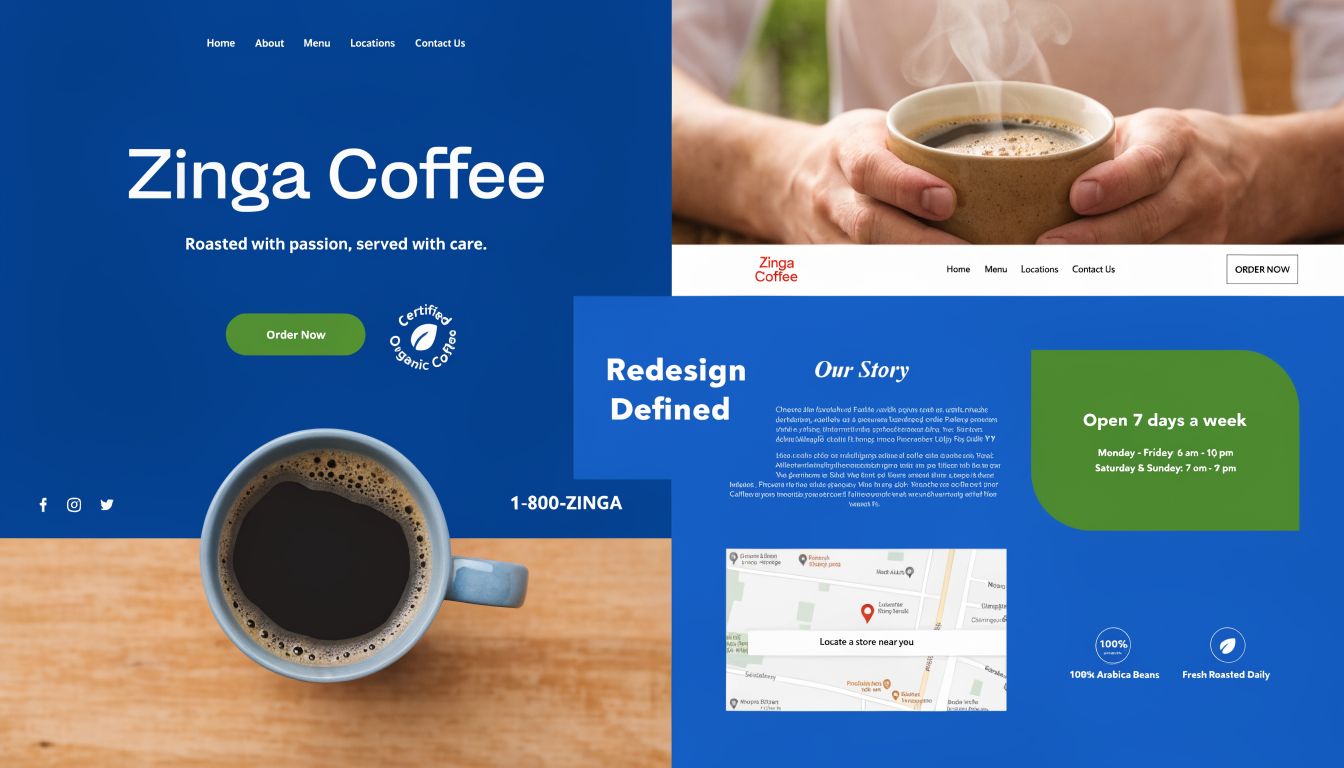
A reskin is not the same as a redesign
If your current site has deeper issues, a cosmetic pass won’t fix them. Those issues often include clumsy navigation, weak mobile layouts, broken content hierarchy, outdated CMS setups, tracking gaps, insecure forms, or pages that rank poorly because the site architecture is fragmented.
In practice, website redesign services usually start when a business sees one or more of these signals:
- Lead quality has dropped and the site no longer filters intent well
- Bounce behaviour is high because pages are slow, cluttered, or unclear
- The tech stack is ageing and updates are risky or expensive
- The business has rebranded and the old site no longer matches its market position
- New functionality is needed such as CRM integration, gated content, advanced forms, or personalised experiences
One of the clearest reasons to act is user experience. 88% of Indian online consumers say they are unlikely to return after a poor experience, and redesigns have reduced bounce rates by an average of 35% for Indian e-commerce platforms, according to this industry page covering web design services.
What clients are actually buying
A proper redesign isn’t just design time and development time. It usually includes diagnosis, prioritisation, and decision-making. Someone has to define what stays, what goes, what gets merged, what gets redirected, what gets rebuilt, and how success will be measured after launch.
That’s why the most useful way to define website redesign services is this:
A structured process that replaces an underperforming website with one that is easier to trust, easier to use, easier to manage, and better aligned with lead generation, sales, or customer retention.
Some projects need a full rebuild. Others need selective redesign of high-value page groups, checkout paths, or service pages. The right scope depends less on aesthetics and more on where the site is failing the business.
The Scope and Deliverables Driving Real Results
When clients ask what’s included in website redesign services, the honest answer is that it depends on the business model, the platform, and the performance problems being solved. But the structure is usually consistent. Strong projects cover strategy, UX, content, development, SEO foundations, QA, launch, and post-launch measurement.
What changes is the depth.
What a serious redesign usually includes
Some deliverables directly affect conversion. Others protect existing traffic and reduce the risk of losing visibility after launch. Both matter.
A redesign with real commercial intent usually includes:
- Discovery and audit work. This covers stakeholder interviews, analytics review, user journey mapping, and an audit of technical, content, and UX issues.
- Information architecture. The page hierarchy, menu logic, internal linking, and content grouping are revised so users can find the right path quickly.
- Wireframes and UI design. These define layout, hierarchy, CTA placement, form logic, and page-by-page behaviour before visual design is finalised.
- Content refinement and migration planning. Existing pages are evaluated instead of blindly copied into the new build.
- Development and CMS implementation. The site is rebuilt with performance, maintainability, and responsiveness in mind.
- Technical SEO and redirect mapping. Metadata, crawl structure, canonicals, schema where relevant, and redirect handling are addressed before launch.
- QA and launch support. This includes browser testing, mobile checks, form testing, event tracking, and post-launch validation.
One practical reference point for design and build scope is a team that can cover both interface work and implementation. For example, website and UI design services are typically most effective when they’re planned alongside development and analytics, not handed off in isolation.
Anatomy of a Website Redesign Project
| Service Area | Key Deliverables | Business Outcome (ROI Driver) |
|---|---|---|
| Strategy and discovery | Stakeholder workshops, analytics review, competitor scan, user journey audit | Better prioritisation, fewer wasted features, clearer conversion goals |
| UX and information architecture | Sitemap, navigation model, wireframes, CTA flows, form logic | Lower friction, easier navigation, stronger lead paths |
| Visual design | UI system, responsive page designs, component library, brand alignment | Higher trust, stronger perceived credibility, more consistent experience |
| Content and messaging | Content audit, rewrite priorities, migration map, page templates | Clearer offers, better qualification, stronger SEO relevance |
| Development | Front-end build, CMS setup, integrations, responsive implementation | Faster site operations, easier internal management, scalable platform |
| Technical SEO | Redirect map, metadata planning, crawlability checks, structured foundations | Preserved rankings, safer migration, stronger discoverability |
| QA and launch | Device testing, speed checks, event tracking, form validation, launch checklist | Fewer post-launch issues, cleaner attribution, reduced revenue risk |
| Optimisation | Analytics review, heatmap feedback, A/B priorities, content tuning | Continuous improvement after launch |
Deliverables only matter if they tie to outcomes
The trap is treating scope as a checklist. A redesign isn’t valuable because it includes wireframes or a component library. It’s valuable when those artefacts reduce ambiguity, remove friction, and produce a site that can support campaigns, search, and sales activity.
Practical rule: If a deliverable can’t be tied to a business outcome, challenge whether it belongs in scope.
That’s also why experienced teams push back on vague requests. “Make it modern” isn’t a deliverable. “Reduce friction on demo enquiries from mobile users” is. One creates opinion loops. The other creates a project.
Your Redesign Roadmap From Discovery to Launch
The redesign process should never feel like a black box. The strongest projects move through visible phases with clear approvals, controlled revisions, and disciplined handoffs. That’s what keeps scope from drifting and budgets from expanding unexpectedly.
A simple roadmap helps clients understand where decisions happen and why some choices must be locked before development starts.
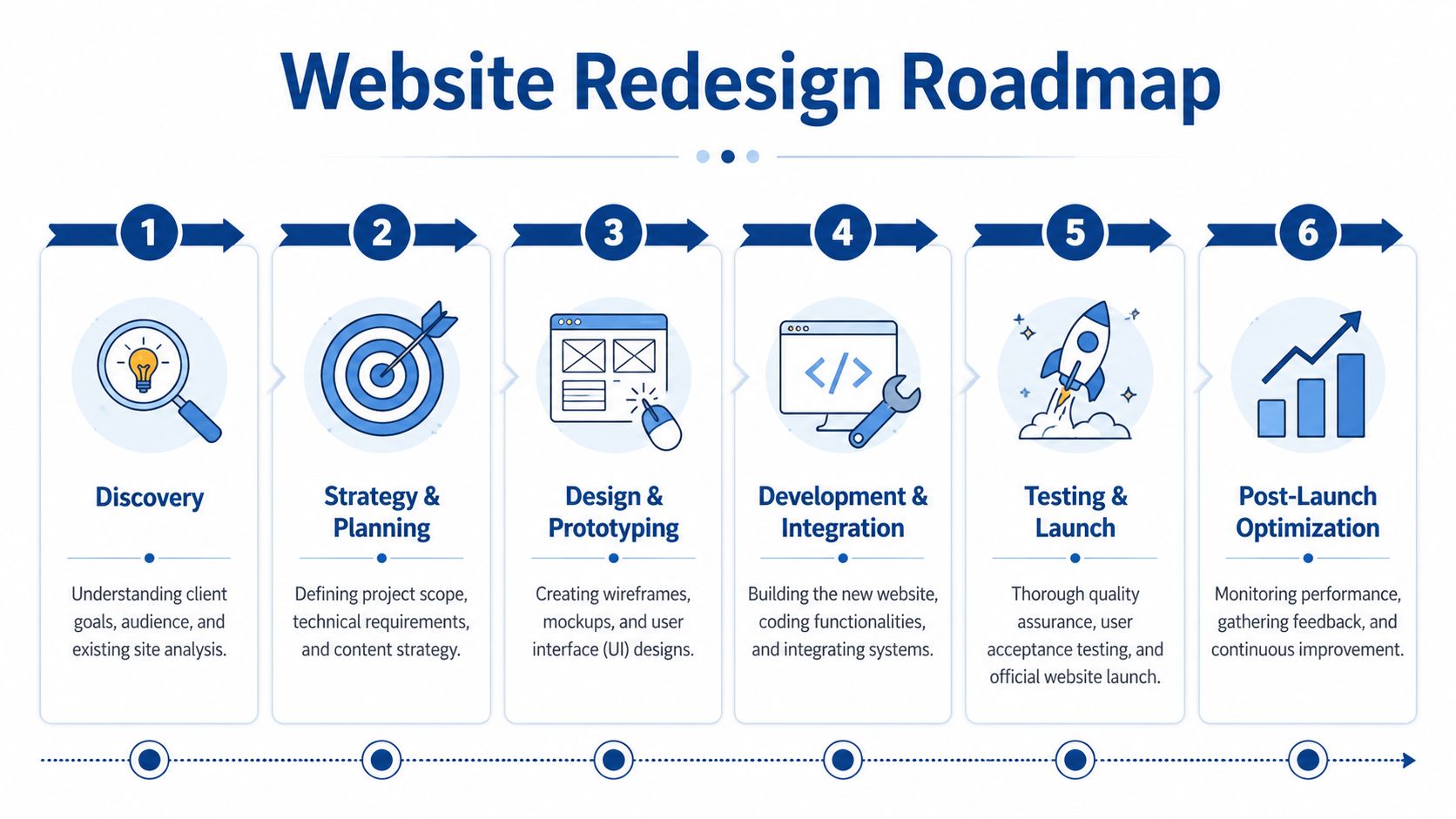
The phases that keep projects controlled
A typical roadmap looks like this:
Discovery
The team reviews analytics, current user journeys, business goals, key pages, technical debt, and stakeholder expectations. This stage also surfaces what not to rebuild.
Strategy and planning
Scope is finalised. The sitemap, page priorities, CMS approach, integrations, and content requirements are defined. At this stage, expensive ambiguity should be removed.
Design and prototyping
Wireframes come first. High-fidelity designs come after the underlying page logic is agreed. When teams skip that order, visual revisions pile up because structural questions were never resolved.
A capable build partner should also be able to carry the work through implementation. That often means working with a dedicated web development team that can handle CMS decisions, custom functionality, testing, and launch readiness inside the same process.
A quick walkthrough can help visualise how redesign thinking translates into build decisions:
Where performance work earns its keep
The build phase is where many redesigns either become profitable or become expensive theatre.
Development isn’t just about reproducing approved screens. It’s where page weight, script handling, image delivery, layout stability, component reuse, tracking, form reliability, and mobile responsiveness are decided. For Indian e-commerce sites, every 100ms improvement in Largest Contentful Paint can increase conversion rates by up to 1.2%, according to this website redesign checklist discussing Core Web Vitals.
That’s why Core Web Vitals work shouldn’t be treated as a post-launch clean-up task. It needs to be designed into the build.
Teams usually get better outcomes when they enforce a few key principles:
- Wireframe approval before visual refinement
- Content freeze before final QA
- Redirect planning before migration
- Tracking validation before go-live
- Rollback planning before DNS and launch steps are executed
Slow pages don’t just frustrate users. They distort campaign efficiency because paid traffic lands on a weaker experience than the media plan assumes.
The final phases are QA, launch, and optimisation. That’s where forms are tested, analytics events are checked, redirects are verified, and stakeholders review live behaviour. A launch is not the finish line. It’s the first clean data point after the rebuild.
Decoding Redesign Costs and Measuring True ROI
A redesign is easier to approve when the commercial model is clear. The problem is that many proposals still bundle strategy, design, development, migration, SEO, analytics, and post-launch fixes into one line item, which makes cheap quotes look comparable when they are not.
In practice, cost follows business risk.
A five-page marketing site with stable content and no integrations is a different job from a lead-generation site tied to a CRM, ad platforms, event tracking, regional landing pages, and an existing base of organic traffic. Both may be called a redesign. Only one carries serious migration, attribution, and revenue risk.
What actually pushes redesign costs up
Page count matters, but it is rarely the main driver. These are the factors that usually change the budget in a meaningful way:
- Business model complexity. Brochure sites are simpler than websites with product catalogues, gated resources, user logins, quote flows, bookings, or multi-step forms.
- Content quality and volume. Weak messaging, duplicated pages, outdated service copy, and inconsistent CTAs create extra strategy, writing, and review cycles.
- Integration work. CRM sync, marketing automation, analytics setup, payment systems, ERP connections, and custom APIs add implementation time and testing overhead.
- Design system depth. A few reusable templates cost less than a full component library with variant states, localisation rules, and governance for future teams.
- Search migration risk. Sites with existing rankings need URL mapping, redirect rules, metadata control, indexation checks, and post-launch monitoring.
- Decision-making load. More stakeholders means more revisions, more workshops, and more time spent getting alignment.
Budgets often get distorted. Low-cost proposals often exclude tracking architecture, content restructuring, redirect mapping, structured QA, or post-launch support. Those line items do not disappear. They either resurface later as change requests or show up as lost leads, broken attribution, and traffic drops.
ROI starts before design starts
The right way to evaluate a redesign is to tie the work to financial outcomes before the first wireframe is approved. For a B2B company, that usually means more qualified leads, a higher visitor-to-enquiry rate, and lower customer acquisition cost from paid and organic channels. For e-commerce teams, it may mean better conversion rate, stronger average order value, and less checkout drop-off.
The Indian market makes this more important, not less. Paid traffic is expensive in competitive categories, sales cycles often involve multiple touchpoints, and many businesses still under-measure what happens between landing page visit and sales conversation. A redesign that improves conversion and attribution can make the same media spend work harder.
A useful measurement model looks like this:
| ROI lens | What to track |
|---|---|
| Lead generation | Form submissions, booked calls, qualified enquiries, demo requests |
| Revenue contribution | Assisted conversions, pipeline created, sales accepted leads, checkout completion |
| Traffic efficiency | Organic landing page performance, paid landing page conversion rate, bounce rate by source, branded versus non-branded acquisition |
| Cost control | Customer acquisition cost, cost per qualified lead, reduced spend on manual fixes or patchwork development |
| Operational efficiency | Faster content publishing, fewer support tickets, lower developer dependency for routine updates |
| Reporting accuracy | Event tracking coverage, campaign attribution quality, funnel visibility across devices and channels |
I usually advise clients to model return in scenarios. If conversion rate improves by a small margin, what does that mean over 12 months at current traffic levels? If technical SEO fixes recover lost visibility on high-intent pages, how many extra enquiries would that create? If the team can finally trust channel attribution, which campaigns get cut and which get more budget? Those are board-level questions. A redesign should answer them.
Good reporting setup matters here. Teams that plan analytics during discovery get cleaner decision-making after launch than teams that add tags at the end. Tools such as Google analytics mcp are relevant because they reflect the broader requirement: analytics must be designed into the project, with defined events, conversion points, and reporting ownership.
If success cannot be measured, ROI cannot be defended.
The better client question is not “what does a redesign cost?” It is “what revenue, efficiency, or acquisition gains should this site produce, over what timeframe, and what has to be included in scope to get there?” That question leads to a much smarter budget.
A Checklist for Choosing Your Redesign Partner
Choosing the agency matters more than choosing the colour palette, the CMS logo, or the animation style. A weak partner can burn budget even with a decent brief. A strong one will challenge assumptions, tighten scope, and connect the work to outcomes that matter.
The easiest way to tell the difference is by the questions they ask.
Questions worth asking before you sign
A serious redesign partner should be comfortable answering these without slipping into generic portfolio talk:
How do you define success for a redesign like ours?
Listen for metrics, business goals, and user behaviour. Be cautious if the answer stays purely visual.What’s your process for handling existing SEO equity?
They should discuss content inventory, URL mapping, redirect planning, and validation.How do you decide what content to keep, rewrite, merge, or remove?
Migration discipline matters. Copying everything into a new design is rarely the right move.What happens between design approval and launch?
You want to hear about build standards, QA, analytics checks, browser testing, and launch protocols.How do you handle scope changes?
This tells you whether the partner has a mature project process or absorbs chaos until things break.Who is responsible for analytics and tracking validation?
If nobody owns this, reporting will be unreliable after launch.
Red flags that usually lead to expensive rework
Some warning signs show up early if you know where to look.
| Red flag | Why it matters |
|---|---|
| They talk about aesthetics before business goals | It usually means strategy is thin |
| They don’t ask for analytics access | They’re designing in the dark |
| They promise a fixed answer before discovery | They may be underestimating complexity |
| They avoid SEO migration details | Rankings can drop after launch |
| Their proposal is vague about QA and post-launch support | Risk is being passed back to you |
| They quote unusually low without explaining exclusions | Critical work may be missing from scope |
A reliable agency will also be transparent about trade-offs. Sometimes a full rebuild is justified. Sometimes it isn’t. Sometimes the right move is to redesign only the pages that influence pipeline most, stabilise tracking, and phase the rest later.
That kind of restraint is a good sign. It usually means they’re solving the business problem, not trying to maximise project size.
Learning from Success Stories and Common Pitfalls
The easiest way to understand website redesign services is to look at the before-and-after logic behind successful projects. Not brand names. Not inflated claims. Just the mechanics of what changed and why it worked.
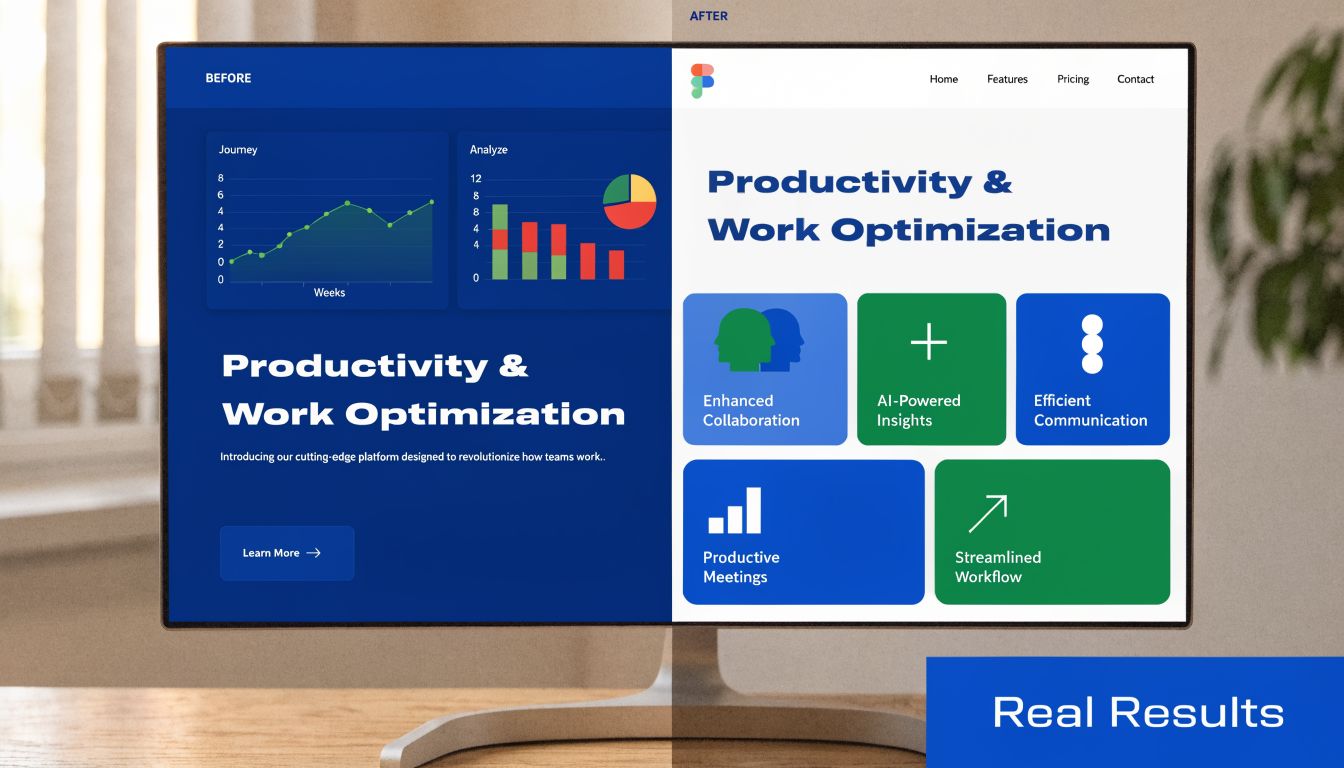
What successful redesigns usually get right
Scenario one. A B2B services firm with strong traffic but weak enquiries.
The old site looked respectable, but the homepage tried to say everything at once. Service pages were broad, the forms asked for too much, and there was no clear path from search landing page to consultation request. The redesign focused on message hierarchy, shorter forms, stronger internal linking, and tighter service-page intent. The visual update helped, but clarity did most of the work.
Scenario two. A D2C brand with decent product demand but heavy mobile friction.
The site had large media assets, inconsistent product page layouts, and sluggish mobile behaviour. The redesign simplified templates, reduced visual noise, and treated mobile product discovery as the main journey instead of a secondary one. Checkout support content became easier to find. Returns, shipping, and trust signals moved closer to the buying decision.
Most successful redesigns don’t win because they add more. They win because they remove confusion.
Scenario three. A startup after a positioning shift.
The company had changed its offer, but the website still reflected an earlier stage of the business. Investors, prospects, and potential hires all landed on a site that no longer matched reality. The redesign aligned the narrative, clarified product value, and gave internal teams a flexible CMS structure so they could keep pace after launch. That’s a common but underappreciated win. A redesign should reduce future content bottlenecks, not create them.
Pitfalls that keep showing up
The most expensive redesign mistakes aren’t usually dramatic. They’re procedural.
Skipping content strategy
Teams often spend heavily on design, then paste old copy into new layouts. The result looks fresh but still communicates poorly.Treating mobile as a responsive afterthought
If the core buying or enquiry journey isn’t designed mobile-first, the site can feel polished on desktop and weak where most real users experience it.Ignoring redirect planning
When URLs change without disciplined mapping, organic visibility and referral equity can be lost.Choosing a CMS based only on familiarity
The easiest platform for the internal team today might become limiting when content operations, localisation, landing page creation, or integrations expand.Launching without measurement discipline
If event tracking, attribution logic, and form validation aren’t checked before launch, teams end up debating performance with incomplete data.
A useful way to think about redesign risk is simple. Design errors are visible. Structural errors are usually invisible until traffic, leads, or campaign efficiency suffer.
How LitSpark Delivers Redesigns with Measurable Impact
A redesign earns its budget when it improves conversion rate, protects organic traffic, shortens sales cycles, or lowers acquisition cost. That is the standard LitSpark applies. The work is not organised around mockups alone. It is organised around business targets, operational constraints, and the metrics that will prove whether the rebuild paid off.
In practice, that means starting with diagnosis. LitSpark reviews where the current site is underperforming across messaging, UX, page speed, crawlability, form flow, tracking, and CMS usability. The goal is to find the expensive failure points first. A weak enquiry path, poor mobile interaction, or broken attribution setup can cost more than outdated visuals.
The delivery model brings strategy, design, development, and measurement into one workflow. That matters because redesign problems often sit between disciplines. A design decision can hurt search visibility. A development shortcut can weaken Core Web Vitals. A content migration choice can break campaign attribution. Keeping those decisions connected reduces rework and protects launch quality.
AI also has a place here, but only where it improves commercial performance or team efficiency. Personalised content blocks, smarter search, assisted content operations, and faster testing cycles can help. They also add complexity. The right question is not whether AI is trendy. The right question is whether it can increase relevance, improve conversion paths, or reduce manual effort without making the site harder to manage.
For businesses that want one accountable partner across redesign strategy, UI/UX, development, analytics, and growth alignment, LitSpark Solutions Private Limited offers that combined model. That structure usually works well for companies that need the site to support both brand credibility and measurable pipeline generation.
The real deliverable is a stronger revenue system, backed by cleaner data and a site your team can actually run after launch.
That is the benchmark. If the redesign looks better but leaves lead flow, search performance, tracking quality, and internal publishing efficiency unchanged, the business has paid for surface improvement instead of measurable impact.
If you’re assessing a redesign and want a practical conversation about scope, technical risk, ROI, and rollout planning, speak with LitSpark Solutions Private Limited.
Prepared with Outrank
- website redesign services
- website redesign process
- website redesign cost
- web design company
- digital transformation