AI Adoption in Indian SMEs: What the 2026 Data Says
AI adoption in Indian SMEs in 2026: what five surveys say about usage, integration gaps and barriers, plus real examples and a 90-day plan for results.

LitSpark Solutions Team
On This Page21 sections
- Table of Contents
- AI adoption in Indian SMEs: the 2026 numbers at a glance
- How Indian SMEs actually use AI today
- Communication and content come first
- General-purpose assistants do most of the work
- Back office before customers
- The real gap: wide usage, shallow integration
- Barriers to AI adoption for SMEs in 2026
- What SMEs getting real results do differently
- Accolade Electronics: redesign the work, keep the team
- TejasInfo and City Connect: build the foundation first
- Manufacturing examples from the WEF playbook
- How Indian SMEs can move from experiments to results in 90 days
- What comes next for AI adoption in MSMEs in India
- Frequently asked questions
- What percentage of Indian SMEs use AI in 2026?
- What are the main barriers to AI adoption in MSMEs in India?
- How are small businesses in India using AI?
- How should an SME start using AI properly?
- Keep Reading.
- Want Help Putting This Into Practice?
Most surveys now agree on one thing: AI adoption in Indian SMEs is no longer a question of "if". Between two-thirds and three-quarters of small and mid-sized businesses surveyed in 2026 say they use AI in some form. The harder question is what that use actually looks like, and why so little of it has changed how these businesses run. We compared the five most credible studies on AI adoption in Indian SMEs side by side and pulled out what they mean for an owner deciding what to do next.
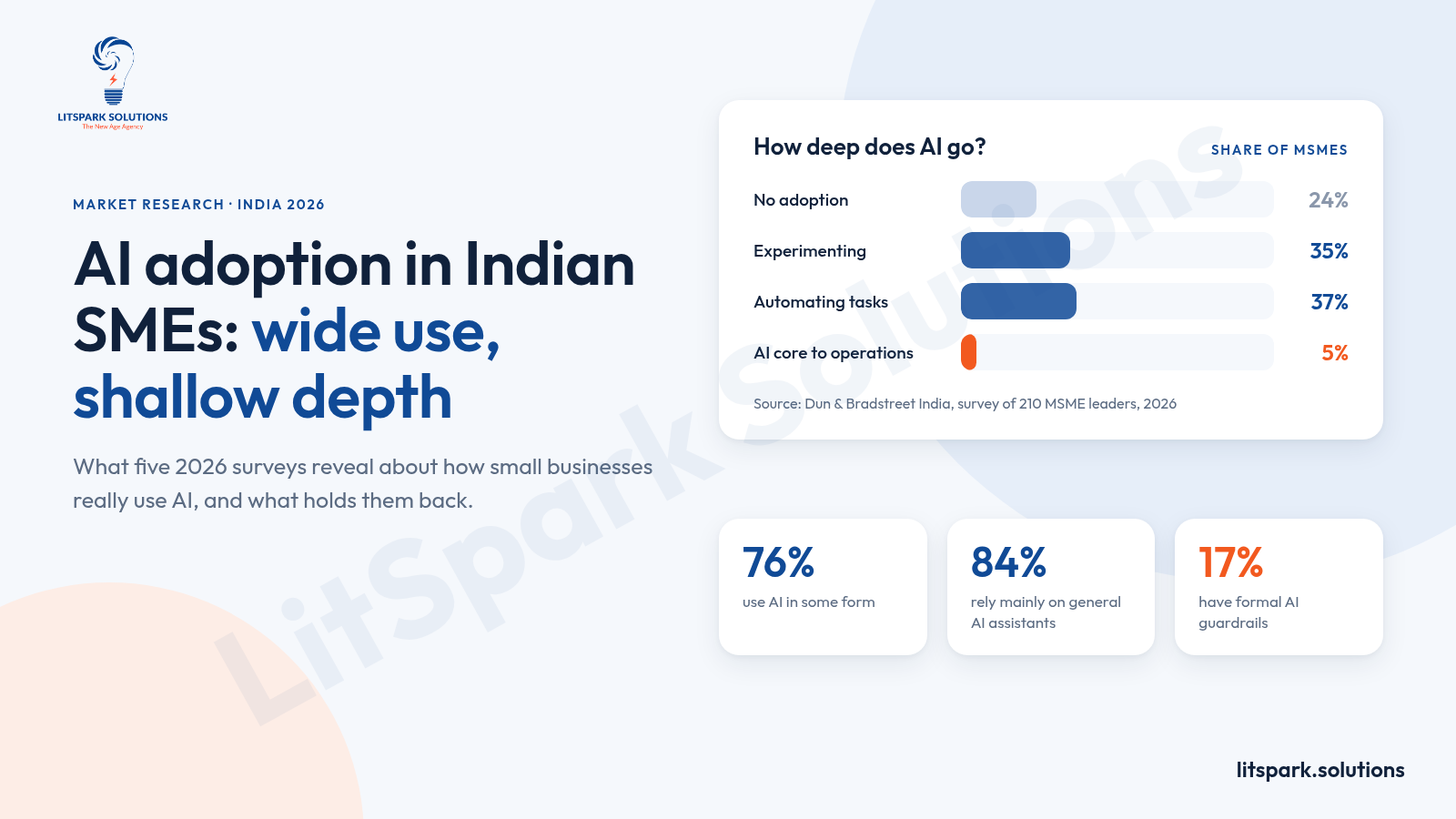
The short version: usage is wide, integration is shallow, and the constraint has shifted from cost to capability. In Dun & Bradstreet India's survey of 210 MSME leaders, 76% use AI in some form, but only 5% have made it core to how they operate.
Table of Contents
- AI adoption in Indian SMEs: the 2026 numbers at a glance
- How Indian SMEs actually use AI today
- The real gap: wide usage, shallow integration
- Barriers to AI adoption for SMEs in 2026
- What SMEs getting real results do differently
- How Indian SMEs can move from experiments to results in 90 days
- What comes next for AI adoption in MSMEs in India
- Frequently asked questions
AI adoption in Indian SMEs: the 2026 numbers at a glance
Five studies give the clearest picture of AI adoption in MSMEs in India right now. Their samples and definitions differ, but they point the same way.
| Study | Sample | Headline finding | Published |
|---|---|---|---|
| Dun & Bradstreet India, Business Enterprises of Tomorrow 2026 | 210 MSME leaders, 12 industries | 76% use AI in some form; 5% have made it core to operations | October 2026 |
| CII and ISB, MSMEs in India: Challenges, Opportunities and the Road Ahead | 2,919 MSMEs, all 36 states and UTs | 65.8% use AI tools; only 21% use ERP or custom business software | October 2026 |
| Salesforce Small and Medium Business Trends Report | 200+ Indian SMBs | 78% are using or experimenting with AI | September 2026 |
| Vi Business MSME Growth Insights Study 2026 | Insights from 2.5 lakh+ MSMEs, 16 sectors | 25% have integrated AI into practices and workflows; 57% see AI as a core growth tool | June 2026 |
| Nasscom and Meta, AI Enablement for MSMEs | 220+ tech-enabled MSMEs | 94% believe AI can drive growth; 65% lack awareness of the right tools | June 2024 |
How to read AI adoption statistics for Indian SMEs: "Uses AI" ranges from an owner drafting messages in a free chatbot to an automated workflow running every day. That is why one study reports 76% adoption and another reports 25% integration. Both can be true at once. The CII-ISB authors also note their survey was voluntary and not weighted to represent every Indian MSME, so treat any single number as a direction, not a census.
How Indian SMEs actually use AI today
The pattern behind the headline numbers is consistent: AI is mostly a personal productivity tool, used for writing and internal work, rather than a part of the business's systems.
Communication and content come first
In the CII-ISB study, the most common use was business communication (34.9% of respondents), followed by content creation (22.3%) and training (18.9%). That matches what we see in most small teams: AI drafts emails, quotations, social posts and product descriptions, and a person copies the result into the real system.
General-purpose assistants do most of the work
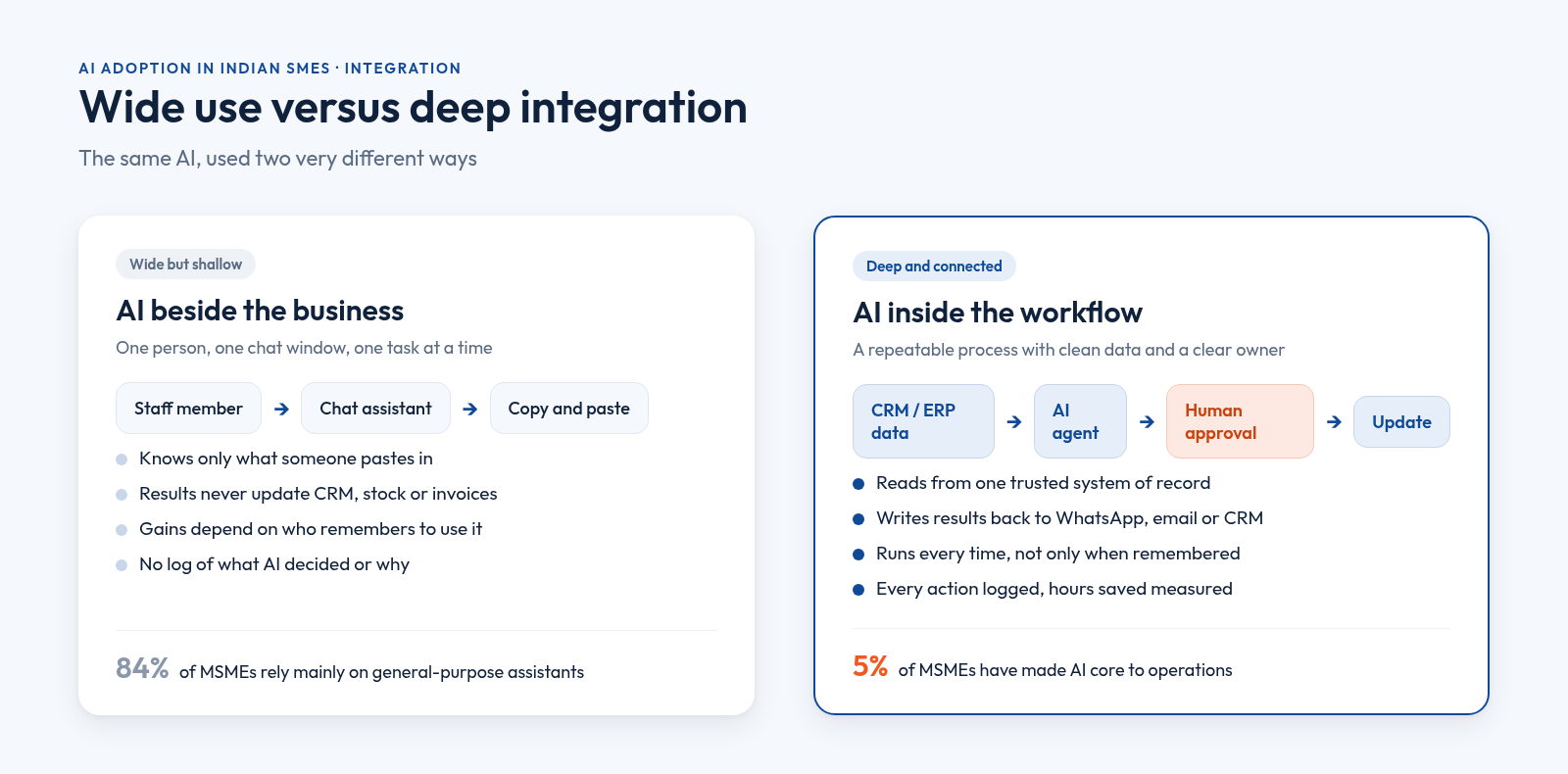
Dun & Bradstreet found that 84% of MSMEs rely primarily on general-purpose AI assistants rather than AI built into their business systems. These tools are easy to start with, but they only know what someone pastes into them, and nothing they produce updates a CRM, an inventory record or an invoice on its own.
Back office before customers
Cost is the main reason businesses start. In the D&B survey, 69% cited reducing costs or improving margins as their main driver, while only 21% pointed to customer demand. Use is concentrated in back-office functions, internal operations and supply chains, and customer-facing and vernacular AI adoption sits at just 9%. For a country where many customers prefer to talk in their own language, that last number is a large, open gap. Our guide to WhatsApp AI agents for Indian SMEs covers one of the most practical ways to close it.
The real gap: wide usage, shallow integration
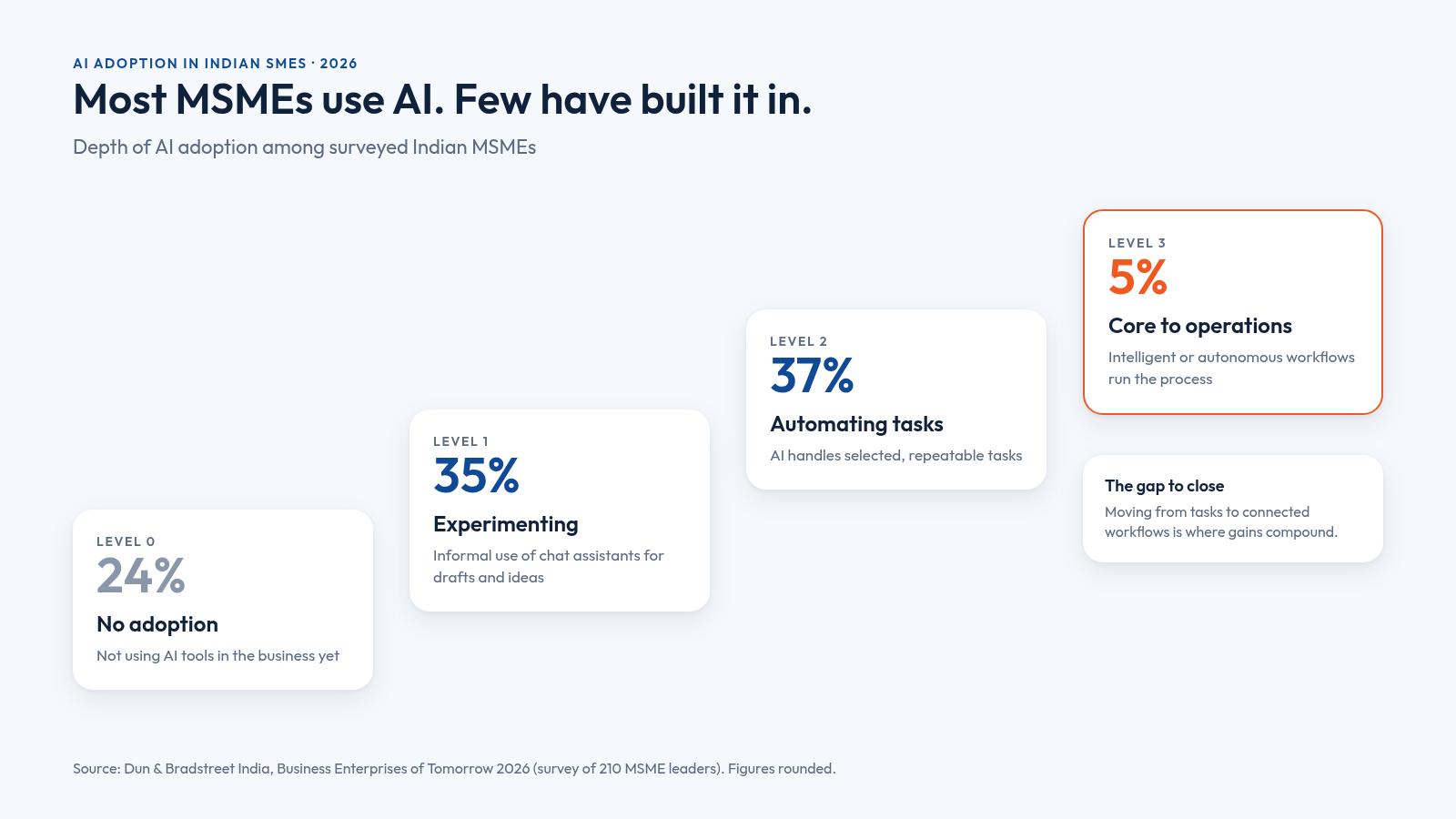
The most useful finding about AI adoption in Indian SMEs in 2026 is not how many businesses use AI. It is how few have connected it to anything.
- Only 5% are at the core. D&B's breakdown shows 24% with no adoption, 35% experimenting informally, 37% automating selected tasks and 5% running AI as a core part of operations.
- Most lack the systems AI needs. Only 21% of MSMEs in the CII-ISB sample use ERP or customised business software. AI that cannot read or write to a system of record stays a side tool.
- Digital maturity is still uneven. D&B places 60% of MSMEs at digital maturity Level 3 or below. In the Fortune India interview on the Salesforce report, Salesforce's Arun Kumar Parameswaran estimated that roughly half of businesses still run largely on spreadsheets and WhatsApp.
- Benefits are real but narrow. Among AI users in the D&B survey, 94% report time savings, 61% better quality and accuracy and 60% faster decisions, but only 20% have created new products or services with AI.
Put simply, most AI gains in small businesses today come from individuals working faster, not from processes running differently. That is useful, but it does not compound. The gains start to add up when AI is attached to a repeatable workflow with clean data going in and a clear owner checking what comes out.
Barriers to AI adoption for SMEs in 2026
The barriers to AI adoption in Indian SMEs have changed since the first wave of surveys. In the 2024 Nasscom and Meta study, 59% of tech-enabled MSMEs cited budget constraints. In D&B's 2026 survey, 60% say AI is now within reach for a business of their size and only 8% disagree. Cost has not vanished, but D&B concludes that capability, not cost, is now the binding constraint.
| Barrier | What the data shows | A practical response |
|---|---|---|
| Trust in output | 68.7% say AI is relevant to their business, but 53.4% trust its output (D&B) | Start where errors are easy to spot, and keep a human approval step |
| Skills | 70.8% say training would speed up adoption, yet only 15% reinvest AI gains in people (D&B) | Budget team training as part of every AI project, not after it |
| Safeguards | 80% act on AI outputs, while only 17% have formal AI guardrails (D&B) | Write simple rules for what data can be shared and who signs off |
| Awareness | 65% of tech-enabled MSMEs did not know the right tools to use (Nasscom and Meta, 2024) | Learn from businesses like yours; 53% call proof from similar firms an accelerator (D&B) |
| Data and systems | Only 21% use ERP or custom business software (CII-ISB) | Fix the system of record before adding AI on top |
Our take: If your team already uses AI every day but nothing in your business runs differently, you do not have an AI problem. You have a workflow and data problem. The fix is usually one well-chosen process, not another tool subscription.
What SMEs getting real results do differently
The businesses that have moved beyond experiments share three habits: they pick one painful workflow, they connect AI to real systems, and they keep people in charge of judgement calls.
Accolade Electronics: redesign the work, keep the team
The D&B report includes a detailed case study of Accolade Electronics, a Pune-based automotive electronics supplier that handles AIS-140 certification for around 6,000 vehicles a month. Each certificate took roughly 150 minutes of human effort across three stages, and an analysis showed 88% of the team's time went on mechanical work.
Instead of adding people, the company rebuilt each stage around AI:
- Verify: a multilingual voice AI calls customers in their own language to confirm vehicle and SIM details, cutting the stage from 45 minutes to 4.
- Process: software bots submit applications to state portals and retry on failure, cutting 75 minutes to 9.
- Issue: AI notifies stakeholders, updates internal systems and closes the ticket, cutting 30 minutes to 2.
Exceptions go to a person. Between January and April 2026, monthly certificate output rose 61%, from 5,028 to 8,106, with the same 23-person team. The share of the team's time spent on judgement-led work rose from 12% to 75%.
TejasInfo and City Connect: build the foundation first
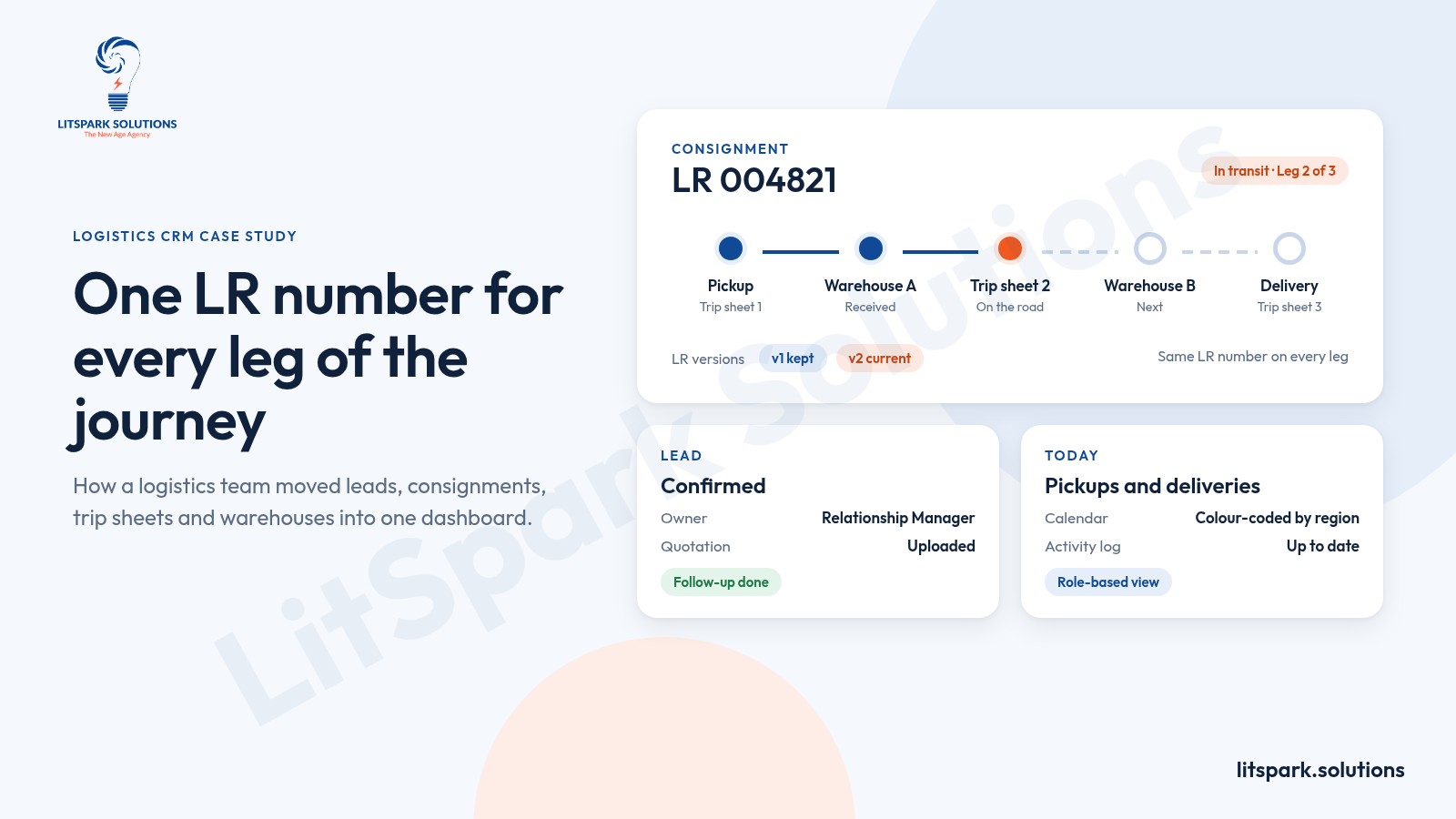
Not every business is ready to automate on day one, and the data says most are not. Two projects from our own portfolio show what the foundation layer looks like. For Tejas Info Solutions, an electronics business, we built a custom ERP that connects purchasing, inward QC, item-level stock tracking, sales, returns and invoicing in one panel, replacing fragmented, manual processes with a single source of truth and less duplicate data entry. For City Connect Logistics, we built one dashboard that runs leads, quotations, consignments and multi-leg movements, with role-based access and activity logs. Our logistics CRM case study walks through it in detail.
Neither was an AI project. But a clean, central record of stock, orders and customers is exactly what the D&B report means when it calls for laying the data foundations before anchoring AI in your systems.
Manufacturing examples from the WEF playbook
The World Economic Forum's AI playbook for India's SMEs documents anonymised Indian cases with measured results. A mid-sized gearbox manufacturer that added sensor-based predictive maintenance saw a 40% reduction in unplanned breakdowns and a 30% drop in maintenance costs. A steel-manufacturing MSME that used camera-based defect detection improved first-pass quality rates by 30%.
How Indian SMEs can move from experiments to results in 90 days
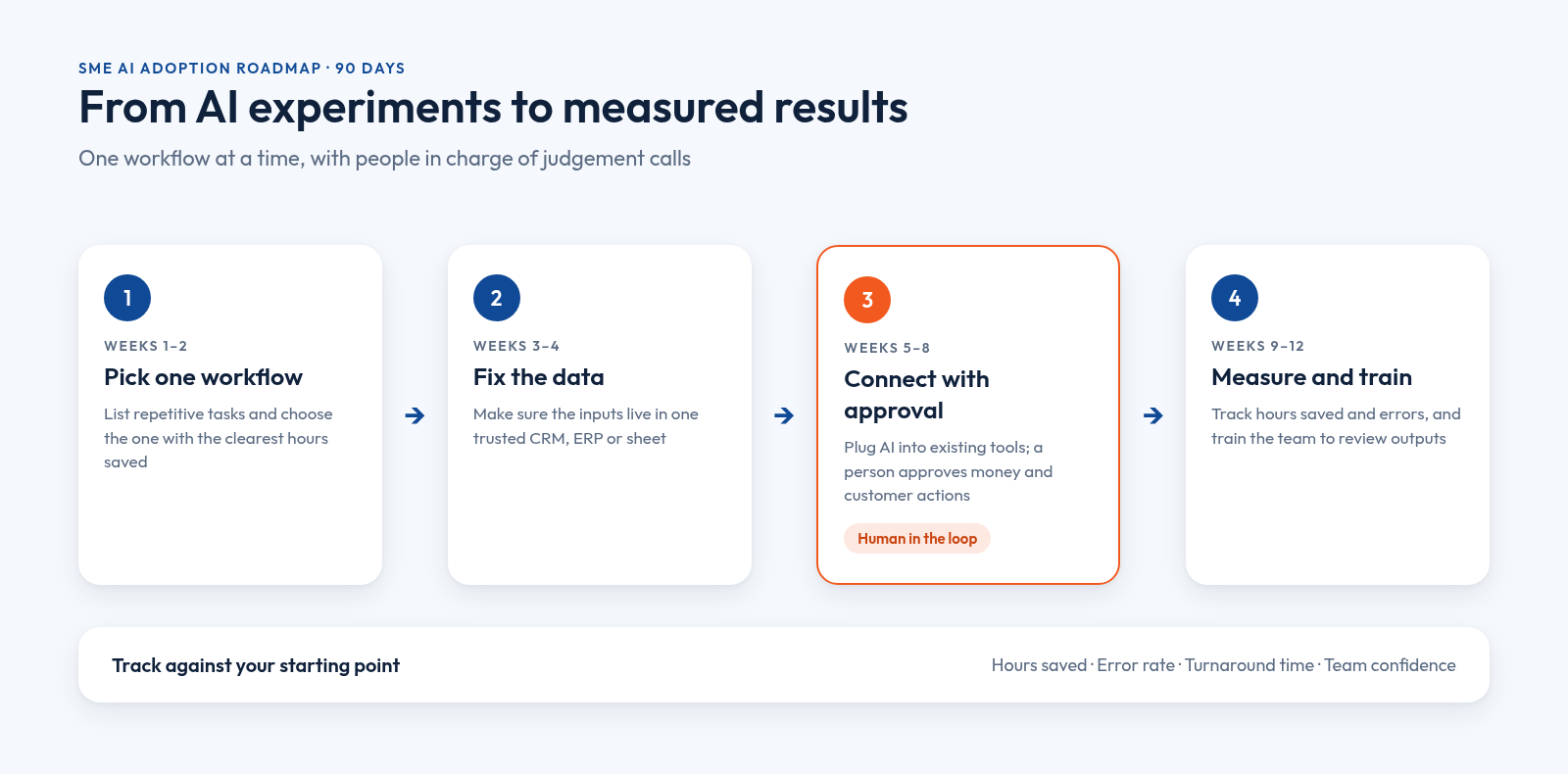
If you are in the 35% experimenting informally or the 37% automating a few tasks, here is a practical way to deepen AI adoption in your SME this quarter.
- Weeks 1-2: list the repetitive work. Ask each team to name the tasks they repeat daily, how long each takes and how often mistakes happen. Pick the one with the clearest hours saved.
- Weeks 3-4: check the data. Confirm the information the task needs lives in one place you trust, such as a CRM, ERP or shared sheet. If it does not, fix that first.
- Weeks 5-8: build and test on real data. Connect AI to the tools your team already uses, with a person approving anything that touches money or customers.
- Weeks 9-12: measure and train. Track hours saved, error rates and turnaround time against your starting point, and train the team to review outputs well.
This is close to how we approach it at LitSpark: our AI and automation work starts with a process audit of one repetitive workflow, moves to a working prototype on real data, and only then connects the agent to WhatsApp, email, CRM or sheets with approval steps and logs. Starting small keeps the risk low and gives you a measured result to decide on the next workflow. If you are weighing outside partners, our roundup of AI automation companies to watch in 2026 is a useful starting list.
What comes next for AI adoption in MSMEs in India
If AI adoption in Indian SMEs deepens, the upside is large. The WEF estimates AI could unlock between $490 billion and $685 billion in economic value for Indian MSMEs by 2030. Building on that, D&B's most accelerated scenario has MSMEs raising their share of India's GDP from 31.1% to nearly 40% by 2030, though that is a modelled scenario, not a forecast.
Three shifts will decide who captures that value:
- From assistants to workflows. The gains compound when AI is connected to systems, not just used beside them.
- From back office to customers. With customer-facing and vernacular adoption at 9%, voice and chat in Indian languages is the clearest open space.
- From tools to skills. Businesses that reinvest some of their time savings into training will be the ones that trust, and use, AI output with confidence.
Frequently asked questions
What percentage of Indian SMEs use AI in 2026?
AI adoption in Indian SMEs depends on the definition. Dun & Bradstreet's 2026 survey found 76% of MSMEs use AI in some form, CII-ISB found 65.8% use AI tools, and Salesforce found 78% of SMBs use or are experimenting with AI. Far fewer have integrated it: D&B puts AI at the core of operations for only 5%.
What are the main barriers to AI adoption in MSMEs in India?
The main barriers in 2026 are skills, trust and weak data foundations rather than cost alone. D&B found 70.8% say training would speed up adoption, only 53.4% trust AI output and only 17% have formal guardrails. CII-ISB found just 21% of MSMEs use ERP or custom business software.
How are small businesses in India using AI?
Most small businesses in India use AI for business communication, content creation and training, usually through general-purpose assistants. The CII-ISB study found communication was the top use at 34.9%. Deployment is concentrated in back-office work, and customer-facing and vernacular AI use is only 9%, according to Dun & Bradstreet.
How should an SME start using AI properly?
Start with one repetitive workflow that wastes measurable hours, such as lead follow-ups or document entry. Make sure the data it needs sits in one trusted system, connect AI to the tools your team already uses, keep a human approval step, and measure hours saved before you automate the next process.
Keep Reading.
- Why Companies in 2026 Should Automate Manual Workflows Before They Scale
- WhatsApp AI Agents for Indian SMEs: What They Can Automate in 30 Days
- Top 7 AI Automation Companies to Watch in 2026
Want Help Putting This Into Practice?
Tell us what you're working on. We'll reply within 24 hours with next steps.
See how we find and automate your first repetitive workflow with AI agents, explore our custom software and ERP development, or add dedicated developers to your team. Email business@litspark.solutions, or book a discovery call.
- AI adoption in Indian SMEs
- AI adoption in MSMEs India
- AI adoption statistics India 2026
- Barriers to AI adoption
- AI for small businesses in India
- Market research
Written By
LitSpark Solutions Team
We build websites, apps and AI automations, and run marketing for growing businesses from Bengaluru. These guides come from that work. About us