Development15 min read
Top 7 AI Automation Companies to Watch in 2026
Explore the top 7 AI automation companies for 2026. This guide compares services, pricing, and use cases to help you choose the right partner for your business.
By the LitSpark Solutions team · Updated
- AI Automation
- Advertising
- Designing
- Development
- Digital Marketing
- MVP
- Resource Hiring
- Shoot
India's AI market was valued at USD 9.51 billion in 2024 and is projected to reach USD 130.63 billion by 2032. That scale matters because buyer confusion rises with market growth. More vendors enter, more service labels blur together, and more teams struggle to tell apart a chatbot shop, an enterprise AI integrator, and a full-stack automation partner.
That's why evaluating ai automation companies needs a procurement lens, not a trend lens. You're not buying “AI” in the abstract. You're choosing who can automate a real workflow, fit your budget, integrate with your stack, and support change after launch. For some firms, that means WhatsApp lead qualification. For others, it means KYC, document intelligence, call-centre automation, or governed GenAI in regulated operations.
India is a particularly useful market to study because it combines depth and velocity. It has 1,920 AI companies, including 536 funded firms that have raised $6.14 billion, so buyers can compare specialist tools, enterprise consultancies, and end-to-end delivery partners in one ecosystem. If your automation roadmap also touches creative production, there's a parallel lesson in smarter AI video editing. The strongest partners usually connect workflow automation to actual business output, not just technical deployment.
Table of Contents
- 1. LitSpark Solutions Private Limited
- 2. Quantiphi
- 3. Fractal
- 4. Tredence
- 5. Yellow.ai
- 6. Haptik (Jio Haptik)
- 7. HyperVerge
- Top 7 AI Automation Companies Comparison
- Final Thoughts
1. LitSpark Solutions Private Limited
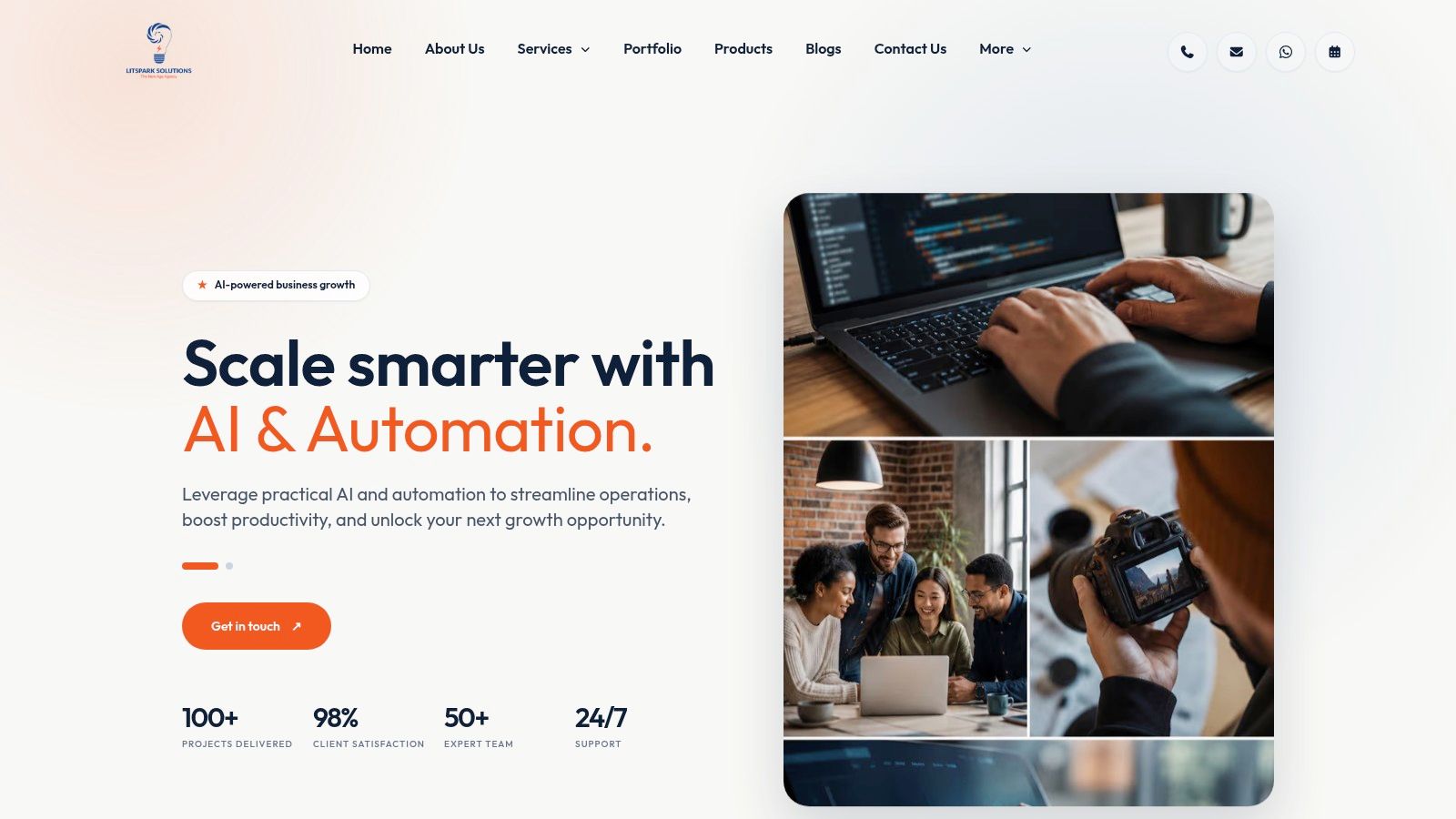
LitSpark Solutions Private Limited is the most broadly useful option on this list for startups and SMEs that don't want separate vendors for product, growth, design, and automation. Its value isn't just that it offers AI services. It's that automation sits inside a wider operating model that also includes engineering, UI/UX, digital marketing, creative production, and resource hiring through the LitSpark Solutions website.
That structure solves a common buyer problem. Many ai automation companies can build one workflow, but few can also fix the landing page, clean up the CRM handoff, design the funnel, and supply developers if the product needs changes after launch. LitSpark can.
Why LitSpark stands out
LitSpark positions itself as a practical delivery partner, not a research-heavy AI consultancy. For founders launching fast, that matters more than theory. The company advertises onboarding in 5 to 7 working days, emergency mobilisation within 48 hours, 24/7 support, free initial consultation, and an average 24-hour response promise. It also highlights a 98% client satisfaction rate, a team of roughly 50+ specialists, and more than 100 delivered projects, with some site references pointing to 200+ shipped projects.
Its AI offering is best understood through integration. The AI automation development service sits beside full-stack build, marketing execution, brand design, ad campaigns, and dedicated developer hiring. That reduces vendor handoffs, which is often where automation projects stall.
Practical rule: If your automation project also requires app changes, campaign assets, analytics fixes, or developer augmentation, a full-service partner usually reduces delay more than a specialist point solution.
Best-fit buying scenarios
LitSpark is especially well suited for buyers who need commercially useful automation, not just technical proofs of concept.
- Budget-sensitive product teams: LitSpark's MVP track starts under $1,000, which gives early-stage teams a lower-risk entry point before they commit to broader automation work.
- Growth-focused SMEs: Firms that need lead capture, workflow automation, campaign execution, and reporting from one accountable team will likely get more value here than from a pure implementation agency.
- Resource-constrained enterprises: Teams needing screened Android, iOS, or full-stack developers can use LitSpark for augmentation while keeping automation delivery in the same relationship.
There are caveats. Public pricing beyond the MVP offer is limited, and the publicly visible project count isn't perfectly consistent. Detailed case studies and testimonial depth also appear lighter than what some enterprise buyers may expect. Those aren't deal-breakers, but they are worth validating in a sales conversation.
The bigger takeaway is strategic. In a crowded market, LitSpark is differentiated less by one flagship platform and more by execution range. If your goal is to move from idea to launch without stitching together five agencies, it's one of the most practical ai automation companies to shortlist first.
2. Quantiphi
Quantiphi makes sense when the automation problem is large, regulated, and operationally critical. Its profile is enterprise-first: digital engineering, data platforms, MLOps, managed services, and automation programs that usually stretch beyond a single workflow. You can review its capabilities on the Quantiphi website.
That makes Quantiphi a different buying decision from LitSpark. You're not choosing it for a quick SME automation sprint. You're choosing it when claims processing, lending operations, call-centre transformation, or fraud workflows need governance from day one.
Where Quantiphi fits best
Quantiphi's appeal is breadth. It works across Google Cloud, AWS, and Azure, and it covers document processing, contact-centre automation, fraud and risk analytics, personalisation, and GenAI implementations. Buyers in BFSI, healthcare, retail, media, and public sector environments usually care less about low entry pricing and more about whether a vendor can design, deploy, and run a production programme without creating operational risk.
A useful benchmark here comes from the broader Indian market. The services segment, which includes AI automation and digital transformation solutions for enterprises, held the largest revenue share at 56.69% in 2025. That's a signal that enterprise buyers are still paying heavily for implementation depth, integration, and managed delivery, not just software access.
Quantiphi is strongest when the buying committee includes IT, operations, compliance, and business-unit owners. It's built for multi-stakeholder deals.
For companies earlier in their automation journey, that maturity can feel heavy. Timelines are often longer. Commercials are usually custom. Teams with narrow use cases may end up overbuying if they don't define scope tightly.
If you're comparing vendors, this is the practical dividing line. Choose Quantiphi when governance, cloud flexibility, and managed scale matter more than speed-to-pilot. If you mainly need a quick customer-facing workflow, smaller or more productised providers may be easier to start with. Buyers who want a more modular first step can also compare this route with a business automation partner before moving into a full enterprise programme.
3. Fractal
Fractal sits in the domain-led end of the market. It's a fit for organisations that want AI strategy, analytics modernisation, and workflow automation tied closely to decisioning, CX operations, and data digitisation. Its enterprise positioning is visible on the Fractal website.
What separates Fractal from many ai automation companies is the way it frames automation as part of a larger decision system. That matters in industries where the workflow isn't the only problem. The underlying data model, operating process, and compliance design often matter just as much.
Why buyers shortlist Fractal
Fractal is particularly relevant for financial services, insurance, healthcare, and CPG environments where automation has to coexist with analytics, forecasting, and governed deployment. Its GenAI and modernisation work is attractive to teams that already have data assets but haven't yet turned them into repeatable operational gains.
Its India fit is also notable. The country's AI talent pool already exceeds 600,000 professionals and is projected to grow to 1.25 million by 2027 at a 15% CAGR. For buyers, that means firms like Fractal can support large delivery teams, specialist domains, and long-horizon programmes without depending on a thin local talent base.
- Choose Fractal for governed transformation: It's better suited to enterprises that need research depth, domain playbooks, and operating-model change.
- Avoid Fractal for lightweight pilots: Small firms that want a single workflow live quickly may find the engagement model too heavy.
- Press on data readiness: Fractal's strengths compound when the client already has usable process data and internal stakeholders aligned.
There's also a subtle buying advantage here. Fractal has enough consulting depth to challenge a bad brief. That can be uncomfortable, but it's often useful. When a team says it wants automation, the underlying need may be better digitisation, process redesign, or model governance before deployment.
For enterprise buyers, that challenge function is part of the value. It lowers the chance of automating the wrong process well.
4. Tredence
Tredence is a practical shortlist option when unstructured data is the bottleneck. Retail, CPG, telecom, manufacturing, and BFSI teams often know which workflows hurt, but the documents, summaries, and internal knowledge needed to automate them are scattered. Tredence focuses on that translation layer through GenAI-led services, vertical solutions, and India-based delivery. Its offering is outlined on the Tredence website.
This makes Tredence less of a broad “AI everything” vendor and more of a use-case-led automation partner. That's often a strength. Buyers usually succeed faster when the vendor starts with operational pain, not abstract transformation language.
Where Tredence creates value
Tredence is strongest in workflows like document extraction, summarisation, knowledge assistants, and process automation linked to supply chain or retail operations. Those aren't flashy demos. They are the kinds of workflows that create compounding business value because they remove delay from teams that already operate at scale.
A useful macro signal supports that positioning. In 2025, India's generative AI segment generated USD 1.47 billion in revenue and is projected to reach USD 23 billion by 2033. That suggests buyers are increasingly paying for production-oriented GenAI use cases, not just experimentation.
Buyers should ask Tredence one direct question early: which workflows can be automated with existing documents and knowledge bases, and which ones need data cleanup first?
That question matters because Tredence's value rises when the client has enough process discipline to operationalise outputs. If your documents are inconsistent, business rules are tribal, and owners aren't aligned, even a strong vendor will struggle to deliver fast wins.
For mid-market firms, Tredence can still be useful, but the best path is usually a scoped pilot. For large organisations with clear process owners, it's often a strong fit because it speaks the language of operations instead of just model sophistication.
5. Yellow.ai
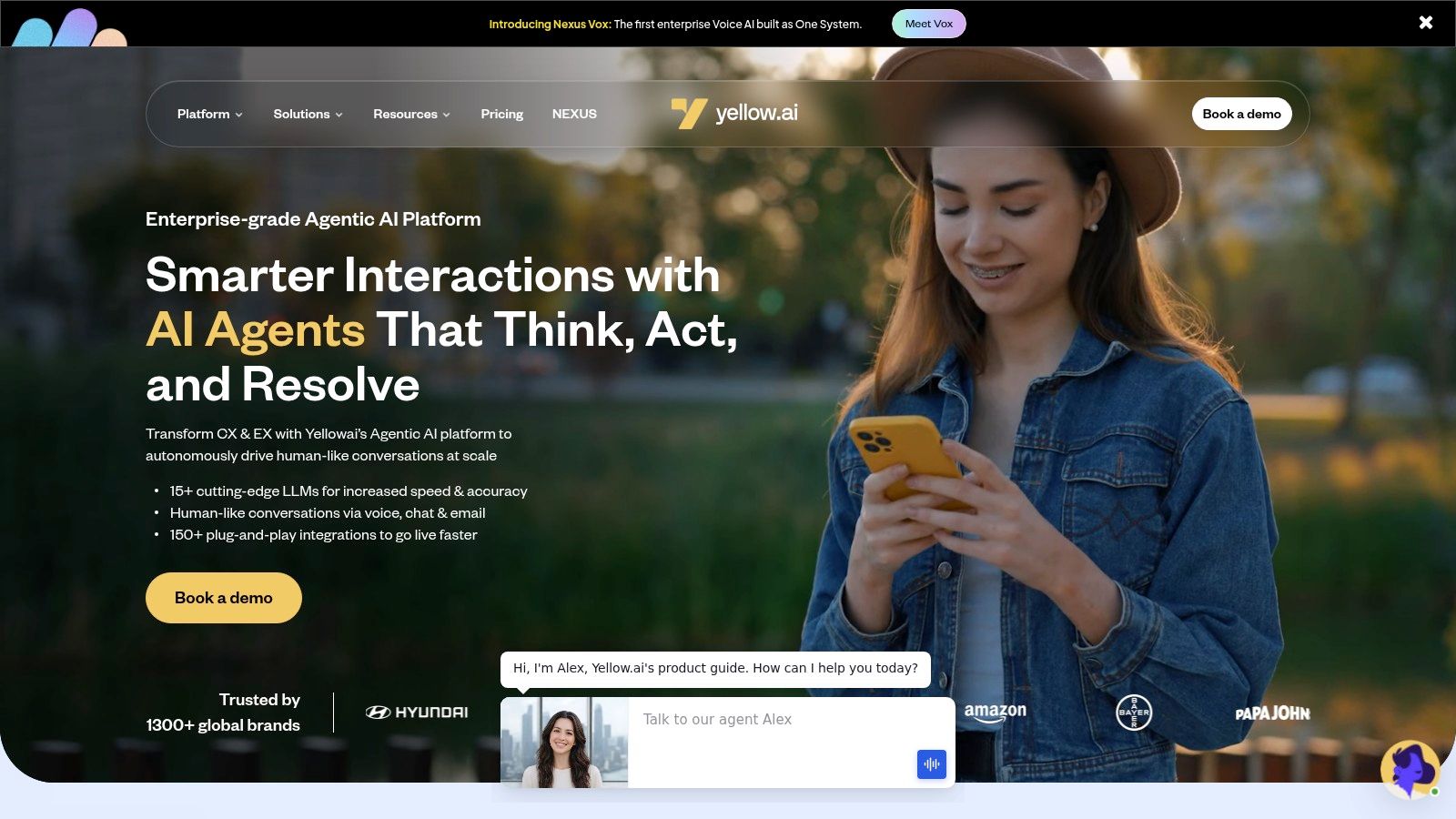
Yellow.ai is one of the easier ai automation companies to understand from a buyer perspective. It focuses on conversational automation across web, mobile, WhatsApp, and voice, and it pairs platform software with implementation support. You can explore its plans and product direction on the Yellow.ai website.
That clarity matters. Many vendors mix platform and services so heavily that buyers can't tell whether they're purchasing software, delivery, or both. Yellow.ai is more legible, especially for teams testing CX automation without committing to a broad transformation programme.
When Yellow.ai is the practical choice
Yellow.ai is attractive for businesses that want to launch customer-facing automation quickly, especially in support, marketing, and commerce journeys. Workflow builders, omnichannel orchestration, analytics, and native integrations lower the barrier to pilot launches. Public plan structure also makes early-stage cost modelling easier than with fully custom enterprise vendors.
Its strongest use case in the Indian market is channel-led automation for smaller and mid-sized businesses. One underserved opportunity stands out: WhatsApp-based lead qualification for SMEs. A documented market view shows that this workflow can cost ₹30,000 to ₹50,000, launch in 2 to 3 weeks, and replace ₹3 lakh to ₹5 lakh annually in manual follow-up labour. That's exactly the kind of narrow, high-clarity use case where a conversational platform can outperform a broad automation consultancy.
- Best for fast pilots: Teams can start with CX automation without redesigning the whole operating model.
- Best for channel-heavy businesses: WhatsApp, web chat, and voice-led interactions are the natural fit.
- Less suited for back-office depth: If your priority is end-to-end operations automation across internal systems, this isn't the first vendor to call.
Yellow.ai is also a good benchmark vendor. Even if you don't choose it, its packaging helps buyers pressure-test what “fast time-to-value” should look like in conversational AI. Teams comparing build-versus-buy options can also review adjacent packaged offerings through LitSpark products to decide whether they need a platform, a bespoke workflow, or a hybrid approach.
6. Haptik (Jio Haptik)
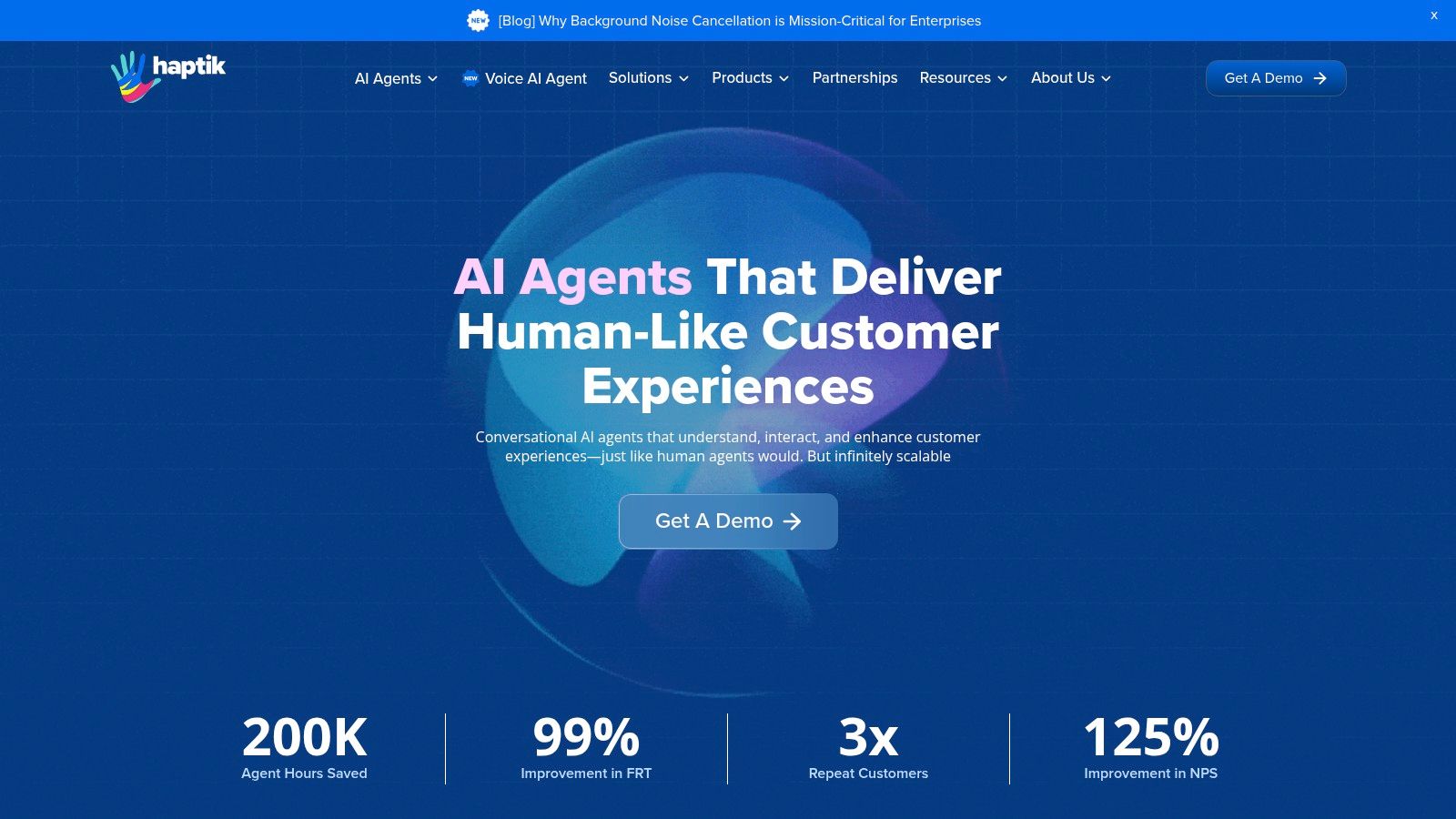
Haptik is a strong option for businesses that want conversational automation with more enterprise structure than a lightweight self-serve tool. Its mix includes omnichannel bots, agent assist, AI search and Q&A, analytics, and professional services, all visible through the Haptik website.
Its practical strength is speed through pre-built workflows. Haptik's Smart Skills framework reduces the amount of process design a client has to invent from scratch, which is useful when teams need deployment momentum across support, commerce, or appointment-style journeys.
What makes Haptik operationally useful
Haptik is especially relevant in India because conversational automation is already crossing from simple support use cases into broader business workflows. In Bangalore, enterprises deploy intelligent AI agents on WhatsApp, websites, and apps for customer queries, lead qualification, appointment booking, and 24/7 support, according to MNB Research's Bangalore AI automation overview. That operational pattern matches Haptik's core strengths closely.
There's another reason Haptik deserves a shortlist spot. It's one of the vendors here that can bridge the gap between quick-launch CX automation and a more customised enterprise rollout. Buyers who need design, integration, and optimisation help often prefer that middle ground over either extreme.
Speed matters most when the workflow is customer-facing. Every week spent overdesigning a safe, basic bot is a week of missed conversations and delayed feedback.
That principle aligns with a broader view in India's AI deployment debate. Responsible rollout doesn't always mean waiting for perfection. In underserved or time-sensitive contexts, basic safe deployments with human oversight can be more useful than slow ideal designs. Haptik is a good fit for teams that believe that and still want professional services around implementation.
The main limitation is scope. If you need deep back-office orchestration, Haptik is narrower than a full operations-automation provider. But for high-volume conversational journeys in the Indian market, it remains one of the most operationally ready choices.
7. HyperVerge
HyperVerge is the specialist on this list. It isn't trying to automate everything. It focuses on identity, onboarding, KYC, fraud detection, underwriting support, and document-led verification flows designed for Indian requirements. Its APIs and product suite are detailed on the HyperVerge India website.
That narrowness is exactly why it belongs in a serious vendor comparison. Buyers often make poor decisions when they compare specialist vendors to broad automation firms using the same criteria. HyperVerge should be judged on onboarding accuracy, verification speed, regulatory fit, and integration ease, not on whether it can run a company-wide automation programme.
Where HyperVerge is strongest
HyperVerge is best for fintech, BFSI, telecom, mobility, and any business where customer acquisition depends on trust checks and identity verification. Face and ID verification, liveness detection, document parsing, and India-specific screening make it useful in onboarding journeys where manual review slows growth and increases risk.
Budget context matters here. In Bangalore, custom AI agent development typically ranges from ₹3 lakh to ₹10 lakh, while enterprise automation systems can exceed ₹10 lakh. HyperVerge offers a useful alternative logic for buyers in regulated spaces. Instead of funding a broad custom build, they can adopt a specialist layer for the highest-risk workflow first, then integrate outward.
- Choose HyperVerge when verification is the core workflow: It shines when identity and fraud controls are the bottleneck.
- Don't choose it as a generalist automation partner: Its scope is intentionally narrower.
- Ask for integration detail early: API maturity and onboarding flow compatibility matter more here than broad consulting capability.
Specialists often create the fastest ROI when they sit at a high-friction point in the funnel. HyperVerge is a good example. If your user journey breaks at KYC, the right answer usually isn't a broad AI transformation project. It's a purpose-built verification engine.
Top 7 AI Automation Companies Comparison
| Provider | Implementation complexity 🔄 | Resource requirements & speed ⚡ | Expected outcomes ⭐📊 | Ideal use cases 💡 | Key advantages ⭐ |
|---|---|---|---|---|---|
| LitSpark Solutions Private Limited | Low–Medium, single accountable team; rapid onboarding (5–7 days; 48h emergency) | Moderate, cost-effective MVP track (<$1k); flexible developer hiring; 24/7 support ⚡ | Startup/SME ROI focus, fast MVP launches, measurable ad/analytics impact 📊 | Early-stage founders, SMEs wanting one partner for product + growth | End-to-end stack; fast turnaround; AI/automation-first |
| Quantiphi | High, enterprise-grade programs with governance and MLOps 🔄 | High, enterprise budgets; multi-cloud integrations; custom pricing | Scalable, production-grade automation for regulated industries ⭐📊 | Large enterprises in BFSI, healthcare, retail needing MLOps & managed-run | Broad cloud & industry breadth; mature program structure |
| Fractal | High, research-backed, governed large-scale deployments 🔄 | High, significant data readiness and enterprise resourcing | Robust AI strategy, analytics modernization, decisioning improvements 📊⭐ | Large enterprises (financial services, insurance, CPG) seeking domain-led AI | Strong R&D and government recognition; consulting + build capability |
| Tredence | Medium–High, use-case-led pilots to production for unstructured data 🔄 | Medium–High, delivery centers, vertical expertise; custom packaging | Practical GenAI automation for unstructured workflows and ops 📊⭐ | Retail/CPG, supply-chain and telecom needing document/knowledge automation | Use-case focus; recognized Generative AI services |
| Yellow.ai | Low, self-serve platform with freemium and channel builders 🔄 | Low–Medium, transparent plan tiers; channel fees (WhatsApp) may apply ⚡ | Quick CX automation and channel-level performance insights 📊⭐ | SMEs and teams piloting conversational CX across web/mobile/WhatsApp | Fast time-to-value; clear pricing; omnichannel capabilities |
| Haptik (Jio Haptik) | Low–Medium, pre-built “Smart Skills” speed deployment 🔄 | Medium, professional services and enterprise contracting typical | Rapid conversational workflows, ticket deflection and agent-assist 📊⭐ | Large-scale WhatsApp/web CX in India; enterprises needing pre-built bots | Extensive pre-built workflows; strong India market fit; services support |
| HyperVerge | Low–Medium, API/SDK for rapid integration into onboarding flows 🔄 | Medium, high-volume verification needs; pricing via negotiation ⚡ | High-accuracy, low-latency KYC/identity verification and fraud checks 📊⭐ | BFSI, fintech, telecom needing regulation-aware identity & risk automation | Purpose-built identity/KYC; anti-deepfake and India-specific coverage |
Final Thoughts
The AI automation market in India is now too large and too segmented for name recognition alone to guide vendor choice. By 2033, the Indian AI market is projected to reach USD 325.34 billion, placing India among the top four global AI markets by absolute size. That level of growth means more options for buyers, but it also means more mismatched purchases if teams don't define the job before selecting the vendor.
The most useful way to compare ai automation companies is by operational fit. LitSpark is strongest when you need one partner to build, automate, design, market, and supply talent. Quantiphi and Fractal make more sense for large, governed enterprise programmes. Tredence is compelling when unstructured data and vertical workflows are the problem. Yellow.ai and Haptik are better for channel-led conversational automation. HyperVerge is the specialist pick for KYC, onboarding, and fraud-sensitive journeys.
There's also a timing lesson in the broader market. In 2025 alone, Indian AI startups raised $1.2 billion across 260 deals, which signals that buyers are no longer evaluating AI automation as a side experiment. More teams are moving from pilots into production. That shift changes what good vendor selection looks like. The right question isn't “Who has AI?” It's “Who can deploy the right workflow, with the right support model, at the right level of complexity for us?”
One more benchmark matters for decision-making. Indian businesses in 2026 reported automation payback periods almost always under 12 weeks, often under 6 weeks, with revenue impacts typically ranging from 1.5x to 3x on the specific workflows automated, according to the India AI market outlook. That doesn't mean every vendor will produce those results. It means buyers should demand a credible path to business impact quickly.
If you're building a shortlist, keep the selection checklist simple:
- Match scope to vendor shape: Don't hire an enterprise transformation firm for a narrow SME chatbot workflow.
- Test implementation reality: Ask what happens after launch, who maintains the system, and how human review stays in the loop.
- Price the full motion: Include integration, content, training, analytics, and change management, not just software or build fees.
- Prioritise one high-friction workflow first: Lead qualification, document processing, support deflection, and KYC are often better starting points than a vague “AI roadmap.”
If you want a broader view of customer-service automation categories before choosing a partner, this IllumiChat review of best chatbots is a useful companion read.
If you want one partner that can build your product, automate your workflows, support your marketing, and extend your team without forcing you to manage multiple vendors, LitSpark Solutions Private Limited is a practical place to start. It's especially well suited for startups, SMEs, and growth-stage teams that need fast onboarding, hands-on execution, and automation tied to real business outcomes rather than isolated demos.
- ai automation companies
- ai automation services
- business automation
- ai development services
- top ai companies