How to Choose an AI Automation Partner: A US Buyer's Guide
How to choose an AI automation partner: a practical guide for US businesses, with a weighted scorecard, questions to ask, red flags and a 4-week pilot plan.

LitSpark Solutions Team
On This Page22 sections
- Table of Contents
- Why the AI automation partner decision matters more in 2026
- The market is crowded with relabelled products
- The research points to partnerships, with caveats
- Define the job before you choose an AI automation partner
- How to evaluate AI vendors: a weighted scorecard
- Use NIST's framework as a neutral checklist
- Watch for claims nobody can back up
- Questions to ask an AI automation agency before you sign
- Questions about the work
- Questions about risk and accountability
- Questions about ownership and support
- Klarna's lesson: keep a human path from day one
- Run a short paid pilot before a larger contract
- What US teams should check with offshore partners
- Frequently asked questions
- How should a small business choose an AI automation partner?
- What questions should you ask an AI automation agency?
- How can a business evaluate AI vendors without a technical team?
- Should a US business work with an offshore AI automation partner?
- Keep Reading.
- Want Help Putting This Into Practice?
Most US businesses do not fail at AI automation because they picked the wrong model. They fail because they picked the wrong AI automation partner, or picked a good one for the wrong job. The demo looked sharp, the proposal promised an "autonomous agent", and three months later the pilot still sits beside the real workflow instead of inside it. Choosing the right partner is less about who has the slickest pitch and more about who understands your process, plans for failure, and leaves you owning what gets built.
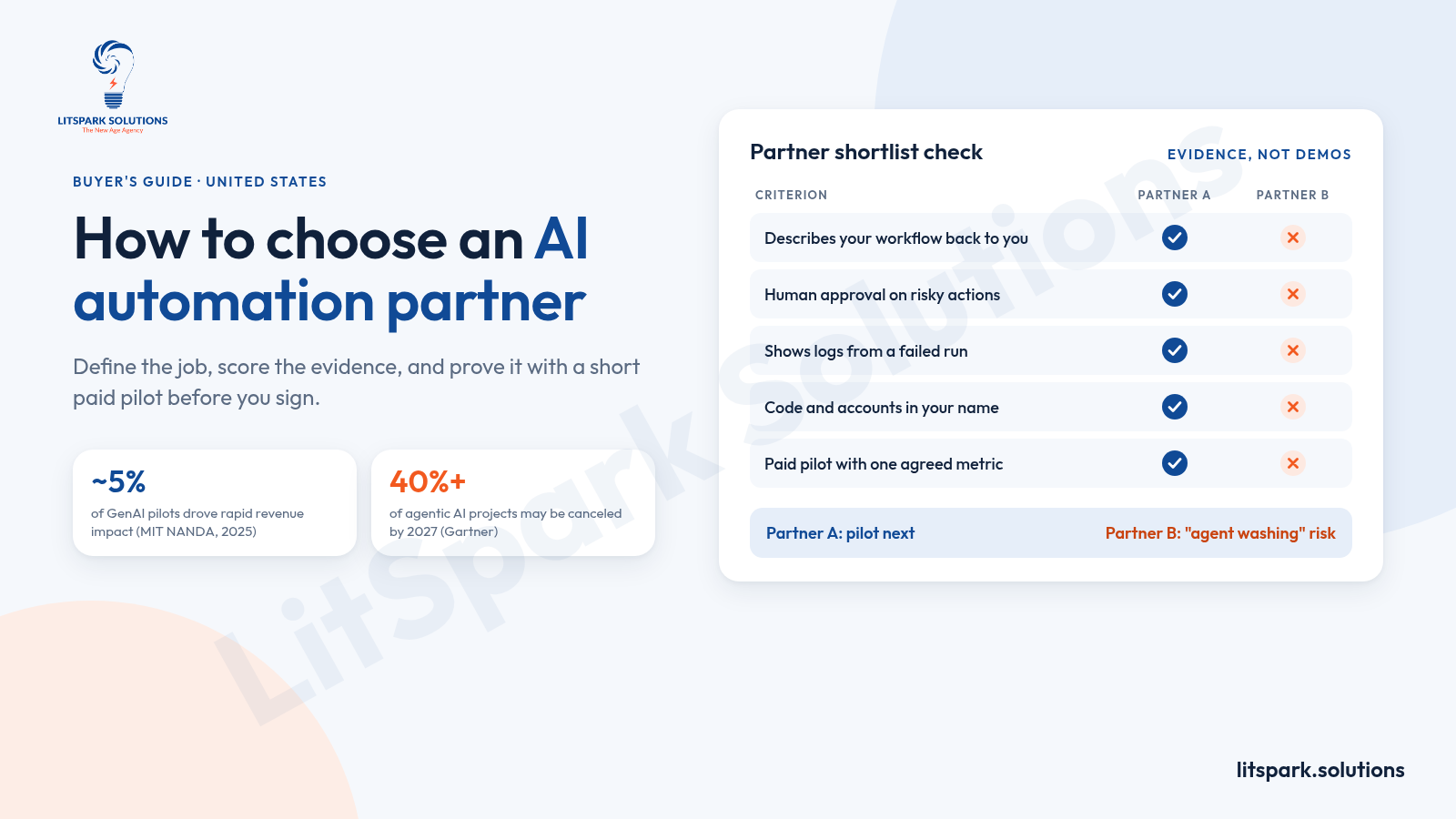
The stakes are real. MIT NANDA's State of AI in Business 2025 report found that only about 5% of enterprise generative AI pilots delivered rapid, measurable revenue impact. In the same research, tools bought from or co-built with specialized vendors reached deployment roughly twice as often as fully internal builds. Picking a partner well is one of the few levers you control.
This guide walks through how to choose an AI automation partner step by step: the job to define first, the evidence to ask for, a weighted scorecard, the questions that expose weak answers, and a short paid pilot that settles the decision.
Table of Contents
- Why the AI automation partner decision matters more in 2026
- Define the job before you choose an AI automation partner
- How to evaluate AI vendors: a weighted scorecard
- Questions to ask an AI automation agency before you sign
- Klarna's lesson: keep a human path from day one
- Run a short paid pilot before a larger contract
- Frequently asked questions
Why the AI automation partner decision matters more in 2026
Two years ago, most buyers were comparing chatbot vendors. Today almost every agency, freelancer and software firm says it builds AI agents. That makes the shortlist longer and the signal weaker.
The market is crowded with relabelled products
In June 2025, Gartner predicted that over 40% of agentic AI projects will be canceled by the end of 2027 because of escalating costs, unclear business value or inadequate risk controls. It also warned about "agent washing", the rebranding of existing assistants, RPA tools and chatbots as agents, and estimated that only about 130 of the thousands of agentic AI vendors are real. A label on a proposal tells you very little.
The research points to partnerships, with caveats
The MIT NANDA report says external partnerships with learning-capable, customized tools reached deployment about 67% of the time in its interview sample, against about 33% for internal builds. The authors are careful: the sample was 52 organizations, outcomes were self-reported, and the gap may reflect the buyers as much as the approach. Read it as a reason to choose deliberately, not as proof that any vendor beats your own team.
Why this matters: A partner that cannot explain where AI fits and where it does not will usually build the most impressive-sounding option, not the one your team will still trust in six months. The cheapest mistake to fix is the one you catch before signing.
Define the job before you choose an AI automation partner
The best way to evaluate an AI automation partner is to arrive with one specific workflow, not a wish list. Gartner's own advice is to use AI agents when decisions are needed, automation for routine workflows and assistants for simple retrieval. A good partner will sort your problem into one of those buckets before talking about tools.
Bring three things to every first call:
- One workflow that repeats every week, such as inbound lead qualification, invoice intake or support triage.
- One baseline number, like hours per week, cases per day or average response time. Without it, nobody can test an ROI claim.
- One owner who can say how the process should work and approve changes.
| Type of build | What it does well | Typical US use case | What to ask the partner |
|---|---|---|---|
| Rules-based workflow automation | Moves data between tools on fixed logic, fast and predictable | Syncing form leads into HubSpot, routing approvals, scheduled reports | Why does this need AI at all? What runs on plain rules? |
| AI assistant or chatbot | Answers questions from your own content and hands over to a person | Website chat, an internal Slack helper for policies and docs | Where do answers come from, and what happens when it is unsure? |
| AI agent | Makes bounded decisions and takes actions across several systems | Qualifying a lead, updating the CRM and booking a meeting | Which actions need human approval, and what are the limits? |
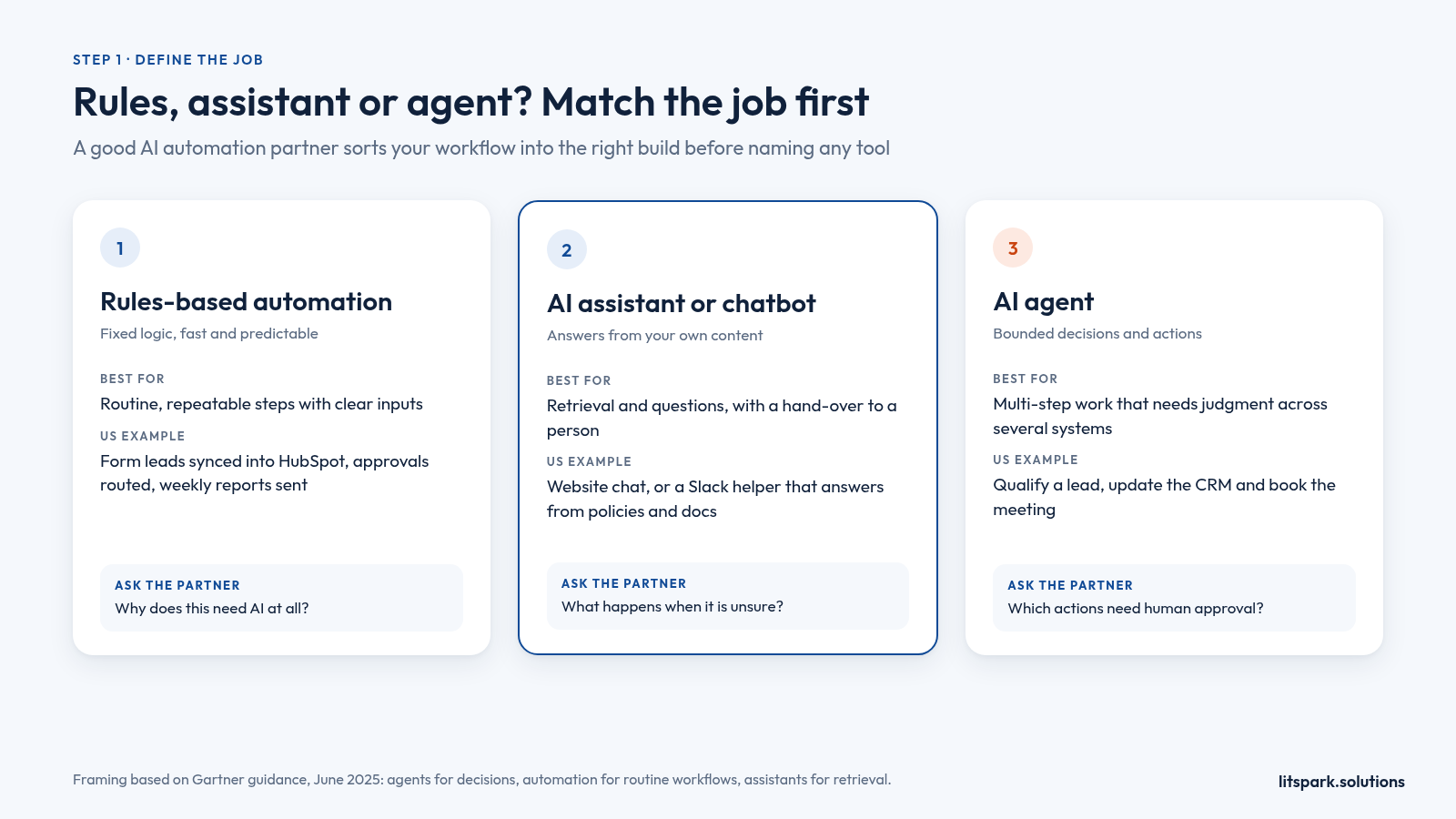
If a partner proposes an agent for a job that a few rules would handle, treat that as a warning sign, not ambition.
How to evaluate AI vendors: a weighted scorecard
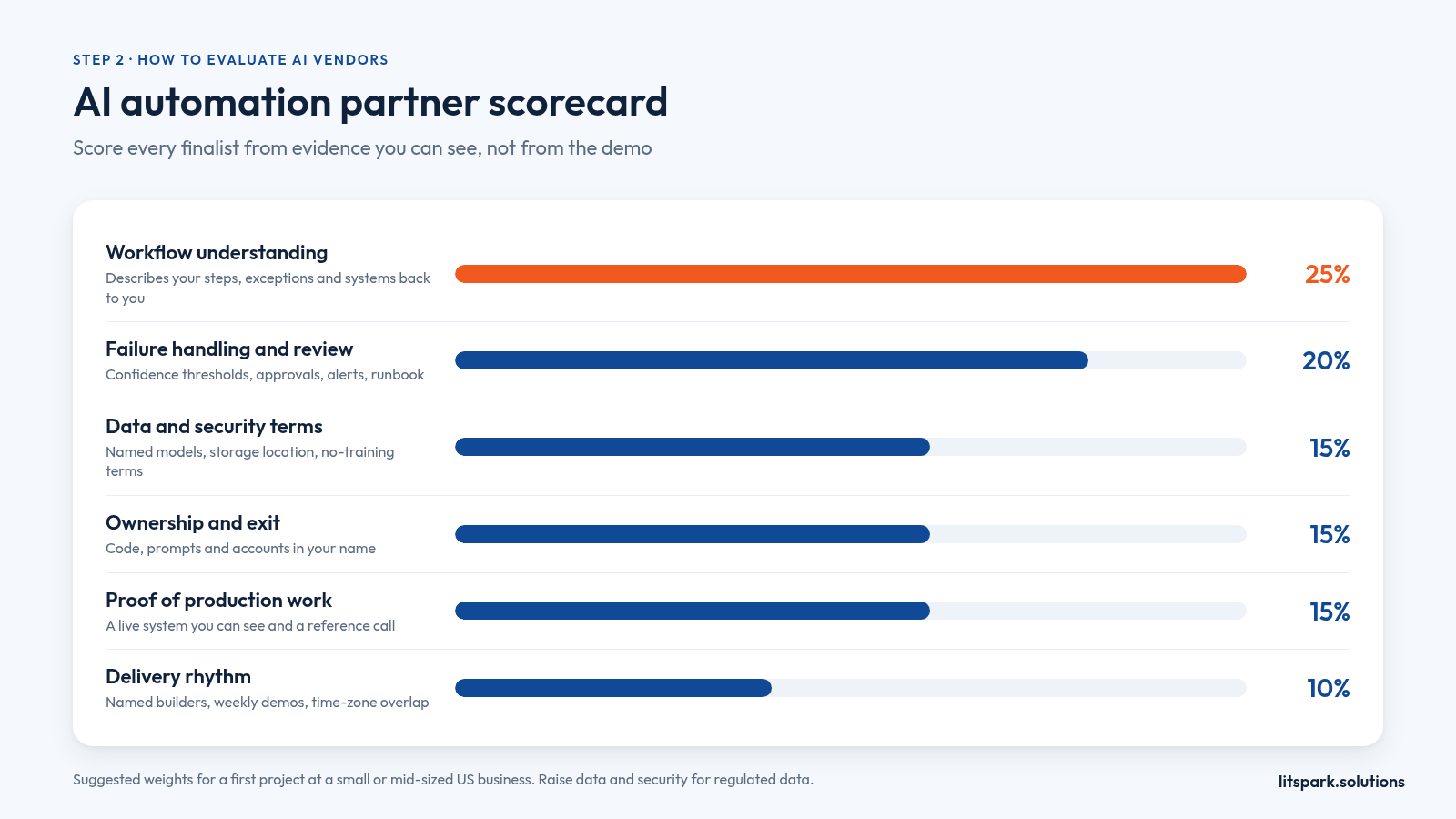
Give every AI automation partner on your shortlist the same scorecard and score from evidence, not from the demo. These weights are our recommendation for a first project at a small or mid-sized US business. Raise the data and security weight if you handle health, financial or children's data.
| Criterion | Weight | What strong evidence looks like | Red flag |
|---|---|---|---|
| Workflow understanding | 25% | They describe your steps, exceptions and systems back to you | Talks about models and tools before asking about your process |
| Failure handling and human review | 20% | Confidence thresholds, approval steps, alerts and a recovery runbook | "The models are very accurate now" |
| Data and security terms | 15% | Named model providers, where data is stored, written no-training terms | "Our platform is secure" with no detail |
| Ownership and exit | 15% | Code, prompts, accounts and docs in your name from day one | Workflows built and hosted only in the vendor's own accounts |
| Proof of production work | 15% | A live system you can see, plus a reference you can call | A slide of logos and no walkthrough |
| Delivery rhythm and communication | 10% | Named builders, weekly demos, a written scope and clear time-zone overlap | A sales contact, then an anonymous team |
Use NIST's framework as a neutral checklist
If your company has never assessed an AI vendor, borrow the vocabulary from the NIST AI Risk Management Framework. It is voluntary, it was released on January 26, 2023, and NIST added a Generative AI Profile (NIST-AI-600-1) on July 26, 2024. Its four functions, Govern, Map, Measure and Manage, translate neatly into partner questions: who is accountable, what the system touches, how quality is measured, and what happens when something goes wrong.
Watch for claims nobody can back up
In September 2024, the FTC announced Operation AI Comply, a set of actions against companies it said used AI in deceptive ways. One of them, DoNotPay, had marketed a "robot lawyer"; it agreed to pay $193,000, and the FTC finalized the order in early 2025. The lesson for buyers is simple: ask any AI automation partner how they tested a claim before you repeat it to your customers.
Questions to ask an AI automation agency before you sign
Good partners answer these with specifics from past work. Weak ones answer with adjectives.
Questions about the work
- What would you not automate in this workflow, and why?
- Which steps will use plain rules, and which will use a model?
- How will we know it worked? Which metric, against which baseline, measured on which date?
Questions about risk and accountability
- What happens when the AI is wrong or unsure? Who receives the exception?
- Which actions need a person to approve them, such as refunds, discounts or outbound messages?
- Where does our data go, which models see it, and is it ever used for training?
- Can we see the logs for a single run, including a failed one?
A real case shows why that second group matters. In February 2024, a British Columbia tribunal held Air Canada responsible for its chatbot's wrong advice about bereavement fares and ordered it to pay a passenger C$812. The airline had argued the chatbot was "a separate legal entity". The tribunal replied that the company is responsible for all the information on its website, whether it comes from a static page or a chatbot. Your AI automation partner builds the system, but your brand answers for it.
Questions about ownership and support
- Whose accounts, API keys and cloud environment will this run in?
- What do we receive at handover: code, prompts, documentation, test cases and training?
- Who monitors it after launch, and how often do we review accuracy together?
Klarna's lesson: keep a human path from day one
Klarna's AI assistant is one of the most cited AI automation success stories. In its first month, the company said, the assistant handled 2.3 million conversations, two-thirds of its customer service chats, did the equivalent work of 700 full-time agents and cut average resolution time from 11 minutes to under 2.
In May 2025, CEO Sebastian Siemiatkowski told Bloomberg that cost had been "a too predominant evaluation factor" and that the result was lower quality. Fortune reported that Klarna started recruiting human agents again so customers would always have the option of speaking to a person, while the company said it remained "AI-first". A Klarna spokesperson later told Silicon Republic that the quality comment referred to outsourced human support, not the AI itself. Either way, the takeaway for buyers holds: insist that your partner designs the handover to a person as carefully as the automation.
Our take: The partner you want is the one who asks, early, "what should a person always handle here?" If that question never comes up in discovery, it will come up later from your customers.
Run a short paid pilot before a larger contract
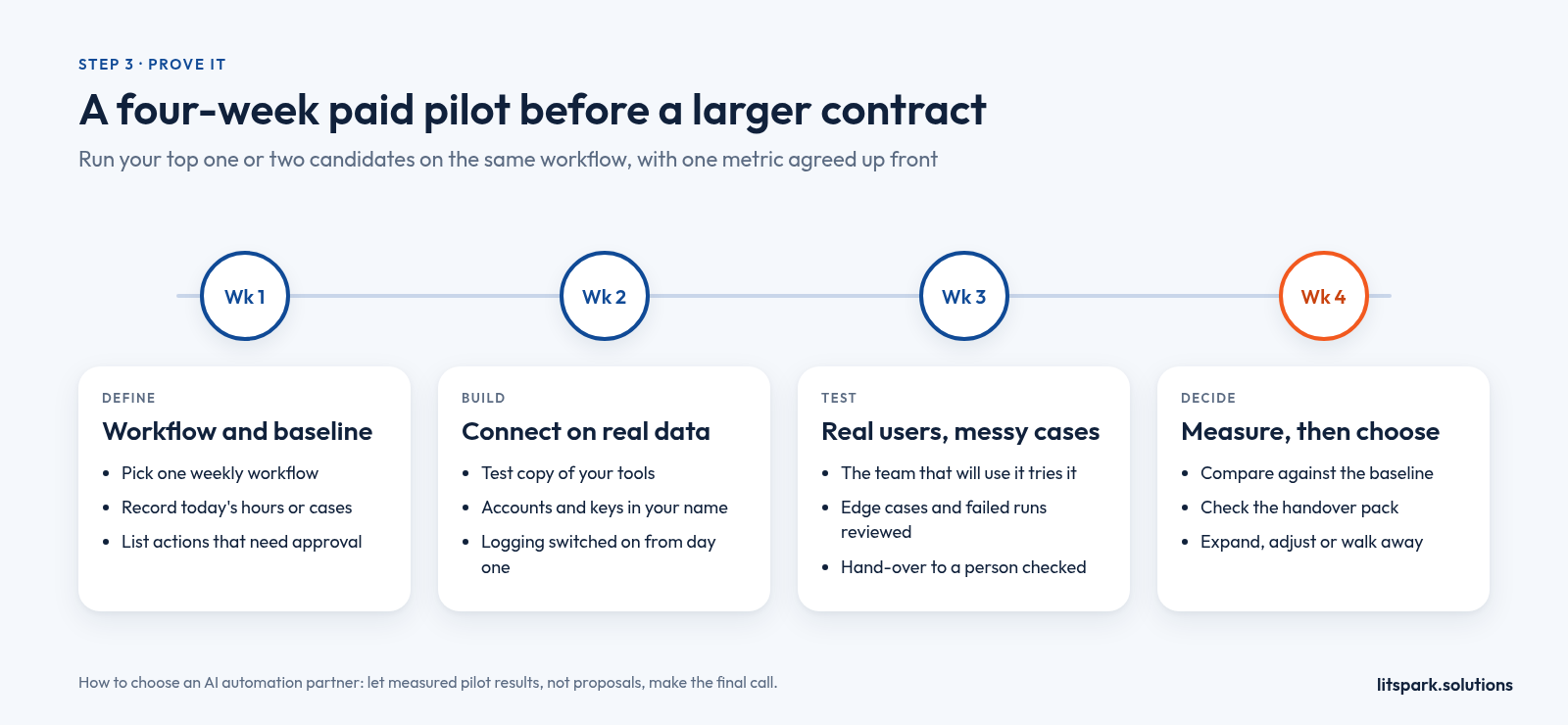
A proposal is a promise. A pilot is evidence. The most reliable way to choose an AI automation partner is to run your top one or two candidates through a small, paid pilot on the same workflow, with the success metric agreed up front.
- Week 1: Define. Pick the workflow, record the baseline and write down the success metric and the actions that need approval.
- Week 2: Build on real data. The partner connects to a test copy of your tools, with accounts and keys in your name and logging on from day one.
- Week 3: Test with real users. The people who will use it try it on real cases, including messy ones, and you review failed runs and the hand-over to a person.
- Week 4: Measure and decide. Compare results against the baseline, review the logs and failed runs, and check the handover pack. Then expand, adjust or walk away.
What US teams should check with offshore partners
If your shortlist includes an AI automation agency in another country, distance is manageable when the basics are in writing: guaranteed overlap hours with your time zone, a named team, a written scope before work starts, weekly demos and clear IP transfer. That is how we set up US engagements at LitSpark from Bengaluru, with at least four hours of overlap with US time zones and human approval on actions that touch money or customers, as described on our AI automation for US businesses page. Whoever you choose, ask for those terms on paper. If you are still building a longer shortlist, our roundup of AI automation companies to watch in 2026 is a useful starting point, and our piece on why companies should automate manual workflows before they scale helps you pick the first process.
Frequently asked questions
How should a small business choose an AI automation partner?
Start with one weekly workflow, a baseline number and one internal owner. Shortlist two or three partners, score them on workflow understanding, failure handling, data terms, ownership, proof of live work and communication. Then run a short paid pilot on that workflow and decide on measured results, not on the demo or the proposal.
What questions should you ask an AI automation agency?
Ask what they would not automate, which steps use rules versus AI, what happens when the AI is wrong, which actions need human approval, where your data goes and whether it trains any model, whose accounts everything runs in, and what you receive at handover. Strong answers reference past projects; weak answers stay general.
How can a business evaluate AI vendors without a technical team?
Use a simple weighted scorecard and ask for evidence you can see: a live system, the logs from one failed run, a sample handover document and a reference call. The NIST AI Risk Management Framework's four functions, Govern, Map, Measure and Manage, give non-technical buyers a structured set of questions to ask.
Should a US business work with an offshore AI automation partner?
It can work well when the terms are written down. Look for guaranteed overlap with your time zone, a named team, weekly demos, a written scope, US-friendly contracts and full IP transfer. Judge an offshore partner on the same scorecard as a local one: process understanding, failure handling, data terms and ownership.
Keep Reading.
- Top 7 AI Automation Companies to Watch in 2026
- Why Companies in 2026 Should Automate Manual Workflows Before They Scale
- Outsourced Product Development Services: 2026 Partner Guide
Want Help Putting This Into Practice?
Tell us what you're working on. We'll reply within 24 hours with next steps.
Bring one workflow to a call and we will map it with you, then show how our AI and automation team would build, test and hand it over. Email business@litspark.solutions, or book a discovery call.
- AI automation partner
- how to choose an AI automation agency
- how to evaluate AI vendors
- questions to ask an AI automation agency
- AI vendor evaluation scorecard
- offshore AI automation partner
- Guide
Written By
LitSpark Solutions Team
We build websites, apps and AI automations, and run marketing for growing businesses from Bengaluru. These guides come from that work. About us