Quick Commerce for D2C Brands: What Indian Shoppers Now Expect
Quick commerce for D2C brands in India: how shopper expectations changed, what the 2026 data shows, plus practical lessons on listings, margins and ops.

LitSpark Solutions Team
On This Page20 sections
- Table of Contents
- What Indian shoppers now expect from every brand
- Speed is the new minimum
- Availability matters more than a wide catalogue
- Discovery happens inside the app
- Quick commerce India: the 2026 numbers at a glance
- What this means for D2C brands on Blinkit, Zepto and Instamart
- Listings take longer, and commissions are higher
- Revenue can arrive faster than a durable brand
- Established FMCG companies show how far the shift has gone
- The operational lesson most guides on quick commerce for D2C brands skip
- A practical 90-day plan for quick commerce for D2C brands
- Start with a few SKUs, then decide the channel's job
- Frequently asked questions
- What does quick commerce for D2C brands actually involve?
- Is selling on Zepto and Instamart profitable for a D2C brand?
- How should D2C brands start on Blinkit or other quick commerce apps?
- How have Indian shopper expectations changed because of quick commerce?
- Keep Reading.
- Want Help Putting This Into Practice?
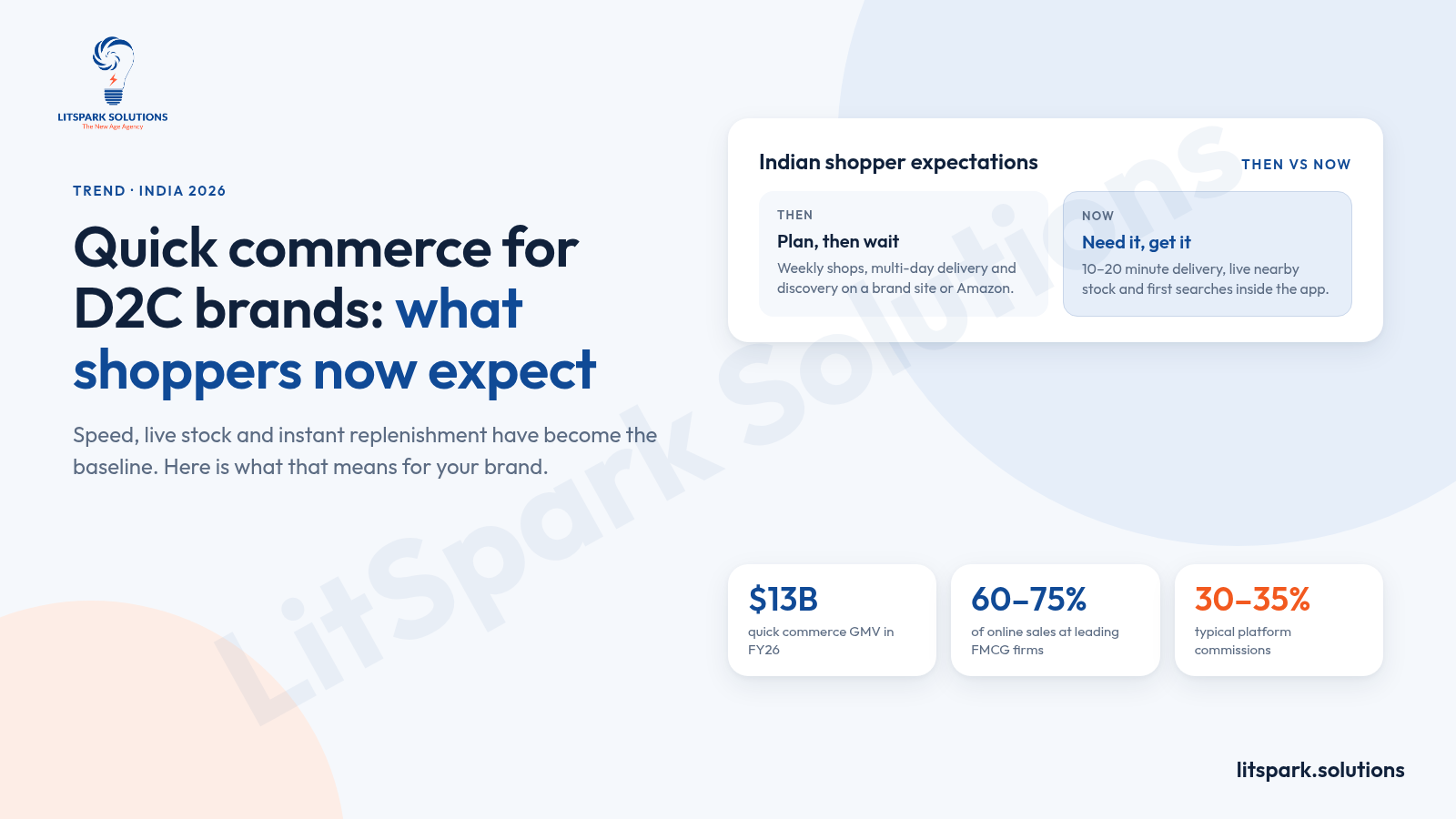
Most Indian shoppers in large cities no longer treat a 10- to 20-minute delivery as a novelty. They treat it as normal. That shift is the real story behind quick commerce for D2C brands, not the race to get a listing on Blinkit, Zepto or Swiggy Instamart. Once people can restock a shampoo, a snack or a serum before the kettle boils, they bring the same expectations everywhere they buy: live stock, a clear pack size, a short wait, and an order they can track.
The channel is now large enough that those habits are spreading. A Redseer report developed with Google, published in October 2026, sizes India's quick commerce market at about $13 billion in FY26 and projects $70–90 billion by FY31. Two years earlier, Flipkart and Bain & Company found that quick commerce already accounted for more than two-thirds of online grocery orders and a tenth of e-retail spending.
This article unpacks what shoppers now expect, what the 2026 data actually says, and the practical lessons for a D2C team that wants the volume without giving away the brand or the margin.
Table of Contents
- What Indian shoppers now expect from every brand
- Quick commerce India: the 2026 numbers at a glance
- What this means for D2C brands on Blinkit, Zepto and Instamart
- The operational lesson most guides on quick commerce for D2C brands skip
- A practical 90-day plan for quick commerce for D2C brands
- Frequently asked questions
What Indian shoppers now expect from every brand
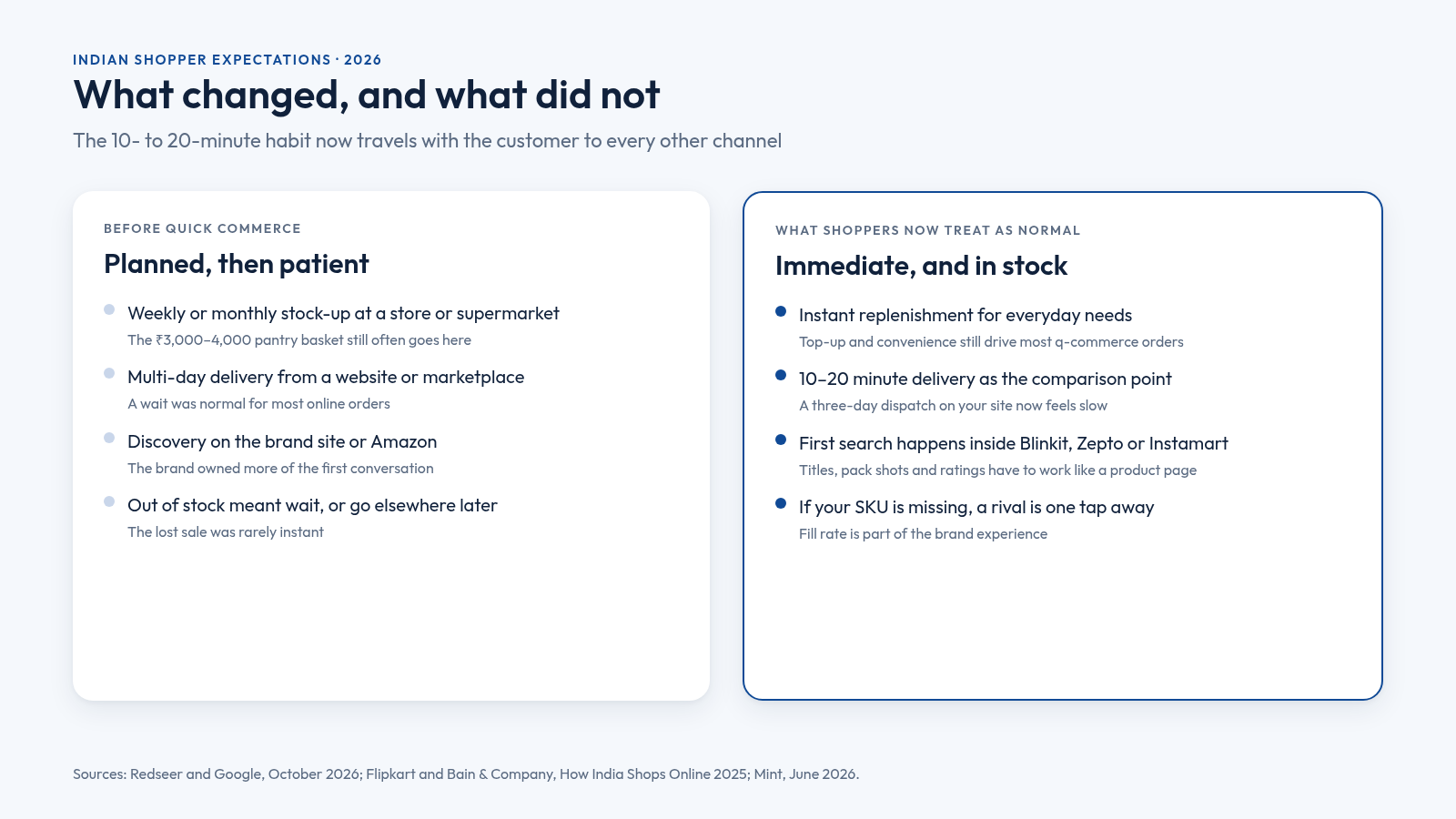
Quick commerce trained a large urban audience to solve a small need immediately. Platforms still win most often on top-up purchases, which is why Redseer and Google argue that the next pot of growth is the planned monthly grocery basket of ₹3,000–4,000 that still goes to supermarkets. For a D2C brand, the point is that the "I need it now, and I can see if you have it" habit does not stay inside one app.
Speed is the new minimum
Shoppers will still wait days for a considered purchase, such as a large appliance they want to see in a store. Beyond Appliances made that point after crossing ₹100 crore in revenue in FY26, its first complete financial year, and began expanding offline so people could experience the product. For everyday items, though, a three-day dispatch window on your own site now feels slow next to a 15-minute alternative. The comparison is unfair, but it is the comparison customers make.
Availability matters more than a wide catalogue
Dark stores carry a tight range, so the product in front of the shopper is the one in stock nearby. If your hero pack is missing, a rival fills the basket in the same session. Inventory accuracy and fill rates become part of the brand experience, not a back-office metric.
Discovery happens inside the app
Ten years ago, many new consumer brands were built on Amazon, as Vineet Satija of PwC India told Mint. Today, a growing share of first purchases happens when someone searches "protein bar" or "face wash" on a quick commerce app. Your brand site and ads still matter, but they are no longer the only front door. Listings, titles, pack shots and ratings have to work as hard as a product page.
Quick commerce India: the 2026 numbers at a glance
Four public sources give a clear enough picture for a founder deciding what to do next. Their metrics differ, so read them side by side rather than as one number.
| Source | What it measured | Headline finding | Published |
|---|---|---|---|
| Redseer and Google, Think Quick Commerce | Market GMV, FY26 and FY31 forecast | About $13 billion in FY26, projected $70–90 billion by FY31 at a 41–48% CAGR; roughly 1% of Indian retail today, 4–5% by FY31 | October 2026 |
| PTI coverage of the same report | Monthly transacting users | 40–44 million in FY26, about 12 million in FY24, projected to surpass 100 million by FY31 | October 2026 |
| Flipkart and Bain, How India Shops Online 2025, GMV detail | 2024 GMV and channel share | $7 billion GMV, up from $1.6 billion in 2022; over two-thirds of e-grocery orders and a tenth of e-retail spend; 15–20% of GMV already from non-grocery; 85% of GMV from the top six cities | March 2025 |
| The Economic Times | Share of online sales, FY26 | Quick commerce accounted for 60–75% of total online sales at companies including ITC, AWL Agri Business, Tata Consumer Products and Parle Products, up from less than half a year earlier | May 2026 |
How to read these figures: "Market size" can mean calendar year or fiscal year, and the 2031 forecasts assume platforms keep winning planned baskets and non-metro users they have not fully won yet. The $13 billion FY26 figure and the $7 billion 2024 figure can both be right. Treat the long-range ranges as a direction of travel, not a target your brand has to hit. The useful question for a founder is whether a given SKU can earn a place in that growth, not whether the headline number is $13 billion or $90 billion.
That is the backdrop for quick commerce for D2C brands. The mix is widening too. Flipkart and Bain found that 15–20% of 2024 GMV already came from general merchandise, mobile phones, electronics and apparel, which is why beauty, nutrition and lifestyle brands now sit next to groceries on the same screen.
What this means for D2C brands on Blinkit, Zepto and Instamart
The volume is real. So are the constraints. Quick commerce for D2C brands works only when you treat Blinkit, Zepto and Instamart as a distribution channel, not as a shortcut to a brand, and when you are honest about the cost of each sale.
Listings take longer, and commissions are higher
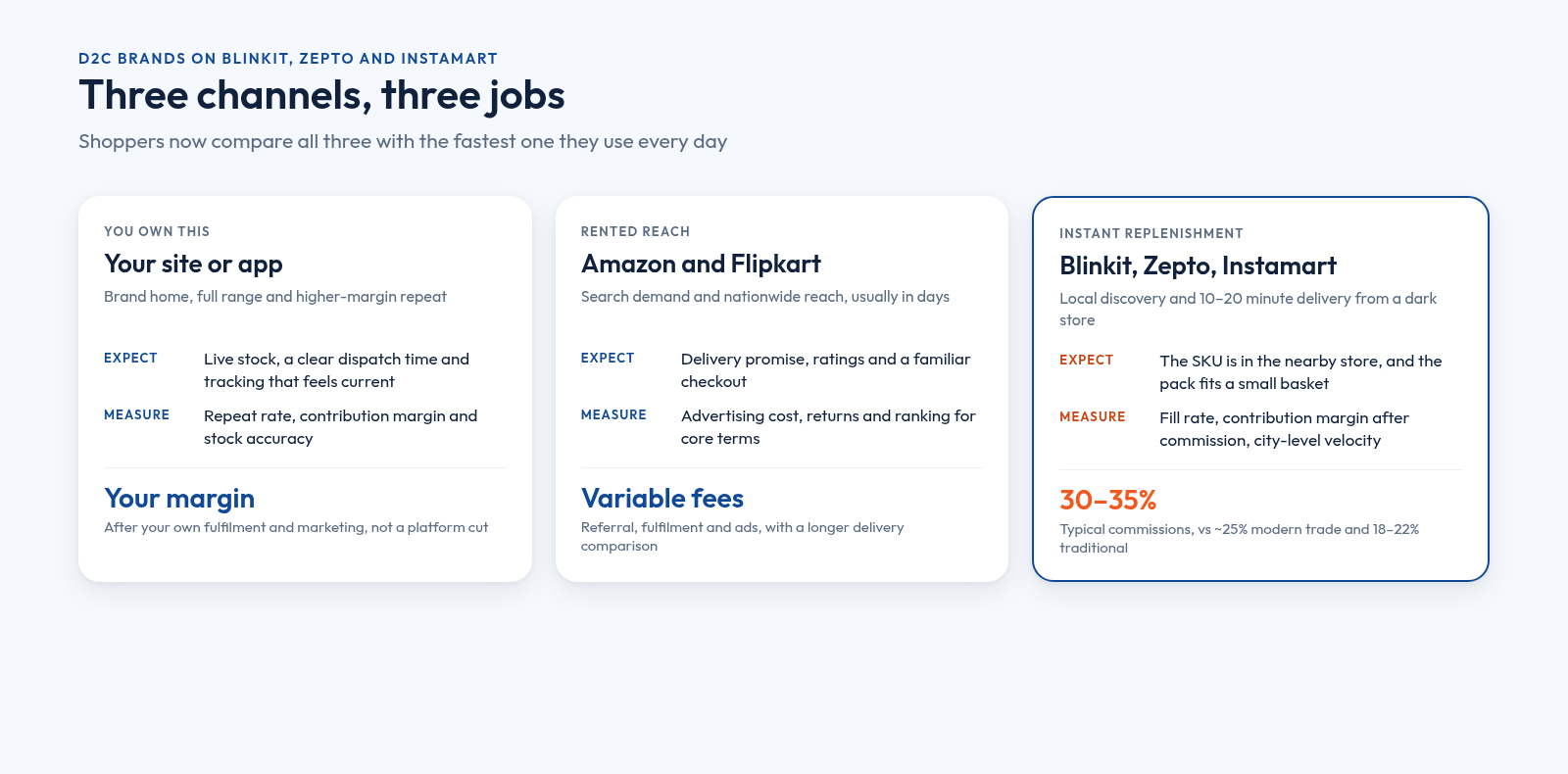
Satija told Mint that brands which listed two or three years ago had an early-mover advantage, but a new brand today can spend up to a year just trying to get listed. The same interview put typical quick commerce commissions at 30–35%, against roughly 25% in modern trade and 18–22% in traditional distribution. Platforms have a long queue of applicants and, with it, bargaining power.
That does not mean "never list". It means you should know the contribution margin of each SKU after commission, discounts, ads and the working capital locked in dark stores, before you celebrate top-line growth. Those costs are the first filter in any serious plan for quick commerce for D2C brands.
Revenue can arrive faster than a durable brand
Mint reported that brands such as Beyond Appliances, Underneat, SuperYou and Palmonas are among a new crop that has reached the ₹100-crore revenue mark in as early as 15 months, against earlier examples such as Licious, which took about four years to cross that mark in FY20. Beyond Appliances confirmed it crossed ₹100 crore in FY26, its first complete financial year.
The same piece is careful about what that milestone does not prove. Palmonas was reported as profitable on its FY25 earnings; SuperYou, Underneat and Beyond Appliances were described as loss-making in media reports. Piyush Kharbanda of Vertex Ventures put the point cleanly: you cannot build a lasting brand purely through quick commerce.
Established FMCG companies show how far the shift has gone
This is no longer only a startup story. The Economic Times reported in May 2026 that quick commerce accounted for 60–75% of online sales at ITC, AWL Agri Business, Tata Consumer Products and Parle Products in FY26, up from less than half a year earlier. If category leaders already rely on the channel for most of their digital sales, D2C teams should expect crowded search results and more expensive visibility, not an empty shelf.
| Channel | Typical role for a D2C brand | What shoppers now compare it with | What to measure first |
|---|---|---|---|
| Your own website or app | Brand home, higher-margin repeat, full range and story | Speed, live stock and tracking they see on quick commerce | Repeat rate, contribution margin, stock accuracy |
| Amazon, Flipkart and other marketplaces | Reach and search demand | Delivery promise and ratings, usually in days not minutes | Advertising cost, returns, ranking for core terms |
| Blinkit, Zepto, Instamart | Instant replenishment and local discovery | 10–20 minute delivery and whether the SKU is in the dark store | Fill rate, contribution margin after commission, city-level velocity |
Our take: In quick commerce for D2C brands, a sale on the app is a useful sale. It is not proof that the brand is strong. If your own site still shows stale stock, a vague dispatch time or a checkout that asks too much, shoppers will feel the gap the moment they leave the app.
The operational lesson most guides on quick commerce for D2C brands skip
Most advice stops at assortment: list three to five fast-moving, smaller packs, watch velocity, spend on in-app search ads. That is necessary. It is not sufficient, because Indian shopper expectations now follow the customer to your other channels.
The unglamorous work is a single, trusted view of inventory and orders. If a dark store, a marketplace warehouse and your own site disagree about stock, you get cancelled orders and a rating problem in more than one place. An order management system for ecommerce is often the layer that keeps those channels honest. The same idea shows up in work we have already shipped. For Gasman4U, we built a delivery platform where the public product site stays in sync with the live backend catalogue, and customers can track orders while delivery staff update status in one workflow. For Tejas Info Solutions, we built a custom ERP with item-level stock tracking, sales, returns and invoicing in a single panel, so the business has one source of truth.
This is close to how we approach custom product work at LitSpark: get products, orders and fulfilment into one system, then let each sales channel sit on top. That discipline helps a D2C team feed dark stores without losing track of what the website can honestly promise. Our custom software and ERP development is built around that operating layer, and our digital marketing work is the other half of the job, because a brand that only exists as a tile in someone else's app is renting its demand. A practical starting point is the tactical playbook for digital marketing. After the order is placed, many customers still message you on WhatsApp; our guide to WhatsApp AI agents for Indian SMEs covers how to answer without typing every update by hand.
A practical 90-day plan for quick commerce for D2C brands
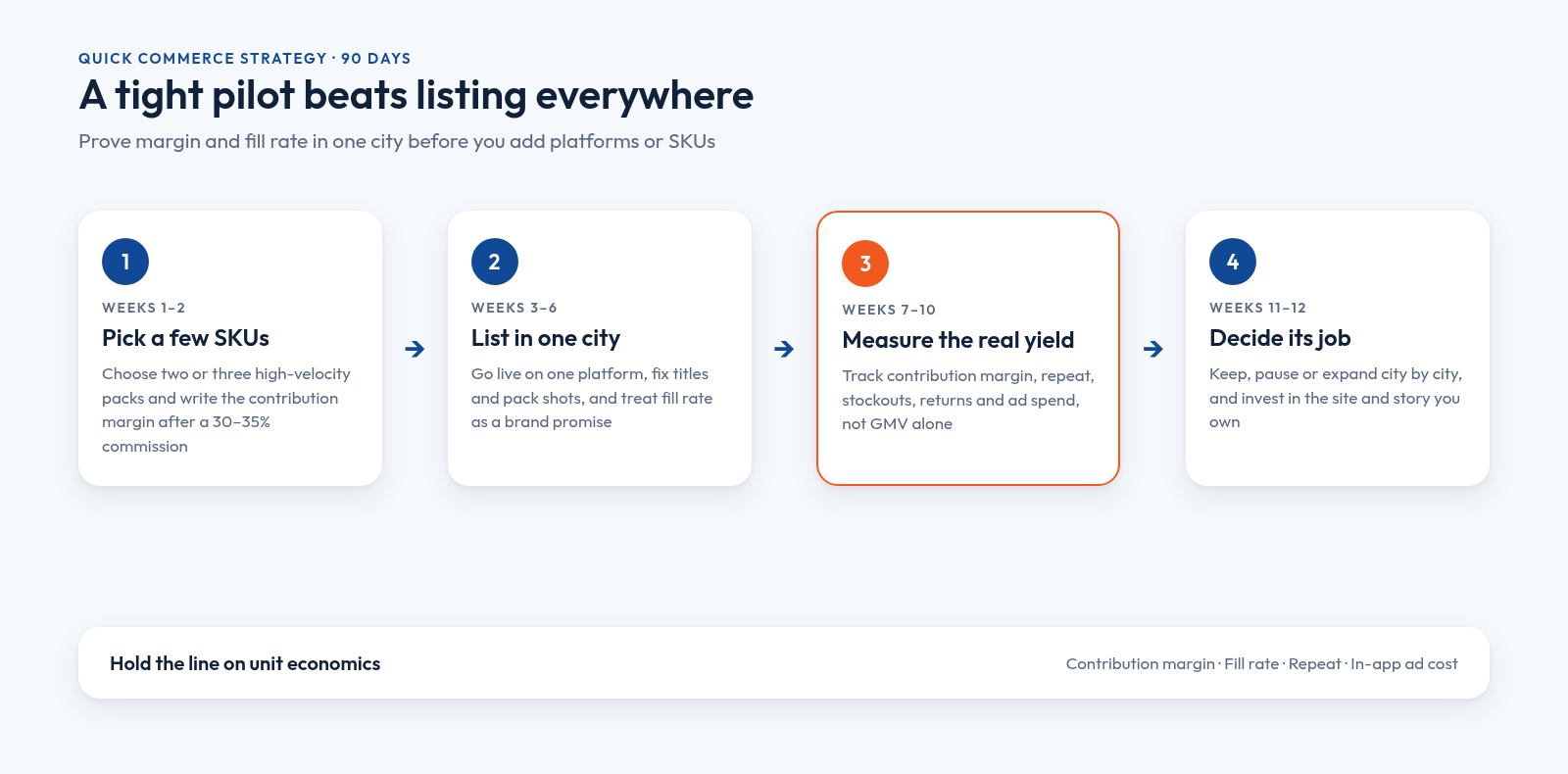
A quick commerce strategy that starts with "list everything in every city" usually fails on fill rates and margin. A tighter 90-day pilot is the most reliable way to test the channel without over-committing stock.
Start with a few SKUs, then decide the channel's job
- Weeks 1–2: Pick the SKUs and the economics. Choose two or three high-velocity packs that fit a top-up basket: smaller sizes, low return risk, a price that makes sense as an add-on. Write down the contribution margin after a 30–35% commission, typical discounts and the cost of holding stock in the platform's stores. If the pack only works at a heavy discount, it is not a hero SKU.
- Weeks 3–6: List on one platform, in one city. Blinkit, Zepto and Instamart have different shopper mixes, but you cannot learn all three at once. Get the title, pack shot, pack size and attributes right so a shopper searching a plain term can find you. Protect fill rate as if it were a brand promise.
- Weeks 7–10: Measure the things that survive a GMV spike. Track contribution margin, repeat rate, stockouts, returns and in-app ad spend. Compare that with the same SKU on your own site.
- Weeks 11–12: Decide the role of the channel. Keep it as a replenishment and discovery channel, pause it, or expand city by city. In parallel, put effort into the properties you own: the site, content, and the follow-up that turns a first 15-minute purchase into a direct relationship.
Do not wait until the pilot is perfect to work on the brand itself. Creator-led marketing and a clear product story are what Mint's sources said sit alongside the channel in the brands that scaled quickly. Quick commerce can introduce you. It will not explain why someone should look for you by name the next time. That is the real lesson in quick commerce for D2C brands: use the apps for replenishment and discovery, and build the brand in places you own.
Frequently asked questions
What does quick commerce for D2C brands actually involve?
Quick commerce for D2C brands means listing a tight set of SKUs on 10- to 20-minute apps such as Blinkit, Zepto and Instamart, then supplying dark stores so local shoppers can buy immediately. It works best when the pack, price and fill rate suit a small, urgent basket, and when the brand is also built in channels you own.
Is selling on Zepto and Instamart profitable for a D2C brand?
It can be, but not automatically. Platforms typically charge commissions of 30–35%, higher than modern trade or traditional distribution, according to PwC India's Vineet Satija, speaking to Mint. Profitability depends on margins, discounts, ad spend and dark-store inventory. Judge the channel on contribution margin and repeat, not on GMV alone.
How should D2C brands start on Blinkit or other quick commerce apps?
Start with two or three fast-moving SKUs on one platform in one city, and set a 90-day test with clear exit numbers for margin, fill rate and revenue. Listing can take longer than it did a few years ago. Optimise titles and pack shots for how shoppers search, and raise ad spend only once stock is stable.
How have Indian shopper expectations changed because of quick commerce?
Urban shoppers now treat fast delivery, live availability and instant replenishment as normal for everyday products. Flipkart and Bain found that in 2024 the channel already handled more than two-thirds of online grocery orders. People then compare your website's stock, dispatch time and tracking with that app experience.
Keep Reading.
- Order Management System Ecommerce: The Complete 2026 Guide
- Digital Marketing for Business Growth: A Tactical Playbook
- WhatsApp AI Agents for Indian SMEs: What They Can Automate in 30 Days
Want Help Putting This Into Practice?
Tell us what you're working on. We'll reply within 24 hours with next steps.
See how we approach custom software and ERP development, or grow demand you own with our digital marketing team. Email business@litspark.solutions, or book a discovery call.
- quick commerce for D2C brands
- quick commerce India
- D2C brands on Blinkit
- selling on Zepto and Instamart
- quick commerce strategy
- Indian shopper expectations
- Trend
Written By
LitSpark Solutions Team
We build websites, apps and AI automations, and run marketing for growing businesses from Bengaluru. These guides come from that work. About us