Staff Augmentation vs Outsourcing: Which Fits Your Team?
Staff augmentation vs outsourcing, plus in-house, freelance and dedicated teams: who manages the work, who owns the risk, and when to use each one.

LitSpark Solutions Team
On This Page22 sections
- Table of Contents
- Staff augmentation vs outsourcing: the short answer
- What staff augmentation means
- What outsourcing means
- Where the two models overlap
- In-house vs freelance vs dedicated team: five ways to add capacity
- What the data says about how companies buy talent now
- Real examples: what each model looks like in practice
- WhatsApp: a freelance contractor who became the first iOS engineer
- Slack and MetaLab: outsourcing a clearly defined result
- Hertz and Accenture: when an outsourced scope goes wrong
- Staff augmentation vs dedicated team vs managed services
- The hidden risks most comparisons skip
- How to choose: a five-question decision checklist
- Frequently asked questions
- What is the difference between staff augmentation and outsourcing?
- Is staff augmentation considered outsourcing?
- When should you use staff augmentation instead of outsourcing?
- What is the difference between staff augmentation and a dedicated team?
- Is staff augmentation better than hiring freelancers?
- Keep Reading.
- Want Help Putting This Into Practice?
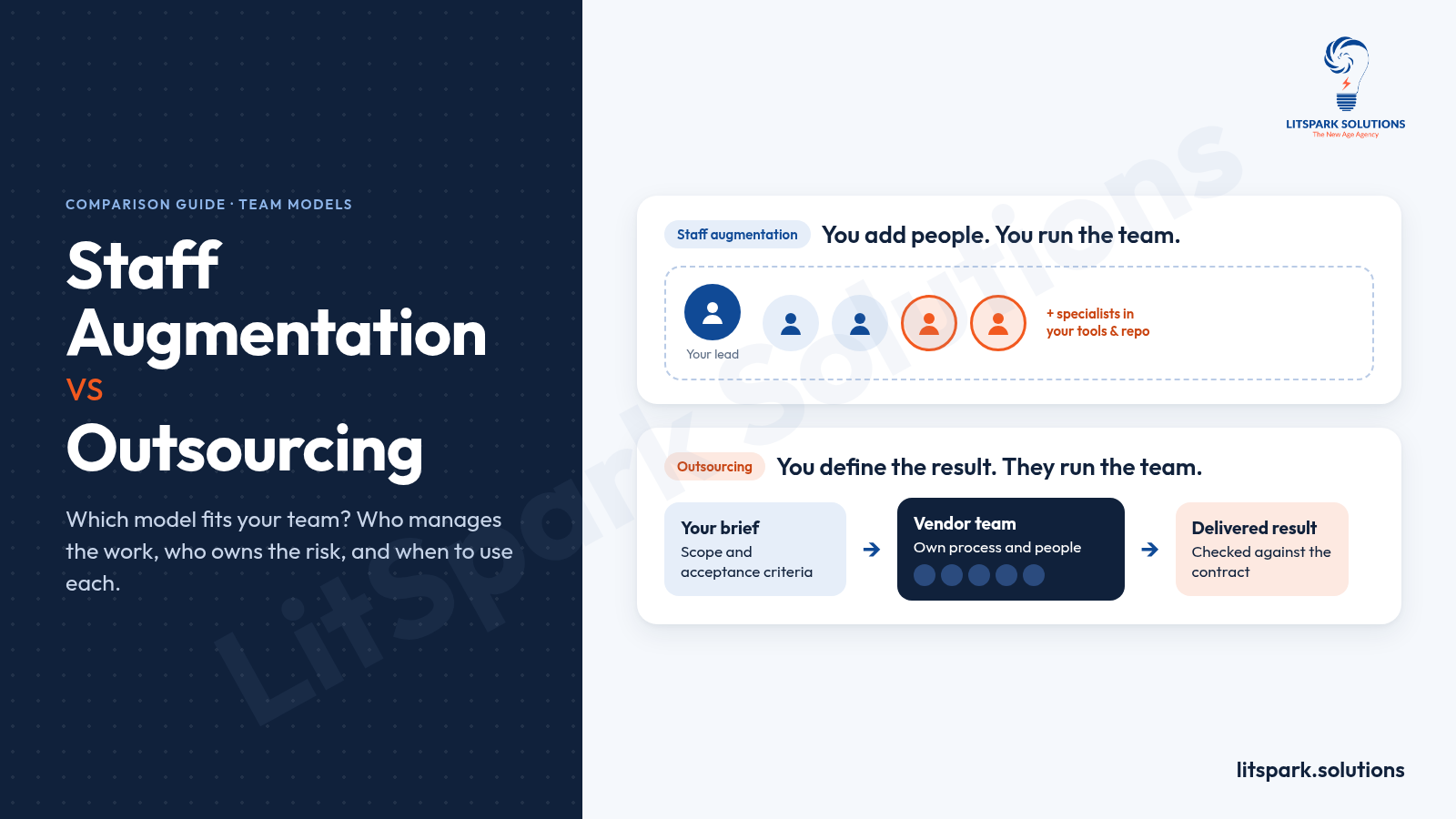
Staff augmentation vs outsourcing is the question most growing teams hit the week the backlog outruns the people. You need more hands, or a skill nobody on the team has, and you need it before a full-time hire could realistically start. The two models sound similar because both bring in outside people. They are not. One adds people to a team you still run. The other hands a result to someone else to run.
This guide compares both, then adds the three options teams usually weigh alongside them: hiring in-house, freelancers and a dedicated team. You will get two comparison tables, three real examples, the risks most comparisons skip, and a five-question checklist.
Table of Contents
- Staff augmentation vs outsourcing: the short answer
- In-house vs freelance vs dedicated team: five ways to add capacity
- What the data says about how companies buy talent now
- Real examples: what each model looks like in practice
- Staff augmentation vs dedicated team vs managed services
- The hidden risks most comparisons skip
- How to choose: a five-question decision checklist
- Frequently asked questions
Staff augmentation vs outsourcing: the short answer
The difference comes down to one question: who manages the work? Everything else (risk, speed, how much your team learns) follows from that answer.
What staff augmentation means
Staff augmentation means adding external specialists to your existing team for a period of time. They join your standups, work in your tools and repo, and take direction from your managers. You buy people's time and skills. You keep the backlog, the priorities and the responsibility for what ships.
What outsourcing means
Outsourcing, in the sense most buyers mean, is handing a defined project or function to an outside provider that runs its own team and process. You agree the scope, the acceptance criteria and the timeline. The provider decides how to staff and organise the work, and you judge the result.
Where the two models overlap
On paper, both use an outside company's people, and analysts often file staff augmentation under the outsourcing umbrella. In practice they are bought and managed very differently. With augmentation, delivery risk stays with you. With project outsourcing or managed services, a large share of it moves to the vendor.
In-house vs freelance vs dedicated team: five ways to add capacity
Staff augmentation vs outsourcing is rarely a two-way choice. Most teams are really choosing between five models, and the right one depends on how long the need lasts, how clear the scope is, and whether you have someone with time to lead the work.
| Model | Who manages day-to-day work | Who carries delivery risk | Speed to start | Where know-how ends up | Best for |
|---|---|---|---|---|---|
| In-house hire | You | You | Slowest (a full hiring cycle) | Stays with you | Core, long-term product work |
| Freelancer | You (loosely) | Mostly you | Fast | With the individual | Small, well-defined tasks |
| Staff augmentation | You | You | Fast (days to weeks) | Stays with your team, if you document it | Backlog spikes and skill gaps under your lead |
| Dedicated team | Shared: vendor lead, your priorities | Shared | Medium | Split, unless handover is planned | Ongoing product work without a full internal team |
| Project outsourcing / managed service | Vendor | Mostly vendor, per contract | Slowest to set up well | With the vendor | Clearly scoped projects or non-core functions |
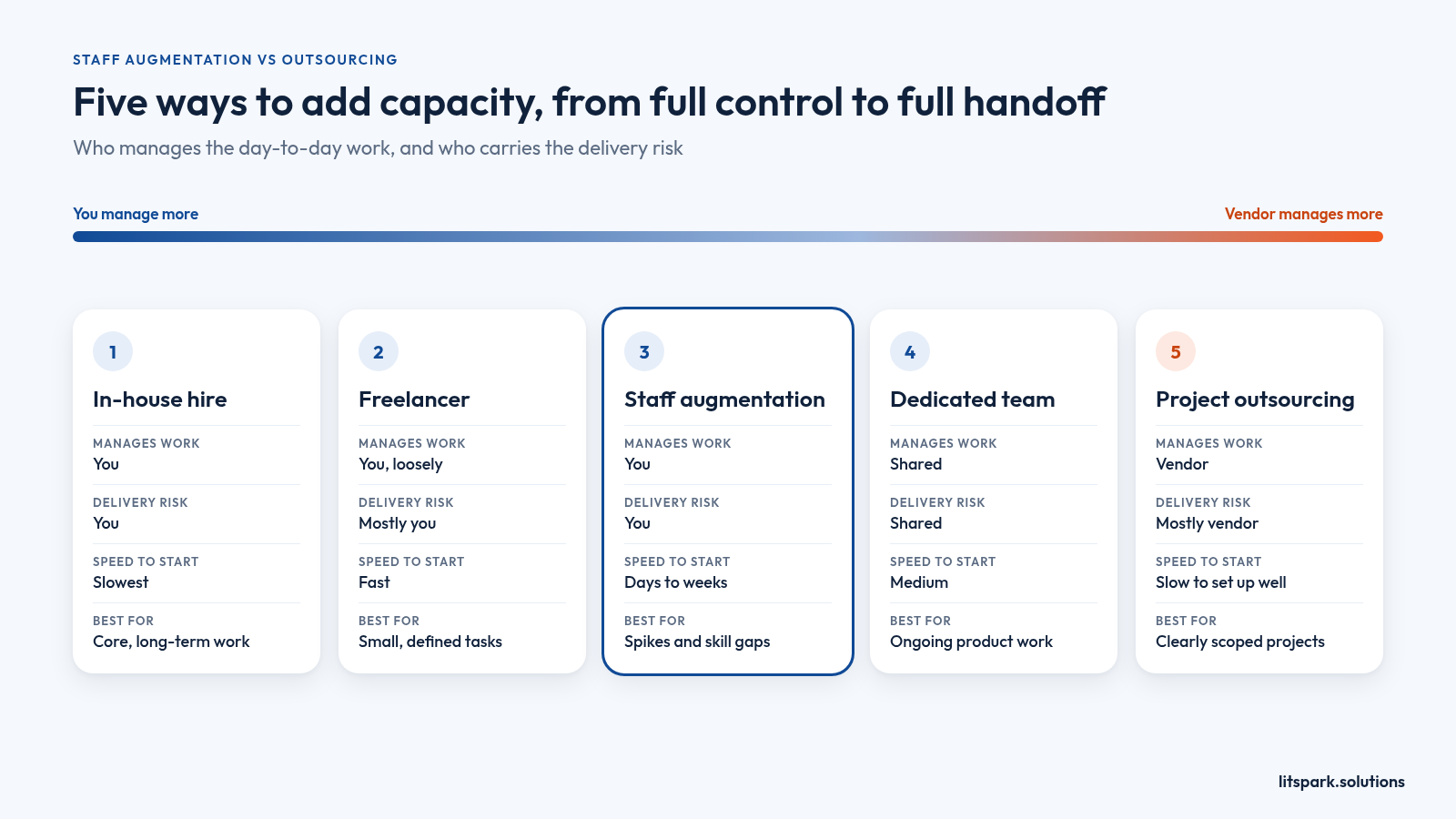
Read the table as a control dial: the closer you move to outsourcing, the less management time you spend, and the less control and learning stays in-house.
What the data says about how companies buy talent now
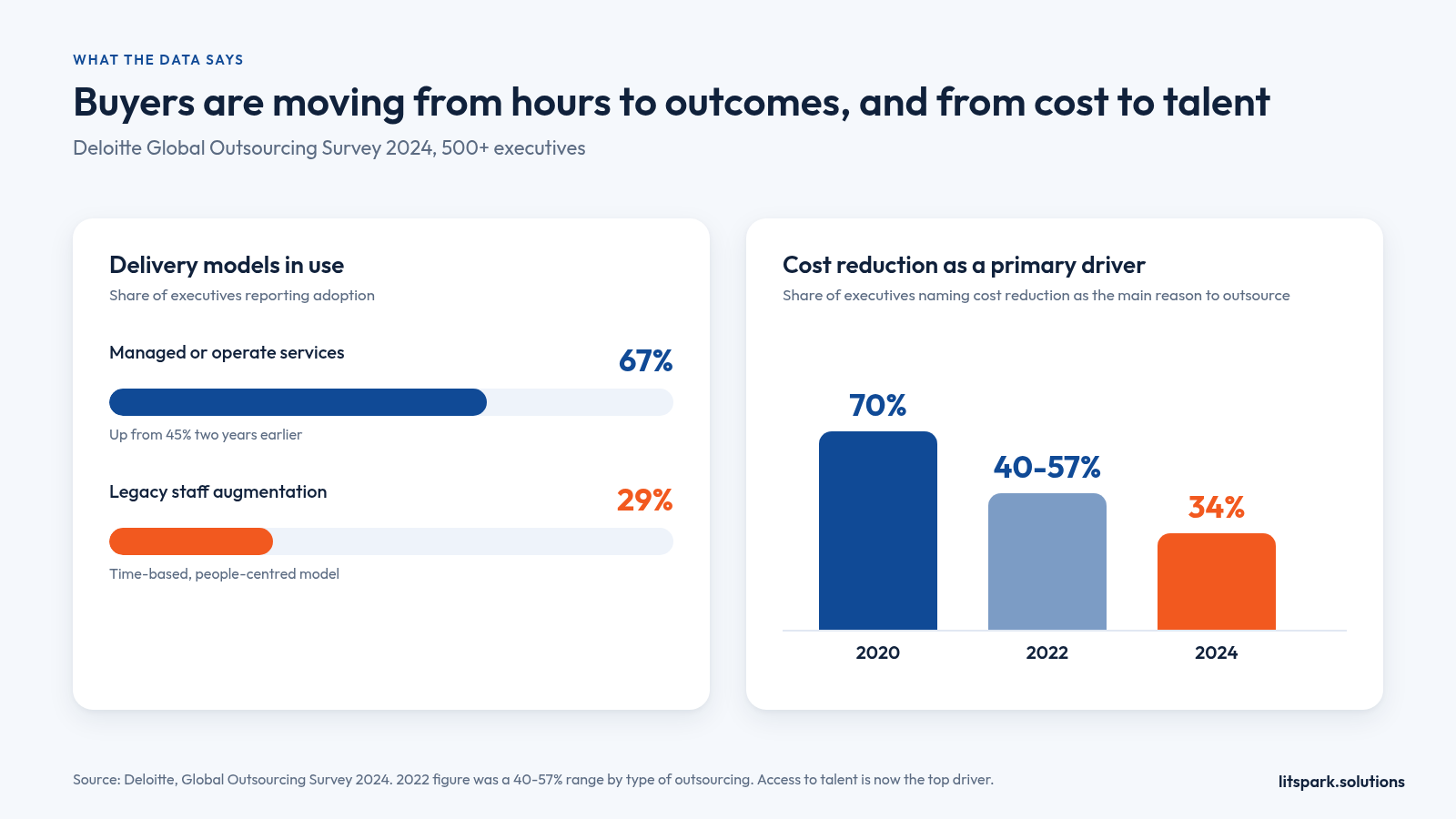
Deloitte's 2024 Global Outsourcing Survey of more than 500 executives is the most useful recent snapshot of how organisations mix these models. A few findings stand out:
- Talent beat cost as the reason to outsource. Access to talent was the number-one driver of outsourcing decisions. Only 34% of executives named cost reduction as a primary driver in 2024, down from 70% in 2020.
- Buyers want outcomes, not hours. 67% reported adopting managed or "operate" services, up from 45% two years earlier, while 29% reported using the legacy staff augmentation model. Deloitte's own summary: organisations are interested in "buying capabilities and outcomes, and not hours."
- Insourcing is rising at the same time. 70% had brought some previously outsourced work back in-house over the past five years, mainly to build internal capability, improve quality and regain control.
- Outsourcing is not shrinking. 80% planned to maintain or increase their investment in third-party outsourcing.
Hiring in-house is the benchmark both models are measured against, and it is slow. SmartRecruiters' 2025 technology benchmark, drawn from nearly 90 million applications, found a median of 48 days to hire at technology companies, 26% slower than the cross-industry median, and only 77% of tech candidates accepted the offer they were made.
What this means for you: The market is not picking one winner. Large buyers are moving routine, well-defined work to outcome-based vendors while pulling core capability back inside. Smaller teams can copy the pattern: own what makes you different, and buy outcomes or extra hands for the rest.
Real examples: what each model looks like in practice
WhatsApp: a freelance contractor who became the first iOS engineer
In early 2009, Jan Koum could write WhatsApp's backend but needed an iPhone developer. According to Forbes, his friend Alex Fishman introduced him to Igor Solomennikov, a developer in Russia he had found on RentACoder.com. In a Meta Careers interview, Igor says he started as a contractor in 2009, when WhatsApp had three employees, and relocated to California in 2013 to join the team. The lesson: a contractor working closely inside your product can become core to it, so plan for that path, including who owns the code, from day one.
Slack and MetaLab: outsourcing a clearly defined result
When Slack was still a rough prototype, Stewart Butterfield brought in the design agency MetaLab. MetaLab founder Andrew Wilkinson wrote that the agency designed the logo, marketing site, and web and mobile apps in six weeks, and that much of the product stayed unchanged long after the handoff. Wilkinson has also said MetaLab designed the product but did not build it; Slack's own engineers did. This is outsourcing at its best: a bounded, specialist deliverable with a clear handoff to an internal team.
Hertz and Accenture: when an outsourced scope goes wrong
The opposite case shows what happens when an outsourced project loses its shared definition of done. The Register reported that Hertz hired Accenture in August 2016 to rebuild its website and apps for a December 2017 launch. After two missed go-live dates, Hertz ended the contract and sued in April 2019, alleging, among other things, that the site lacked the responsive tablet layout the contract specified. Accenture called the claims without merit, and the parties dismissed the case in August 2021. Whoever was right, outsourcing shifts the daily work to the vendor, but it never shifts the job of writing down, and checking, exactly what "done" means.
Staff augmentation vs dedicated team vs managed services
Once you want outside help, the next fork is how much delivery you hand over. These three are often sold under overlapping names, so compare what you actually buy.
| Staff augmentation | Dedicated team | Managed services / project outsourcing | |
|---|---|---|---|
| What you buy | Named people's time and skills | A standing team with its own lead | A result or a running service |
| Who sets daily priorities | Your manager | Your product owner, vendor lead runs the team | Vendor, against agreed scope or SLAs |
| How you measure success | Tickets shipped, code quality, velocity | Releases and roadmap progress | Deliverables, acceptance criteria, service levels |
| Your management effort | High | Medium | Low day to day, high at contract stage |
| Scaling up or down | Person by person | Team by team | Usually a contract change |
| Main risk | Your team lacks time to lead them | Drift from your roadmap | Vague scope and change disputes |
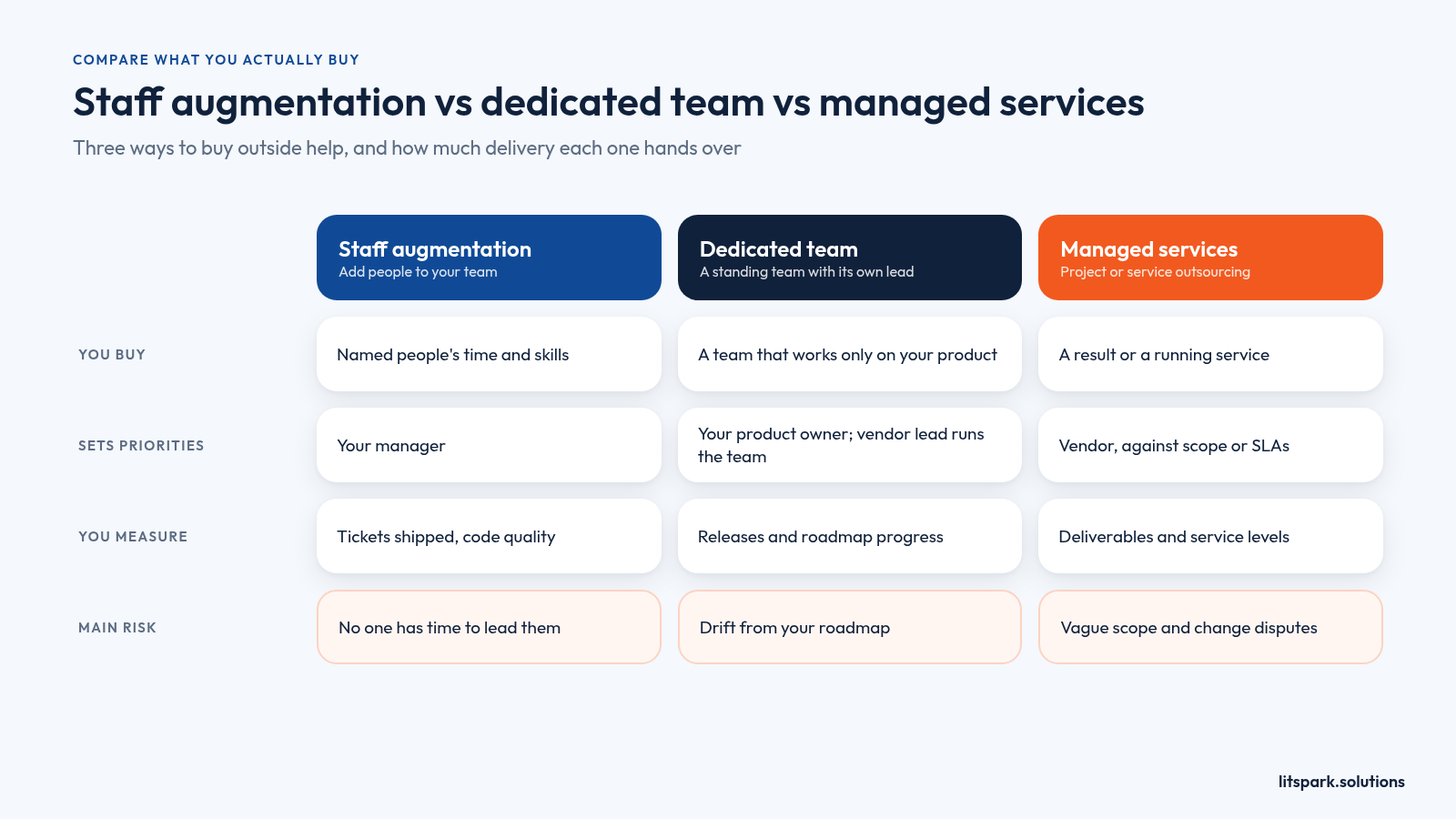
A useful rule: if you can write the acceptance criteria today, outsourcing is viable. If the work will change every sprint as you learn, keep it under your own direction with augmentation or a dedicated team.
The hidden risks most comparisons skip
Most staff augmentation vs outsourcing articles stop at control and speed. These are the issues that actually sink engagements:
- Onboarding drag. Adding people to a late project can slow it further, an effect known as Brooks's law. New engineers need context, reviews and access before they help. Plan a first-week task that ships something small.
- Who owns the code. Under US law, work by an employee belongs to the employer, but work by an independent contractor generally does not become yours automatically. The US Copyright Office's guide to works made for hire says commissioned work counts only in nine specific categories and only with a signed written agreement. Get IP assignment in writing for every freelancer and vendor, wherever they are based.
- Knowledge walking out. With freelancers and outsourced vendors, the person who understands your system may leave with the contract. Ask for documentation, code in your repository and a handover window as part of the deal.
- Contractor misclassification. Treating a long-term contractor like an employee can create legal exposure. Our guide to contract for hire in India covers the clauses and compliance checks.
- Management bandwidth. Augmentation only works if someone has the time to lead. Without a clear backlog and an owner, extra people wait around.
Before you sign: Make sure the contract answers four things in writing: who owns the code and IP, where the code lives, how people are replaced if they leave, and what the handover looks like when the engagement ends.
How to choose: a five-question decision checklist
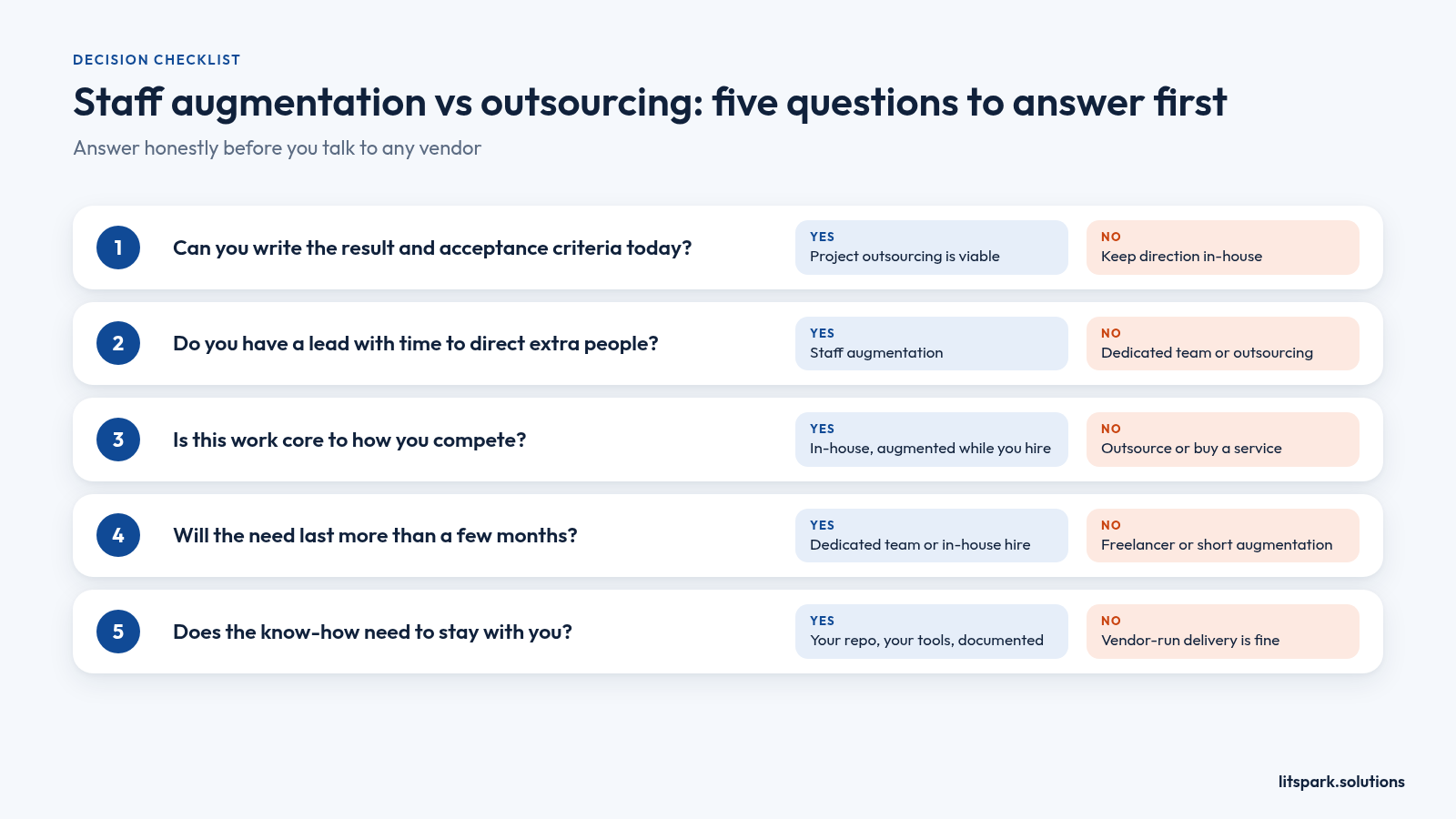
Answer these honestly before you talk to any vendor:
- Can you write down the result and the acceptance criteria today? If yes, project outsourcing is on the table. If not, keep direction in-house.
- Do you have a manager or tech lead with time to direct extra people? If yes, staff augmentation is usually the fastest path. If not, look at a dedicated team with its own lead, or outsourcing.
- Is this core to how you compete? Core product and data work should stay close to you: in-house hires, supported by augmentation while you hire.
- How long will the need last? A few weeks suits a freelancer or a short augmentation. Many months of evolving work suits a dedicated team or a planned in-house hire.
- Does the know-how need to stay with you? If yes, choose a model where people work in your repo and tools, and budget time for documentation.
Many teams end up with a hybrid: a small in-house core, augmented specialists for spikes, and a vendor for clearly scoped side projects. That is how LitSpark's resource hiring model is set up to plug in: developers who work your hours, in your tools and repo, with the code and IP staying yours under NDA. For a fixed-scope build where you would rather hand over the whole delivery, a custom development project is the better fit. If you are weighing the broader category, our practical guide to resource augmentation services goes deeper on KPIs and SLAs, and our MVP checklist helps you write the kind of scope an outsourced build needs.
Frequently asked questions
What is the difference between staff augmentation and outsourcing?
In staff augmentation vs outsourcing, the core difference is who manages the work. With staff augmentation, outside specialists join your team and take direction from your managers, so you keep control and delivery risk. With outsourcing, a vendor runs its own team to deliver an agreed project or service, and you judge the result against the contract.
Is staff augmentation considered outsourcing?
Broadly, yes. Staff augmentation uses an outside company's people, so it is often grouped under outsourcing. The difference is in management and risk. Augmented staff work inside your team under your direction, while project outsourcing and managed services transfer day-to-day delivery, and much of the delivery risk, to the vendor.
When should you use staff augmentation instead of outsourcing?
Use staff augmentation when you already have a clear backlog and a manager or tech lead with time to direct extra people, when requirements will change as you learn, or when you want know-how to stay with your team. Choose outsourcing when you can define the result and acceptance criteria up front.
What is the difference between staff augmentation and a dedicated team?
Staff augmentation adds individual specialists to your existing team, managed by your own leads. A dedicated team is a standing group, often with its own team lead, QA and design, that works only on your product. You set priorities for both, but a dedicated team needs less of your daily management time.
Is staff augmentation better than hiring freelancers?
It depends on the work. Freelancers suit small, well-defined tasks. Staff augmentation suits ongoing work inside your team, because the provider vets people, handles contracts and replaces anyone who leaves. With either model, get IP assignment and confidentiality in writing, and keep the code in your own repository.
Keep Reading.
- Resource Augmentation Services: A Practical Guide for 2026
- Outsourced Product Development Services: 2026 Partner Guide
- Contract for Hire in India: Scale Fast and Stay Compliant
Want Help Putting This Into Practice?
Tell us what you're working on. We'll reply within 24 hours with next steps.
Share the roles, stack and hours you need, or the project you are thinking of handing off. We will tell you honestly which model fits, and if it is augmentation, our resource hiring team can share matched profiles. Email business@litspark.solutions, or book a discovery call.
- staff augmentation vs outsourcing
- staff augmentation vs dedicated team
- staff augmentation vs managed services
- is staff augmentation considered outsourcing
- staff augmentation vs project outsourcing
- in-house vs freelance vs dedicated team
- Comparison
Written By
LitSpark Solutions Team
We build websites, apps and AI automations, and run marketing for growing businesses from Bengaluru. These guides come from that work. About us